Characters
There are lots of characters in Shakespeare’s play Richard III. Take an in-depth look at the main ones identifying their key attributes and relationships and analysing their part in the play.
Overview of characters
In this play about political intrigue, there are a lot of characters. As long as you know who’s done what to whom, you’ll be fine. It’s a history play, and written only a hundred years later, so Shakespeare had to include a lot of different lords who had a role in the events. The most important characters are those in the royal family.
The characters can be split up into groups to make it easier to remember who is who. They are:
- the royal family
- Richard’s allies
- Richmond and his allies
- Churchmen
- Officers, servants and the people
- the ghosts of Richard’s victims
The royal family can be split into present royal family, past royal family and future royal family. They are constantly quarrelling and taking sides, no one trusts anyone and most of them end up dying before their time.
Richard’s allies are mostly just doing their jobs to survive, although Richard has plenty of villainous connections. Some characters, like Hastings, are sucked in by Richard’s charming side and don’t realise how dangerous he is, until it’s too late.
Richmond’s allies are taking a dangerous risk in helping the future Henry VII’s side against Richard. The Churchmen are as much involved in political intrigue as the courtiers are. The officers, servants and the people are the innocent bystanders to events. The ghosts of Richard’s victims make a brief appearance, but there are lots of them!
We will look at all of the characters briefly, but the main three members of the royal family are:
- Richard
- Margaret
- Queen Elizabeth
Richard
Richard belongs to the present royal family. In the beginning, Richard is the Duke of Gloucester and his elder brother is King Edward IV. He is fed up that the wars are over and jealous of his brother’s happiness. Richard is disabled: we don’t get told exactly what is wrong with him, but tradition suggests that there was something wrong with his back and shoulder. He feels ugly and unloved and believes he is unable to live a normal life. Bored with peaceful times, he decides to cause mayhem. He lies, and kills members of his family – even women and small children – to achieve his ambition to become king. Evil comes so naturally to him, he cannot stop. He even proposes to his niece. It’s all bound to end horribly. Of course, he has to die in the end.
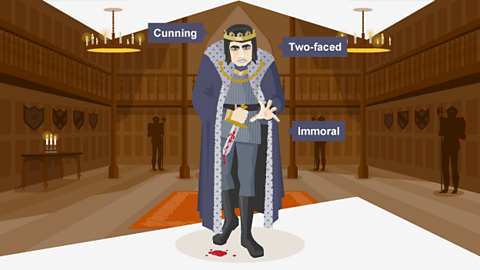
Image caption, Character attributes
1 of 3
Character attributes
Immoral - lies come easily, he has no conscience. He woos his wife in front of her dead father-in-law’s coffin (a man he killed!) and after he’s killed her, he proposes to his niece.
Two-faced - whilst many of the characters believe that Richard is honest and well-meaning, the audience are treated to the true side of his nature. He is named Protector of his nephews but he locks them in the Tower of London and has them brutally murdered.
Cunning - Richard is clever with words and sarcastic. He is a chilling character because his comments about his evil deeds are sometimes quite funny.
Friends and enemies
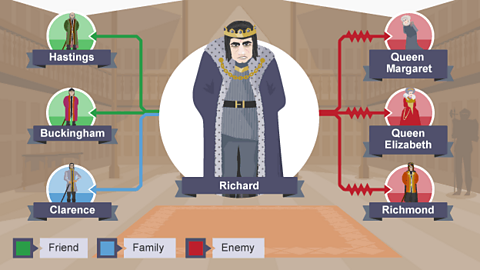
Richard's friends are:
- Clarence - his brother, who loves him until his last breath. Richard has him murdered, because after the princes, he is next in line to the throne.
- Hastings - who confides in Catesby that he will back Prince Edward, and so Richard falsely accuses him of treason and witchcraft – the penalty being death.
- Buckingham - who is Richard’s closest ally until he feels a bit queasy at Richard’s suggestion that they should kill the young princes. He changes sides when Richard won’t give him the land and title that he promised, and when he is caught, he is executed.
Richard is the enemy of many who don’t realise it. The people who are enemies to him include:
- Queen Margaret - curses him and Buckingham just because he is his friend
- Queen Elizabeth - his sister-in-law, who wants to learn to curse him for killing her sons and wanting to marry her daughter
- Richmond - defeats him in battle
Changes in character
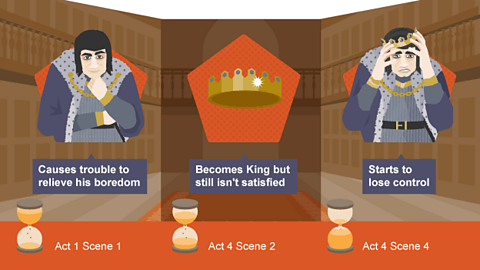
Richard’s character remains remarkably stable through the play: he starts out bad and ends up bad. There are some subtle changes though:
- He starts out causing trouble to relieve his boredom. He is surprised at how far he can go and really begins to enjoy himself.
- In the middle he becomes King, but even this does not satisfy his appetite for evil. He rejects his closest follower, Buckingham and starts to lose control.
- At the end Richard’s victims haunt him, but he doesn’t feel guilty. He only feels sorry for himself. Inevitably he dies as he has lived: violently.
Character analysis
Question
How is Richard shown to be immoral?
Richard suggests that to make up for killing Elizabeth’s young sons he will make her daughter – his niece – pregnant. He doesn’t see this as a problem. Politically, it would make him more secure on the throne and he thinks more babies would cheer the grieving Elizabeth up. This is one of many examples of him behaving in a completely inhuman way. It would have shocked Shakespearean audiences who were very religious.
He says to Elizabeth:
RICHARD
To quicken your increases I will beget
Mine issue of your blood upon your daughter.
Act 4 Scene 4
Question
How is Richard shown to be two-faced?
Richard is a character that behaves in one way to the rest of the characters, and another when he is alone. In his A comment spoken either to the audience or another character that the rest of the characters cannot hear., he reveals his true thoughts and intentions.
RICHARD
As I am subtle, false, and treacherous
Act 1 Scene 1
Question
How is Richard shown to be quick-witted?
Richard very often makes comments that have a double meaning. Usually, they are threats and predictions of his next victim’s death. The enjoyment of his joke lies in the fact that people misread the evil meaning for the innocent one.
RICHARD
Thus, like the formal Vice, Iniquity,
I moralise two meanings in one word.
Act 3 Scene 1
Listening task
Richard III characters - Richard
KING RICHARD
Give me another horse! Bind up my wounds!
Have mercy, Jesu! Soft, I did but dream.
O coward conscience, how dost thou afflict me?
The lights burn blue. It is now dead midnight.
Cold, fearful drops stand on my trembling flesh.
What do I fear? Myself? There's none else by.
Richard loves Richard, that is, I am I.
Is there a murderer here? No. Yes, I am.
Then fly. What, from myself? Great reason why:
Lest I revenge. What, myself upon myself?
Alack, I love myself. Wherefore? For any good
That I myself have done unto myself?
O, no. Alas, I rather hate myself
For hateful deeds committed by myself.
I am a villain. Yet I lie, I am not.
Fool, of thyself speak well. Fool, do not flatter.
My conscience hath a thousand several tongues,
And every tongue brings in a several tale,
And every tale condemns me for a villain.
Perjury, perjury, in the highest degree,
Murder, stern murder, in the direst degree,
All several sins, all used in each degree,
Throng to th’bar, crying all ‘Guilty! guilty!’
I shall despair. There is no creature loves me,
And if I die no soul shall pity me.
Nay, wherefore should they, since that I myself
Find in myself no pity to myself?
Methought the souls of all that I had murdered
Came to my tent, and every one did threat
Tomorrow's vengeance on the head of Richard.
Question
Is Richard: afraid, angry at himself, or out of control?
There are elements of fear, anger and loss of control throughout the speech. Richard has just woken up from a horrible dream and he is confused and afraid, but angry at himself for feeling this way. The confusion makes him seem out of control, especially when he asks himself questions, then replies to those questions. He is a tortured soul. He has committed some terrible crimes and when he dies, which seems like a likely possibility in battle, he will have to face up to what he has done. Elizabethans would recognise this as a real fear, the horror of what would happen to the soul of a sinner in the afterlife.
Question
Does he sound as if he is talking to someone else? Can you think of a reason why he might do this?
In several parts of the speech, Richard sounds as though he is responding to someone who we can’t hear or see. It could be the aftermath of the dream. It could be his conscience – he addresses his conscience as though it is a separate person more than once. The broken rhythms and confusion of thought make it seem like he has lost control. At this point, the audience can be fairly sure that Richard’s downfall is inevitable.
Margaret
Queen Margaret was part of the previous royal family. She is the widow of King Henry VI. Her place as Queen has been To take the place of someone in a position of power illegally by Queen Elizabeth. She is elderly and full of bitterness, but she has plenty to say that makes sense amongst her bitter ramblings. She is also extremely rude and good at name-calling. She is not afraid of Richard and sees him for what he is. In turn, he points out that she is just as bad: she was responsible for the murder of Richard’s little brother Rutland. She is only satisfied when her curses start to come true and Queen Elizabeth is as sad as she is.
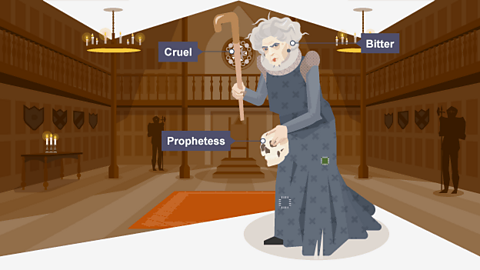
Image caption, Character attributes
1 of 3
Character attributes
- Bitter - Margaret cannot let go of her grief. She remains at the palace, even though she has been banished, to keep reminding the new occupants of the sins they committed to gain their places there.
- Cruel - the names that Margaret calls Richard are outrageous. She mocks the Queen in her distress and points out that she has brought it all on herself. Richard reminds everyone that his little brother died brutally at Margaret’s hands.
- A Prophetess - Margaret curses the new royal family and their followers one by one. Throughout the play the curses come true for each of the characters.
Friends and enemies
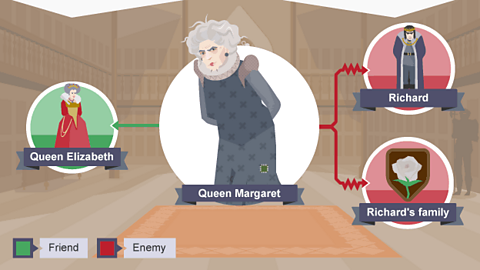
Margaret is friends with:
- Queen Elizabeth - at first they don’t like each other but later Elizabeth begs Margaret to teach her how to curse
She is enemies with:
- Richard - Margaret sees him as an evil murderer
- Richard’s family - she curses them one by one
Changes in character
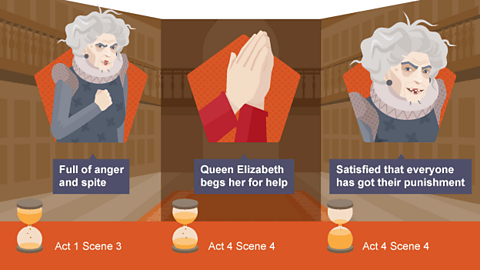
- Margaret begins the play full of anger and spite, cursing everyone at court. They think that the curses are just the ravings of an old, grieving woman. But her curses begin to come true and Margaret goes from appearing unstable to being a prophet of doom.
- Queen Elizabeth is one of Margaret’s enemies at the beginning of the play, but once Richard has murdered her sons, Elizabeth begs Margaret to teach her how to curse. Margaret weeps with Queen Elizabeth and Richard’s mother, the Duchess of York, but enjoys pointing out that they brought it all upon themselves.
- Although we pity Margaret at the beginning of the play, by the end she is satisfied that everyone has got their just punishment. She heads for France, smiling at everyone else’s distress.
Character analysis
Question
How is Margaret shown to be bitter?.
Like Richard, Margaret seems to revel in the distress of others. Her cause is easier to understand: she has lost everyone and everything. Her life is over and all that remains is bitterness.
As Queen Elizabeth grieves for her husband, she tells her:
QUEEN ELIZABETH
Thy Edward he is dead that killed my Edward
Act 4 Scene 4
Question
How is Margaret shown to be cruel?
She says:
MARGARET
Thou elvish-marked, abortive, rooting-hog
Act 1 Scene 3
This three pronged insult suggests that Richard’s disabilities were a result of evil fairy magic, that he is deformed, with particular reference to his hunched back, which make him look like the 'hog', that grubs in the forest. Margaret’s words are as ugly as Richard’s appearance.
Question
How does Shakespeare use Margaret’s curses as a device in the play?
As a character, Margaret wishes ill fortune on everyone to match her own. Historically, she would have already died by this time. Shakespeare uses this character to act as a kind of Chorus. Her curses are a device that provides a structure to the rest of the play. Each character reflects on Margaret’s particular curse when they face death and their own guilty consciences.
MARGARET
Live each of you the subjects to his hate,
And he to yours, and all of you to God’s.
Act 1 Scene 3
Did you know? A device taken from Greek theatre and used often in Shakespeare’s plays, the Chorus stands alone from the action, observing events and wisely commenting on them.
Listening task
In Act 4 Scene 4, Queen Elizabeth is grieving the death of her two young sons. She asks Margaret to teach her how to curse her enemies. Margaret gives her some advice: by dwelling on the death of your loved one and wallowing in self-pity, you will become bitter and be able to curse others.
Richard III characters - Margaret
QUEEN ELIZABETH
O thou well skilled in curses, stay awhile,
And teach me how to curse mine enemies.
QUEEN MARGARET
Forbear to sleep the nights, and fast the days;
Compare dead happiness with living woe;
Think that thy babes were fairer than they were,
And he that slew them fouler than he is.
Bett’ring thy loss makes the bad causer worse;
Revolving this will teach thee how to curse.
QUEEN ELIZABETH
My words are dull. Oh, quicken them with thine.
QUEEN MARGARET
Thy woes will make them sharp, and pierce like mine.
Question
Do you think this advice is kind?
This really is a matter of opinion. Truly, she is describing the devastation of grief. Margaret is saying to Elizabeth, if you follow my example and just be Grief personified, then you will become just like me: bitter and full of hatred. You could see it as kindness if Elizabeth realises that this is not the way to live.
Question
Do you feel sorry for Margaret that she has become so bitter through grief?
You might feel sorry for Margaret. She has lost everything and this is what has made her the way she is. She might lose your sympathy when she delights in other’s misery though.
Queen Elizabeth
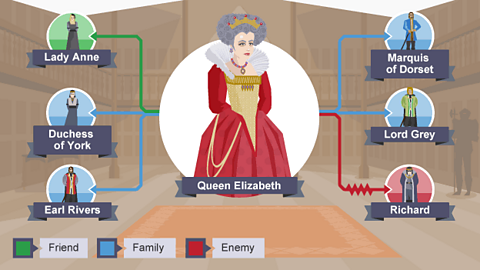
Queen Elizabeth is married to King Edward IV and is part of the present royal family. They have a daughter, and two young sons: Richard, Duke of York, and Prince Edward, the heir to the throne. She also has two sons from her previous marriage (the Marquis of Dorset and Lord Grey). Richard is jealous of the influence she has over her husband. He calls her common and says that she persuades the king to give her friends royal titles and favours. Richard’s main problem with Elizabeth is that as the mother to the heir of the throne, she has presented him with two obstacles on his road to power. Queen Elizabeth knows that Richard is a threat, but refuses to let him bully her.
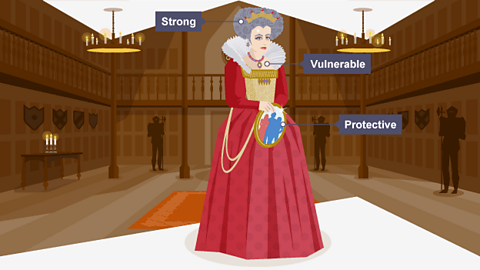
Image caption, Character attributes
1 of 3
Character attributes
- Vulnerable - Elizabeth is frightened of what Richard might do when her husband, the king, dies. He has been named 'Protector' of her son, Prince Edward, and she knows that this will give him too much influence and power.
- Strong - Elizabeth continually faces up to Richard. She lets him know that she is aware of his slander and double-dealings. In an argument, she is able to match his sharp wit.
- Protective - Elizabeth tries to protect her sons, but underestimates Richard’s capacity for evil. She is able to protect her daughter against him, though. Although it appears that she has given in to Richard’s demands, in actual fact, she promises her daughter to Richmond, beginning a long period of peace in England.
Friends, family and enemies
Queen Elizabeth is friends with:
- Lady Anne - they share a hatred of Richard
She is related to:
- Duchess of York - her mother-in-law
- Earl Rivers - her brother
- Marquis of Dorset and Lord Grey - her grown up sons from her previous marriage
She is enemies with:
- Richard - he hates her. She spars with him. He is the source of all of her troubles, but even when he has destroyed all of her hopes of happiness, she proves the stronger of the two, the most morally righteous and sane.
Changes in character
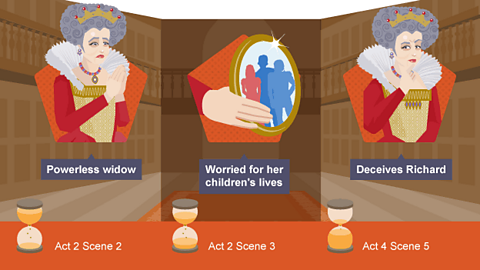
Elizabeth goes from being Queen to being a powerless widow who cannot even get into the Tower of London to visit her sons.
She is worried from the start about Richard’s role in her eldest son’s life as 'Protector', if her husband dies, which he does. Elizabeth underestimates Richard and he kills her brother and eldest son, then has her young sons murdered in the Tower of London.
Elizabeth learns to conceal her hatred to Richard. After arguing with him, she pretends to agree to let him marry her daughter, his niece. Instead she promises her daughter to Richard’s enemy, Richmond.Character analysis
Character analysis
Question
Does Richard make Elizabeth feel vulnerable?
Yes. Elizabeth is a strong female character, but she is aware of the political situation and the role that she is forced to play as Queen and consort, ie her power and influence ends with the death of her husband.
When her husband falls ill, she asks her eldest son, Grey:
ELIZABETH
If he were dead, what would betide on me?
Act 1 Scene 3
Question
How strong a character is Elizabeth?
Elizabeth is not frightened of Richard, possibly because she does not know the full extent of his capacity for evil. She does not let him push her around. She can match him intellectually. The only reason he can take her power from her, is that she is a woman and by law, she has no right to rule.
Elizabeth tells Richard:
ELIZABETH
My lord of Gloucester, I have too long borne Your blunt upbraidings and your bitter scoffs.
Act 1 Scene 3
Question
How does Elizabeth protect her daughter?
Elizabeth says that she will claim that her daughter (also called Elizabeth) is illegitimate if it will keep her safe from Richard killing her. Her little boys died at Richard’s hands because of their link to the Royal Family and she will not let this happen to the only child that she has left. Instead, Richard has other plans for the princess.
When Richard begins to show an interest in the princess, Elizabeth tells him:
ELIZABETH
So she may live unscarred of bleeding slaughter, I will confess she was not Edward’s daughter.
Act 4 Scene 4
Listening task
In Act 4 Scene 4, Richard is trying to persuade Elizabeth to talk to her daughter about the possibility of marrying him. Elizabeth has absolutely had enough of Richard. She isn’t afraid of him, even though he has proven himself to be a cold-blooded killer. She is full of rage from the grief she is suffering from the deaths of her little boys. Her arguments are as cold and piercing as Richard can be. He is unable to argue with her and this is exasperating for him.
Richard III characters - Queen Elizabeth
QUEEN ELIZABETH
An honest tale speeds best being plainly told.
RICHARD III
Then plainly to her tell my loving tale.
QUEEN ELIZABETH
Plain and not honest is too harsh a style.
RICHARD III
Your reasons are too shallow and too quick.
QUEEN ELIZABETH
Oh, no, my reasons are too deep and dead,
Too deep and dead, poor infants, in their graves.
RICHARD III
Harp not on that string, madam. That is past.
QUEEN ELIZABETH
Harp on it still shall I till heartstrings break.
RICHARD III
Now, by my George, my Garter, and my crown —
QUEEN ELIZABETH
Profaned, dishonoured, and the third usurped.
RICHARD III
I swear—
QUEEN ELIZABETH
By nothing, for this is no oath.
Thy George, profaned, hath lost his lordly honour;
Thy Garter, blemished, pawned his knightly virtue;
Thy crown, usurped, disgraced his kingly glory:
If something thou wouldst swear to be believed,
Swear then by something that thou hast not wronged.
RICHARD III
Then by myself.
QUEEN ELIZABETH
Thyself is self-misused.
RICHARD III
Now, by the world—
QUEEN ELIZABETH
'Tis full of thy foul wrongs.
RICHARD III
My father's death.
QUEEN ELIZABETH
Thy life hath it dishonoured.
RICHARD III
Why then, by God.
QUEEN ELIZABETH
God's wrong is most of all.
Question
On a scale of 1-10, how much does Elizabeth hate Richard at this point?
10! She knows how dangerous he is, but she’s not afraid to tell him exactly what she thinks, she hates him so much.
Question
Who is in control here, Richard, or Elizabeth?
Elizabeth seems most in control. She has an answer for everything that Richard has to say. On the other hand Richard is the one with all the real power.
Additional characters
King Edward IV - royal family, present
King Edward takes the throne when his family, the Yorks, defeat the Lancasters. He is Richard’s brother and he is married to Queen Elizabeth. He is her second husband. Richard comments on how happy Edward and Elizabeth are and how much she influences her husband, but the audience are never sure how much of what Richard says can be trusted. Edward becomes gravely ill and dies shortly after his brother, the Duke of Clarence is executed. Richard makes Edward feel guilty for his brother’s death, even though it is Richard himself who paid for his brother to be murdered.
In Act 2 Scene 1, on his death-bed, Edward says:
EDWARD
And more to peace my soul shall part to heaven,
Since I have made my friends at peace on earth.
Act 2 Scene 1
Of course, Richard shatters this peace by mentioning that their brother has been executed, inferring that it was a bureaucratic error on Edward’s part.
Character attributes
- Gravely ill
- A peace-maker
Duke of Clarence - royal family, present
The Duke of Clarence is King Edward and Richard’s brother. At the beginning of the play he is taken to the Tower of London. He isn’t sure what he has done to upset his brother the king. Richard tells us in an aside that he has set his brother up. He promises to help Clarence. Instead, Richard sends murderers to end his brother’s life. Clarence tries to appeal to their consciences, but they stab him and drown him in a barrel of wine.
Right until he is murdered, Clarence insists that Richard is loyal to him:
CLARENCE
Oh, no, he loves me, and he holds me dear.
Act 1 Scene 4
Character attributes
- Trusting
- Religious
Duchess of York - royal family, present
The Duchess of York is Richard’s (and Edward’s and Clarence’s) mother. She is a doting grandmother and is devastated by the deaths of her sons and then her grandsons. She is disgusted by Richard’s villainy and strongly rejects him.
In Act 4 Scene 4, she and Elizabeth go to Richard to tell him how much they hate him:
DUCHESS OF YORK
in the breath of bitter words let’s smother
My damned son that thy two sweet sons smothered.
Act 4 Scene 4
Character attributes
- Despairing
- Angry
Prince Edward, Prince of Wales - royal family, present
Edward is the heir to the throne, but is considered too young for the responsibility of ruling a country when his father dies. Richard, his uncle is named his legal guardian, or Protector. He takes him to the Tower of London and has him killed whilst he is asleep with his little brother.
In Act 3 Scene 1, Edward says to Buckingham:
EDWARD
if I live until I be a man,
I’ll win our ancient right in France again
Or die a soldier, as I lived a king.
Act 3 Scene 1
Character attributes
- Young
- Frightened of the Tower of London
Duke of York - royal family, present
The Duke of York is Prince Edward’s little brother. He is very cheeky to Richard and Richard lets him get away with it. He dies in the Tower of London, murdered by Richard’s henchman whilst asleep in bed with his brother.
In Act 3 Scene 1, Buckingham comments on the Duke of York’s cheeky comments to Richard:
BUCKINGHAM
So cunning and so young is wonderful.
Act 3 Scene 1
Character attributes
-Young
-Mischievous
Young son and daughter of Clarence - royal family, present
When their father, the Duke of Clarence is executed, their grandmother, the Duchess of York tries to hide the news from them, but they are very aware of what is going on. Richard has been lying to the children to make them think that King Edward and Queen Elizabeth are responsible for their father’s death.
In Act 2 Scene 2, the children grieve with their aunt and their grandmother. They say:
CHILDREN
Were never orphans had so dear a loss.
Act 2 Scene 2
Character attributes
- Young
- Naïve
Earl Rivers - royal family, present
Earl Rivers is Queen Elizabeth’s brother. He is her close supporter and keen to see his nephew Edward take the throne. Richard has him executed.
As he is about to be executed in Act 3 Scene 3 he tells Sir Richard Ratcliffe:
RIVERS
For truth, for duty, and for loyalty.
Act 3 Scene 3
Character attributes
-Well meaning
-Loyal
Marquis of Dorset - royal family, present
The Marquis of Dorset is Queen Elizabeth’s son from a previous marriage and a supporter of Prince Edward. When Richard crowns himself king, Derby helps Dorset to escape to avoid execution.
In Act 4 Scene 1, when Queen Elizabeth discovers that Richard is to become king, she urges Dorset to run away:
QUEEN ELIZABETH
Death and destruction dogs thee at thy heels.
Act 4 Scene 1
Character attributes
- Close to his mother
- In danger
Lord Grey - royal family, present
Lord Grey is the Marquis of Dorset’s brother and the son of Queen Elizabeth. He is a strong supporter of Prince Edward and is executed along with Earl Rivers and Sir Thomas Vaughan.
In Act 3 Scene 3, just as he is about to be executed, he shouts:
GREY
God bless the prince from all the pack of you.
A knot you are of damnèd bloodsuckers.
Act 3 Scene 3
Character attributes
- In danger
- Loyal
Lady Anne - royal family, past and present Lady Anne was part of the royal family when the Lancasters were on the throne. She is King Henry VI’s daughter-in-law. Richard kills her husband and King Henry. On the day of her father-in-law’s funeral, Richard proposes to Anne in front of the coffin. She puts up a fight for a while, but finally relents. Shortly after becoming King, Richard has her, his Queen, killed.
In Act 4 Scene 1, she explains to Elizabeth how she came to be married to Richard:
LADY ANNE
my woman’s heart
Grossly grew captive to his honey words.
Act 4 Scene 1
Character attributes
- Passionate
- Gullible
Richmond - royal family, future
Henry, Earl of Richmond is Richard’s enemy. King Henry VI (husband of Queen Margaret, killed by Richard before the play starts) prophesised that Richmond would one day be king when he was just a boy. Richmond raises an army against Richard, and some of Richard’s supporters even defect to his camp. He fights Richard at the battle of Bosworth and wins. He marries Queen Elizabeth’s daughter (also called Elizabeth) and becomes the first Tudor king.
In Act 5 Scene 3, he tells his men before the battle:
*RICHMOND
Yet remember this:
God and our good cause fight upon our side.
Act 5 Scene 3
Character attributes
- Heroic
- Religious
Duke of Buckingham - Richard’s friend
Buckingham seems to be a good person at first. He even tries to comfort Margaret during one of her rants. He sides with Richard though when King Edward dies and quickly becomes his right hand man. When the public reject Richard, Buckingham hatches a plan to make Richard’s public profile more palatable. Richard loses interest in Buckingham when he cannot commit straight away to the murder of the young princes. He escapes to Wales and sides with Richmond but eventually Richard has him executed.
In Act 3 Scene 5, when Richard asks him to spread lies and propaganda to help him become king, Buckingham is keen to help:
BUCKINGHAM
Doubt not, my lord. I'll play the orator
As if the golden fee for which I plead
Were for myself.
Act 3 Scene 5
Character attributes
- Devious
- Greedy
Lord Hastings - Richard’s friend
Lord Hastings has been in prison before for upsetting King Edward and Queen Elizabeth. Even though the Earl of Derby has a dream that warns of the danger Hastings is in, Hastings fails to see the warning signs. It’s horrible to watch. He thinks that he is Richard’s best friend right until the moment that he is arrested for witchcraft and treason to be executed. Hastings was foolishly open about his belief that Prince Edward should be on the throne, not Richard.
In Act 3 Scene 4, showing his appalling judgement of character, Hastings comments on Richard’s honest openness:
HASTINGS
I think there’s never a man in Christendom
Can lesser hide his love or hate, than he.
Act 3 Scene 4
Character attributes
- Naïve
- Good-natured
Other followers of Richard
- Duke of Norfolk - who dies in the battle of Bosworth.
- Earl of Surrey - Norfolk’s son, who commands the front-line at Bosworth.
- Lord Lovell - he brings Hasting’s head to Richard.
- Sir William Catesby - a loyal follower who tries to rescue Richard in the last moments when he is staggering around searching for a horse.
- Sir Richard Ratcliffe - the sarcastic executioner.
- Sir Robert Brakenbury - in charge of the Tower of London, turning a blind eye when he has to.
- Sir James Tyrrell - hired to murder the little princes.
Earl of Derby - Richmond’s friend
Lord Stanley, the Earl of Derby, helps Queen Elizabeth’s son Dorset escape. Secretly, he supports Richmond. He has a dream that warns Hastings of the danger Richard poses, but Hastings ignores it and is executed. Richard holds Derby’s son, George, hostage so that he has to remain loyal to Richard up until the battle.
In Act 4 Scene 5, he sends a message to Richmond to explain his position:
STANLEY
If I revolt, off goes young George's head
Act 4 Scene 5
Character attributes
- Afraid
- Compromised
Other follows of Richmond
- Earl of Oxford
- Sir James Blunt
- Sir Walter Herbert
- Sir William Brandon
Churchmen
- Cardinal Bourchier - the Archbishop of Canterbury who persuades Elizabeth to send her son to Richard.
- Archbishop of York - who helps the Queen to take sanctuary within the church with her youngest son, the Duke of York.
- John Morton - Archbishop of Ely, who switches sides from Richard to Richmond.
- Christopher Urswick - a priest.
Officers, servants and the people
- Tressel and Berkeley - who attend Lady Anne during the funeral of King Henry VI.
- Lord Mayor of London - reluctantly persuaded to support Richard.
- A scrivener - who comments on the lack of legality in the execution of Hastings.
- Murderers - who have a crisis of confidence but finally carry out the murder of Clarence.
- Keeper - who comforts Clarence after his nightmare in the tower.
- Messengers, guards, attendants and soldiers.
Ghosts
The ghosts who visit both Richard and Richmond in their dreams before the battle promising Richmond victory and Richard despair:
- Prince Edward, son of King Henry VI
- King Henry VI
- Clarence
- Rivers, Grey and Vaughan
- Hastings
- The young princes
- Lady Anne
- Buckingham
More on Richard III
Find out more by working through a topic
- count4 of 5
- count5 of 5
- count1 of 5
- count2 of 5