Overview of Send this by Imtiaz Dharker
In Send this the speaker directly addresses another person, who is visiting Lahore, in Pakistan, a city which was once the speaker’s home. The speaker is giving them a series of instructions, relating to their own memories of the city.
The poem has great poignancy as the speaker remembers features of the city that no longer exist, or can no longer be enjoyed as they used to, because so much has changed. However, they refuse to look back at the city sentimentally, as they accept this change is inevitable: they insist on truth.
In the speaker’s mind, the city will always be part of their life and being, but they know that, like life, it is ever-changing.
This poem contains themes of:
- change and memory
- humanity and the environment
- the power of emotions and human experience.
Looking for some quick revision? Try an interactive quiz for Higher English.
You can read Send this by Imtiaz Dharker on the Scottish Poetry Library website.
Context
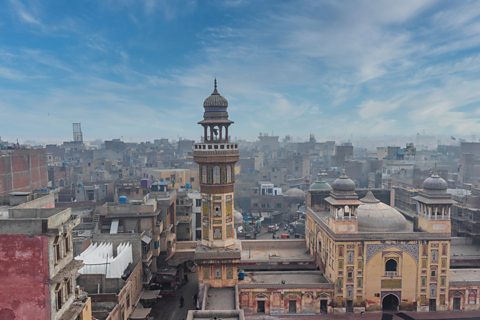 Image source, Muhammad Aqib/Getty
Lahore is an ancient city in Pakistan.
It is the second largest city in Pakistan, and capital of the state of Punjab, with around 14,000,000 people living there today.
It has existed for 2000 years and is famous for its heritage as a capital of empires.
The city was a central point in the movement for independence from British rule, and for the setting up of an independent Pakistan in the 1940.
It is also famous for its heritage of beautiful old buildings and is known today as a centre of culture, finance and banking with many new modern buildings being constructed.
Imtiaz Dharker was born in Lahore in 1954 and her family moved to Scotland before her first birthday. However, just as Send this may be a personal reflection on the city the poet was born in, the reader can separate the poet from the speaker and words of the poem and think about how they contribute to wider themes or feelings.
Image source, Muhammad Aqib/GettyForm and structure of Send this
The poem is divided into five stanzas, each with six lines.
In each stanza, the final line is shorter, often forming a sort of poetic ‘punchline’, ending each stanza with a dramatic note, often poignant in tone. (There is only one example of When the sentence runs onto the next line instead of neatly finishing at the end with a full stop or comma, occurs a few times in the poem. One such example is in lines two, three and four, when she refers to “the depth and breadth and height/ My soul can reach when feeling out of sight/ for the ends…” – it is as if the love she describes is so vast it cannot be neatly contained by the structure of the lines, instead bursting forth and spilling onto the next line. running between stanzas, at the end of stanza five).
The poem uses When the story is told from the point of view of one person using the pronoun 'I'. throughout, allowing the speaker’s voice, regrets and feelings of urgency, to come through.
There is no regular rhyme scheme but as with other poems of Dharker's, a number of sound effects are used in places to tie ideas together such as:
- internal rhyme ("mock it" / "lock it"/"pocket")
- assonance ("domes"/ "show"/ "home")
- onomatopeia ("rattle and spit")
The rhythm varies, following natural speech patterns as the speaker address their companion, including short sentences of instruction or definite statment, and longer more flowing thoughts.
Structure
Stanza one - The speaker instructs their friend not to send them a postcard from Lahore, as it will not capture the sense of the city as home.
Stanza two - The speaker does not even want to be reminded of typical tourist mementoes or stories. They list some examples of these to avoid.
Stanza three - Beginning with the definitive statement "Everything changes", this is the pivotal stanza which suggests that Lahore is continually changing. There is a skeptical note about "the truth retold and sold" as well as the sense of constant construction and everything remaining unfinished.
Stanza four - The speaker feels they no longer fully understand the city as a result of this change, but the people who are still living there are trying to adapt and understand.
Stanza five - The speaker respects those who have chosen the city and make the most of it. There is a realisation that we all create our own cities, our own lives and so the speaker resolves to carry "the unfinished walls of my city" in their pocket - symbolising their memories as well as the change that is happening there.
Stanza one
The poem begins with a strong command to the person visiting Lahore:
Do not send me a postcard
A postcard will not be welcome, The city has changed so much from the speaker's memory that a message of how the city is now could be upsetting. The unusual expression "The city that once lived here"- using
The description of Lahore in the past - "water courses and domes" - conjures up a picture of the city as it was. By referencing these features, the speaker is helping us imagine the conventional "pretty" view that tourists will hope to see, which they then reject.
There is a thread of assonance running through lines three to five - "courses", "domes", "photograph" and two instances of "home" create a flow and rhythm to these lines. The central idea of home is emphasised through repetition and enjambment:
was once home, and that home / is long gone.
In the short final line "is long gone" there is a new repeated vowel sound to give emphasis to this emphatic statement, with a A sequence of two consecutive stressed syllables, used for emphasis in speech or poetry. to finish the stanza. This stresses the finality of this message: as a person moves away, their old home stops being home at all and changes without them.
Stanza two
Stanza two opens with a repetition of the beginning of stanza one, another command:
Do not send me a miniature
The repeated commands of "Do not send" […] "or tell me" […] "or say" lists the things the visitor must not do. This underlines the fact that the speaker does not want their old home city to be characterised by tourist ‘stuff’. They go on to mention a few examples of the conventional thing tourists look for when they visit Lahore and then undermine the value of each one.
The picture "drawn with a camel's-hair brush" sounds authentic – and these brushes do exist - but, even then, they are generally less useful for delicate work as seen in miniatures. Modern brushes for this purpose made from genuine hair are much more likely to be squirrel or sable. Using camel hair, or claiming to, for delicate painting could be seen as an affectation to attract tourists - an attempt to sound exotic and authentic. The speaker seems to be casting some disdain on this activity in general, but also the detail of the brush and the style of painting.
The Anarkali Bazaar is a famous world heritage site. It is lively and popular, with wonderful architecture and shopping, but nowadays, the buildings are often run down through neglect and it can be overcrowded with tourists.
Gulmohar trees are found throughout Pakistan, India, Sri Lanka and other tropical climates. They are much loved because they provide welcome shelter in the heat, and they produce bright red blossom in summer. The expression "were aflame" can be seen as a bit of a tourist cliché (they are also known as flame trees in English), something the speaker rejects.
The speaker also does not want to hear that "koels sang there". These local birds (a species of cuckoo) have an exotic cry, which delights tourists. However their calls are sometimes considered a nuisance for people who live there.
Repeatedly, iconic sights and sounds which are enjoyed by tourists are dismissed due to their lack of authenticity.
Stanza three
The opening words of stanza three: ("Everything changes") are central to the poem.
This emphatic, short sentence at the start of the stanza stresses a turning point. After two stanzas of similar tone and content the tone of the poem itself is changing, just like the city it depicts. Everything does then change - the speaker now moves on to a positive command:
Remind me/of this.
Rather than trying to capture the timeless quality of Lahore, or a tourist view of it, they are interested in the reality of the city now. The city is literally a work in progress with "things not quite made, girders laid" and "half-drawn plans, haggled over". The When a word in the middle of a line rhymes with another at the end of the line (or in the middle of the next). of "made"[…] "laid"[…] "paid, with strong stresses on these words, creates a feeling of repetitive, ongoing hard work and lively negotiations.
We see the business of building as energetic but not attractive. "Girders" are structural but uniform and plain, replacing the "domes" and "water courses" of the past, referenced in the first stanza.
The speaker comments on "truth retold and sold", which is a note of caution and scepticism, suggesting corruption in the modern business world. The "new built malls" of modern times contrast directly with the "Anarkali Bazaar". The suggestion is that the city's true heritage and life is being replaced by a future that seems ordinary, possibly soulless, and based on consumerism.
Stanza four
Stanza four has the speaker interacting with the city directly:
With the wrong key, I come/ to this place and try to unlock it.
The speaker, who does not live in the city, wants to "unlock" the city, but has the "wrong key". The metaphor of the lock and key suggests their desire to understand the real city, the lives that take place behind closed doors. They realise that they lack the capacity to do so, because so much has changed in the time they have lived elsewhere.
They mention "air conditioners" in the suburbs, representative of progress and very welcome in a hot, modern city. However, the onomatopoeia of "rattle and spit" suggests it does not run smoothly.
The speaker observes how a hopeful person has "built a room" though it is clearly not a whole house, and "left space for a window" which is not yet installed. The place is unfinished and uninhabitable without even the basics, suggesting that there are limits to this apparent progress, and it is all very much ongoing.
Stanza five
Enjambment takes us straight into a change of tone with "opened a door, a desire". This is a positive shift, with the open door looking to the future. The door here is opened, in contrast to the opening of stanza four where the speaker had the "wrong key".
No matter how uncomfortable the building is, the "desire" to build it shows that people is trying to move forward. The command "Do not mock it", is a new type of instruction, as the speaker shows appreciation for this genuine attempt to create a home and make the city their own.
The "almost-done/world" is an ambiguous description: it might mean it is not finished yet, or that it might never be complete. The word "world" suggests that everywhere people are all trying to make a real future for themselves, rather than living in a picturesque or romanticised past.
The speaker's final instruction is "send me this", the first time in the poem that they've found something they would like to receive, and echoing the title of the poem. They realise that ‘nothing is ever fixed.’ Human life is always about change: it is always messy and never sorted.
I will carry the unfinished walls of my city
The poem ends on this pledge, referring not only to Lahore and its ongoing changes, but to the symbolic city we build around ourselves, the life we create for ourselves, of memories, connections and things in progress. The final flourish "with me, in my pocket" suggests that the speaker, like all humanity, has their own ‘city’ with them. This is the reality of life the speaker has been asking for: not a romantic gloss but a genuine connection with a place as it really is.
Video: what are commands and statements?
The title of the poem - Send this - and the repeated negative commands throughout, until the "send me this" in the last stanza, make commands a key part of this poem.
Brush up on your understanding of commands and statements with this short revision video for Higher English.
What are statements and commands? Find out more about these sentence types and why they're used.
Statements and commands
A statement tells someone a fact or an idea about a topic.
The dog wants a treat.
A command tells someone to do something.
Sit!
“Your room is a mess” is a statement.
“Go clean your room!” is a command.
Statements are very common in writing.
A statement must give you information and finish with punctuation, like a full stop.
The soldiers were scattered across the field.
The general might command them to stand.
“Stand in a line!”
In real life, you would find commands as instructions, like in a recipe book.
A command must start with a verb telling someone to do something.
Chop, stir, pour, mix
These are called imperative verbs.
Commands in writing, particularly prose fiction, tend to be part of the dialogue.
In Anne Donovan’s short story, ‘All That Glisters’, she uses a statement, followed by a command, when she describes a tender moment between the speaker and her dying father.
A statement describes the girl showing her dad the glitter pen she’d used at school:
“Ah took his haun in mines and turnt it roon so his palm faced upward. Look, daddy”
Donovan shows that a command doesn’t have to be bossy. It can be gentle or even loving.
Her dad is very ill, and weak, and his daughter is gently guiding him with her hands and her voice.Now you know how to make a statement with your writing.
Take command!
Themes in Send this
Change and memory
Change and memory are at the heart of Send this. The picture of the city as an ancient, beautiful place with traditional architecture may be pleasing for visitors, but it is not a full and realistic picture of the modern city.
Change is everywhere: construction of new houses and shopping centres; people attempting to make futures for themselves, even if the buildings they create are unfinished and uncomfortable. The poems makes clear that beautiful memories are less important than a living reality.
The speaker acknowledges that their memory is also a partial view of the city, just like the tourist perspectives they undermine in the first two stanzas. In stanza four, the lines:
With the wrong key, I come/ to this place and try to unlock it
show that they too are now an outsider, except their romantic view of the place was built on memories rather than tourist ideals. The city has changed, by necessity, into something completely different while the speaker has been living elsewhere.
Humanity and the environment
Send this explores how important it is for people to have a meaningful relationship with their environment.
The speaker rejects the sentimentalised view of Lahore, popularised for the benefit of tourists. They recognise the value of a functional, if less picturesque, city as we head into the future, even if it also means them putting aside their memories of a city they love. Symbolically, the cities we ‘build’ represent the lives we create for ourselves and "nothing is ever fixed", suggesting that life is always changing.
The final lines suggest the unfinished city (which is both the literal, changing city the speaker has come to accept, and the symbolic one we all make through our lives) is something the speaker will cherish - the intimacy of "in my pocket" keeps it close.
The power of emotions and human experience
The speaker’s vehement insistence on rejecting the romanticised view of Lahore demonstrates how important authentic emotions are. The shallow, touristy view is not good enough: the speaker demands truth. When they realise that they, too, no longer fully understand the city, as it has changed, they are open-minded enough to accept this new aspect of a place they love:
send me this, knowing/nothing is ever fixed
The city under construction may be unfinished and unlovely but the speaker expresses admiration for the people who are trying to create futures for themselves. The desire to open a door to the future, a longing for something better, is what makes us all human.
Comparisons with other poems by Imtiaz Dharker
In Send this, the romanticised picture of the city is contrasted with the more functional present and dynamic future of the city under construction. In Letters to Glasgow, past, present and future are also important in the journey. The old lady’s precious memories co-exist with the here and now, as passengers work away on their computers, heading into the future. These are all parts of what makes us human, just like the people attempting to build houses, to create a future for themselves. Both poems express notes of caution about this 'progress' but ultimately, human connection and emotion prevails.
Change and memory are fundamental to Send this as the city inevitably progresses and is renewed; similarly change in human relationships is shown in The Knot and Stitch, both based on childhood memories reflected on from adulthood. Growing up and moving away from childhood to the real adult world is difficult but necessary, just as the civilisation of Lahore must evolve from its picturesque past into a more functional future.
The poems Bairn and Bloom again highlight human connection and emotion. Bloom sees a new mother reflecting on her baby, who is just a small baby but has changed her persepctive on the world. Dharker repeatedly uses this kind of technique where the entire world is connected - in Send this, the unfinished room becomes an "almost-done world", in Bloom the speaker says "Holding you, I hold the world", and in Letters to Glasgow the "blue dot" of the train, tracked on GPS is like a small planet where all of life is present and connected.
Revise Send this by Imtiaz Dharker
Check your understanding of the poem Send this by Imtiaz Dharker with this interactive quiz for Higher English.