Key points
- Classification attempts to impose a hierarchy on the complex and dynamic variety of life on Earth by describing how different species group together and how they are related to one another or not.
- 'Domain' is the highest rank and 'kingdom' is the second highest rank in the sequence of classification.
- Classification groupings have evolved over time in light of new scientific findings.
Why classify organisms?
There are millions of different types of living A living entity such as animals, plants or microorganisms.. Scientists The organisation of living things into groups according to their similarities and characteristics. things to make it easier to study them. It helps to make sense of the world as well as to understand how different groups of living organisms are related to each other.
Linnaean system of classification
Carl Linnaeus was a Swedish scientist and explorer who specialised in The science of identifying, naming and classifying organisms. and developed his system of classification in the eighteenth century. This is known as 'binomial nomenclature'. The classification of species allows the sorting of living organisms into smaller and more specialised groups.
Video
NARRATOR: Manfred, Azumi, Farooq, Gabriela… no wait that's Farooq – or is that Callum.
No, that's Callum.
Hmm, this is difficult.
Well, it doesn't matter. They are fish. They're all fish. That's much more straightforward.
There is so much amazing and diverse life on planet Earth that looking at it all can be a big job. So when we study the natural world it can be very useful to group animals together. When we study nature we classify living things into different groups we do this in order to try and make sense of all the incredible bio-diversity on our amazing planet.
As we're already here, let's start with fish.
I bet all of you could tell me that these animals are fish. You knew that already, right? But why? How did you know? They all look different from each other they have different shapes and colours but we call them all fish. What is it that these creatures have in common that separates them from other animals? They all have eyes but almost all animals have eyes, including you.
So what makes a fish a fish?
The most obvious characteristic of fish is that they live in water. They also breathe using gills. Fish have scales and fins and they lay soft eggs. Fish are cold-blooded which means they don't generate their own body heat but instead get it from the surrounding environment. These are some of the main characteristics that make a fish a fish.
It's a simple idea but when we're trying to work out how all the plants and animals in the world fit together and how we have ended up with such an amazing diversity of life on Earth looking at shared characteristics can tell us a lot.
What about these guys?
Well, they're breathing air so we know straight away they're not fish.
I bet you knew that without even thinking about it and you might even know that these snakes, lizards and tortoise are all reptiles. But what is it they have in common that helps us group them together? Some are big, some are small some are even covered in spiky horns. But what makes a reptile a reptile?
The easiest characteristic to spot on a reptile is that they have scales, not fur. Other clues for spotting a reptile is that they have earholes instead of pointing out ears and also have dry skin. Like fish, reptiles are cold-blooded and usually lay eggs although some reptiles can give birth to live young. Reptiles have four legs or, like snakes, have no legs at all.
This animal lays eggs, but it's not a lizard. Some scientists believe they may have descended from dinosaurs.
I know.
But whether that theory is proven to be true or not, this is a bird. These are all birds. Big, small, plain, amazingly coloured and sometimes even dancing.
But it's not the ability to dance that makes a bird a bird.
So what is it?
Well, all birds have certain shared characteristics. Birds have feathers and wings. They have two legs. They have earholes instead of ears and they are warm-blooded, so they can generate their own body heat. And they lay eggs.
Frogs, toads and salamanders are similar to reptiles in some ways and it can be easy to confuse them but they're classified as amphibians. Amphibians have moist skin, are cold-blooded and they can live on land or in water. Amphibians lay lots of soft jelly-like eggs like the frog spawn you may have seen in a pond in your back garden or local park.
Like all the other groups, mammals come in all different shapes and sizes including human shape but all mammals, including us, have shared characteristics. Mammals have hair or fur they need to breathe air and the mothers almost always give birth to live young which they provide with milk to feed them and help them grow. Mammals are also warm-blooded.
Fish, reptiles, birds, amphibians and mammals. These are just some of the groups we use to make sense of the natural world. Over 200 years ago it was a Swedish scientist called Carl Linnaeus who first started the system of putting plants and animals into certain groups based on shared characteristics. His pioneering work to understand the natural world is still the basis of how we classify plants and animals today and influenced the development of the theory of evolution.
So now we know a lot more about classification and why we do it what do you think about this animal? From the five groups we looked at how would you classify it? Is it a fish, a reptile, a bird, an amphibian or a mammal?
At first glance you would say it's a fish, easy but looks can be deceptive and only by studying it more closely can we come to the true answer.
Dolphins actually breathe air and must come to the surface from time to time. The mothers also give birth to live young and provide them with milk. And although it may not look like it, they do actually have tiny hairs all over their skin.
So what are dolphins?
Yes, dolphins are mammals, just like an elephant or a mouse!
I know.
Amazing.
So we can see that by studying animals and grouping them together based on shared characteristics we have a better understanding of how they all fit together and we can discover things we might not have otherwise realised about the wonder of the natural world.
Can you answer these questions based on the video?
1. What are the main characteristics of birds?
2. What type of animal is a dolphin?
- Lays eggs, has two legs, feathers, wings and ear holes.
- A mammal.
The modern classification hierarchy
The modern classification system includes a more up to date version of the classification system where domain is split into three further groups. These groups are based on genetic analysis not available until more than 200 years after the original work of Carl Linnaeus as well as some structural differences.
Here is a list of the classifications found in the modern hierarchy, their groups and characteristics from highest to lowest taxonomic rank.
| Classification | Groups |
|---|---|
| Domain | Archaea, bacteria and eukaryote. |
| Kingdom | Plantae, animalia, fungi, protoctista and prokaryotae. |
| Phylum | Groups organisms according to body plan eg backbone. |
| Class | Groups organisms to do with general trait eg number of legs. |
| Order | Groups according to organism’s nature eg carnivore/herbivore. |
| Family | Groups of similar genera, based on reproductive characteristics. |
| Genus | Groups of similar species. |
| Species | A group of organisms that can interbreed to give fertile offspring. |
Human classification
Here is the classification for you and every other person in the world. This is known as a modern human, or Homo sapien.
| Classification | Group | Characteristics |
|---|---|---|
| Domain | Eukaryote | Multicellular organism. |
| Kingdom | Animalia | Cells have nuclei and no cell wall. |
| Phylum | Chordata | Have backbones. |
| Class | Mammalia | Have hair and produce milk for young. |
| Order | Primates | Have flat faces, forward facing eyes, opposable digits. |
| Family | Hominidae | Human-like creatures. |
| Genus | Homo | Humans are the only living member. |
| Species | Sapiens | Modern human. |
The binomial naming system
The binomial system is important because it allows scientists to accurately identify individual species. It uses Latin words to name species. Each name has two parts, the genus and the species. For example, human beings belong to the genus Homo and the species is sapiens, that means the scientific name is Homo sapiens.

The five kingdoms
Plantae
| Features | Examples |
|---|---|
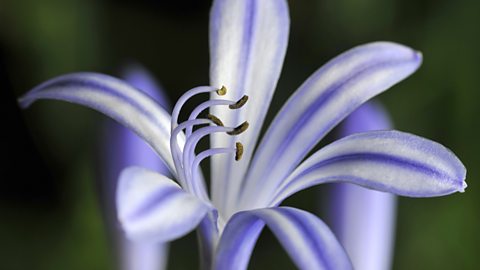
| • Any cell in an organism that possesses a clearly defined nucleus or membrane bound organelles. • Made from more than one cell. Can refer to an organism. • Cell wall made from a substance called cellulose • Uses light to produce food by A chemical reaction that occurs in the chloroplasts of plants in which the energy in light is stored in glucose. • Stores food as starch | All green plants eg algae, ferns, mosses, conifers, flowering plants |
Animalia
| Features | Examples |
|---|---|
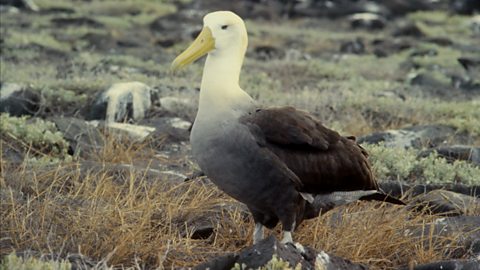
| • Eukaryotic • Multicellular • No cell wall • A nucleus and other membrane-bound A structure found within cells that carry out specific functions. • Heterotrophic • Food stored as glycogen | All multicellular animals eg sponges, fish, reptiles, birds, mammals |
Fungi
| Features | Examples |
|---|---|
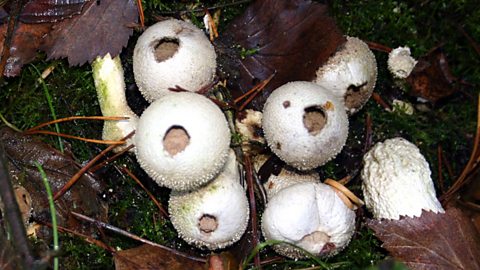
| • Eukaryotic • Usually multicellular, sometimes unicellular • Cell walls made out of a substance called chitin • No chloroplasts • Food stored as glycogen | Moulds, mushrooms, yeast |
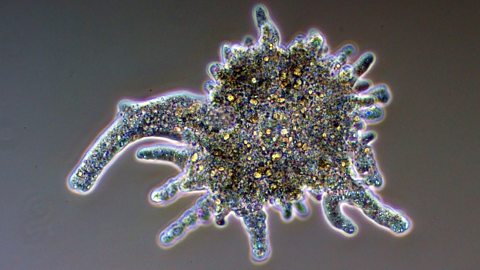
Protoctista
| Features | Examples |
|---|---|
| • Eukaryotic • Single cell organisms or a colony of single cells • Some have chloroplasts • Move using The tiny hairs found on the top of ciliated cells which beat., A tail-like part of the cell that can spin, moving the cell along. or A feature of unicellular organisms which allow the cell to move and can surround food and take it inside the cell. • Nutrients acquired by photosynthesis or ingesting other organisms | Amoeba, Paramecium, Protozoa |
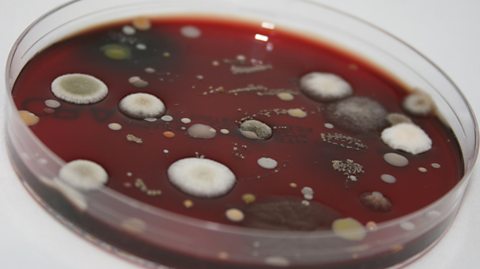
Prokaryotae
| Features | Examples |
|---|---|
| • A microscopic single-celled organism which has neither a distinct nucleus with a membrane nor other specialised organisms. • Unicellular • Cells have no nucleus • Absorb nutrients or produce internally by photosynthesis | Bacteria eg E. Coli, Staphylococcus Aureus, blue-green algae |
Test your knowledge
Play the Atomic Labs game! game
Try out practical experiments in this KS3 science game.

More on Ecosystems and habitats
Find out more by working through a topic
- count6 of 7
- count7 of 7
- count1 of 7
- count2 of 7