Key points
- Bacteria are among the smallest living things.
- A single bacterium consists of just one cell.
- Not all bacteria are harmful.
- There are different unicellular organisms and types of bacteria.
What are unicellular organisms?
A unicellular organism is a living thing that is just one cell. There are different types of unicellular organism, including:
- Unicellular fungi
- Protozoa
- Bacteria
These organisms have adaptations that make them well suited for life in their environment.
Unicellular fungi
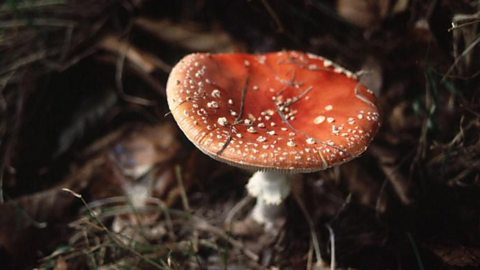
Yeast are unicellular fungi. They are used by brewers and wine-makers because they convert sugar into alcohol, and by bakers because they can produce carbon dioxide to make bread to rise. Fungi can also form into mushrooms and toadstools.
Protozoa
Protozoa are unicellular organisms that live in water or in damp places, for example, the amoeba.
Bacteria
Even though a bacterium is just one cell, it can carry out all seven life processes - movement, respiration, sensitivity, growth, reproduction, excretion and nutrition.
Bacteria
Video - How knowledge of bacteria helps a chef
Chef Gennaro describes how knowledge of bacteria helps with food hygiene in his kitchen
Chef Gennaro: Bacteria is a type of a single-celled microorganism. They are really tiny. They are just a couple of micrometres across. There are so many different shapes. Some of them have, actually, tails that can make them swim.
I'm Gennaro Garofalo, I'm the head chef. As a head chef, it's very important for me to have knowledge about food safety.
It's very easy if you're thinking about four Cs, cleaning, cooking, chilling, and cross-contamination. It's important to wash your hands because like this you can prevent bringing bacteria from your hands to the food.
We cook food to make sure we kill the bacteria. To do that, we bring the food at 72 degrees. 72 degrees is the temperature for killing bacteria in high-risk food.
Some of the high-risk foods are chicken, white fish, pork. So I take extra care when I go to prep them and cook them. Cross-contamination basically is how the bacteria goes from one area to another one.
There are two ways we prevent cross-contamination in our fridge. It's just like your fridge at home. Firstly, I make sure everything is covered. After that, we make sure everything is separated from the others. So we have ready-to-eat food on the top and raw food on the bottom shelf.
In my kitchen, I have different colours of chopping boards for helping me to prevent cross-contamination. Maybe you at home, have only one chopping board - make sure you wash it properly every time you use it.
Some of the bacteria can make us very ill. The two I'm most worried about are the Salmonella and E. coli.
Not all the bacteria are harmful. Without bacteria, we cannot have cheese or yogurt.
The best thing about my job is the happiness of the customers after they eat my food.
Can you answer these questions based on the video?
1. What is the width of a bacterium?
2. What is the transfer of bacteria from one area to another called?
Two micrometres
Cross contamination
What’s in a bacterium?
There are similarities between plant and animal cells and a bacterium. They all share a cell membrane and cytoplasm. Bacterium also have a cell wall around them, like plant cells. However unlike most plant and animal cells, it has no nucleus.
| Component | Function/description |
|---|---|
| Cell wall | Tough outer layer of the cell, which provides strength and support to the cell. |
| Large circular DNA molecule | Bacteria do not have a nucleus and their genetic material (DNA) is not arranged into chromosomes. |
| Cell membrane | Permeable inner layer that surrounds the cell and controls which substances can pass into and out from the cell. |
| Cytoplasm | Liquid that makes up most of the cell in which chemical reactions happen. This is mainly water. |
| Plasmids | Small circular section of DNA that can move from one bacterium to another. |
There are millions of different types of bacteria. Different types of bacteria have different shapes.
Many types of bacteria have extra cell structures to help them to survive. For example, they may have:
A slime capsule, outside the cell wall, to protect them and stop the bacterium drying out.
Flagellum, a tail-like structure that allows bacteria to move through liquids.
Why is it useful to know about bacteria?
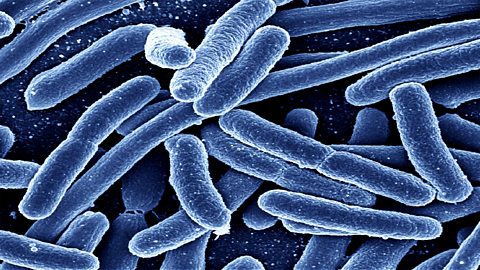
Some bacteria cause diseases, including food poisoning, meningitis and scarlet fever. Inside the body, these bacteria reproduce quickly. They produce poisons that make you feel ill.
Anyone who cooks needs to know how to prevent bacteria spreading in their kitchens, to ensure all the food they produce is safe to eat.
Not all bacteria are harmful. For example, yoghurt and cheese makers use bacteria to make their products. Bacteria like intestinal flora can be helpful to our bodies whereas E.coli can be harmful and cause disease.
There are millions of bacteria in your digestive system. Having the right mix of bacteria here is vital. Gut bacteria help to digest food. They also help to prevent diabetes, obesity and some types of cancer.
Quiz - Bacteria
Play the Atomic Labs game! game
Try out practical experiments in this KS3 science game.

More on Living organisms
Find out more by working through a topic
- count12 of 15
- count13 of 15

- count14 of 15

- count15 of 15