Key points
- Cameras and eyes both detect light.
- Both cameras and the human eye use lenses to focus light.
- Both cameras and the human eye contain material that is sensitive to light.
The eye
The parts of the eye
The eye contains a natural A specially shaped transparent object which refracts light so it focuses at a point. to focus light from an object to produce an image.
This image is detected by photo-sensitive cells in the back of the eye, in a part called the The region that makes up the back of the eye. It contains light sensitive cells..
The Materials which react or change when they absorb light. cells in the retina produce electrical impulses when they absorb light, and these impulses are passed along the The nerve which carries information from the eye to the brain. to the brain, which interprets them as vision.
How the eye ‘sees’
Find out how the human eye and brain work together to create sight.
Follow me please class.
We’re here at the optician’s to get a good look at a human eye and find out how it works.
Human eyes are actually spheres. The part that we can see is only just the front. That coloured circle is called the iris… and the black spot in the middle is the pupil. This is the part of the eye that lets the light in.
Lights out please!
When it’s dark… muscles in the iris make the pupil grow bigger, which means it can let in more light. When there’s lots of light around, it shrinks.
Lights on again please!
Now, light that goes in through the pupil passes through a lens that sits behind it. The lens focuses light on the retina at the back of the eye. Because the front of an eye is curved, it bends light as it goes in, turning the image on the retina upside down. Inside the retina, there are millions of special sense receptors called rods and cones. The rods see the shapes of things, picking out black, white and shades of grey… and the cones see colours: red, green and blue, and all the millions of shades in between. The rods and cones send information about shapes and colours up to the brain through the optic nerve and the brain sorts out the information, flipping the upside down image from the retina the right way up.
It’s really quite clever.
Now, where have they all gone?
Oh yes, very funny. Come along now children.
What is the blind spot?
There is a blind spot in both of your eyes. It is the point on the retina where the optic nerve joins the retina. Any light hitting this point does not get translated into electrical signals. Your brain fills in the gap created by the blind spot, using information from the other eye so you don't realise it is there.
Cameras
Cameras are devices that focus light from an object onto a Materials which react or change when they absorb light. material using a lens.
In older cameras, the photo-sensitive material was camera film. When the film absorbed light, a chemical change produced an image on the film, called the ‘negative’. This was used to produce a photograph on photo-sensitive paper.
In a modern camera such as a smartphone camera, the photo-sensitive material produces electrical impulses, which are used to produce an image file. This can be viewed on the screen, or its information can be shared digitally and printed out.
Image formation in cameras and eyes
Cameras and eyes both use A specially shaped transparent object which refracts light so it focuses at a point. to produce an image, which is detected by light sensitive material. For example special photographic paper in the case of a camera and light sensitive cells in the retina of the eye.The rays of light are A process which causes light to change speed, and sometimes direction, when it enters a material of a different density. by the lens and brought to a focus on the light sensitive material.
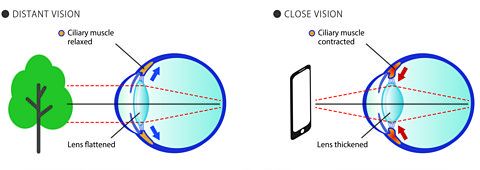
The lens in your eye can change shape to focus objects at nearby or far away.
Cameras often use a system of lenses, which can be moved to produce focused images of objects which are different distances from the camera.
Compare a camera and an eye
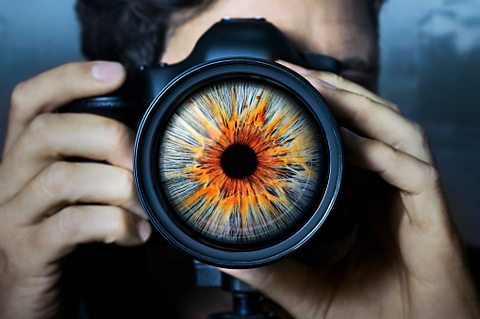
Cameras and eyes have some similarities:
- They both use lenses to focus light on to a light sensitive material
- They also both produce inverted (upside down) images, which then need to be ‘flipped’ by your brain, or the electronic image processing system in the camera
There are also some important differences between cameras and eyes:
- The lens in your eye can change shape to focus on objects at different distances
- The lens in a camera is a fixed shape but may be adjusted to focus on objects at different distances
- Light entering your eye is focused on light sensitive cells in your retina
- Light entering a camera is focused on to a sensor, which produces electrical signals
- The image produced by a camera is transferred as electrical signals to a memory card, where it is saved
- The image produced by your eyes is transferred as electrical signals along the optic nerve, to your brain
Test your knowledge
Play the Atomic Labs game! game
Try out practical experiments in this KS3 science game.

More on Waves
Find out more by working through a topic
- count7 of 15
- count8 of 15

- count9 of 15
- count10 of 15