Key points
- White light is made of a spectrum of different colours.
- Light can be split up into these separate colours using a prism.
- There are three primary colours of light, which can be combined to make secondary colours.
The spectrum of visible light
White light is made up of many different colours, each with a different Frequency is the number vibrations of the wave in one second, also seen as the number of complete waves passing a point in one second. Frequency is measured in hertz (Hz)..
White light can be split up to produce a spectrum containing all the different colours of visible light. This could be seen happening naturally: for example light can be A process which causes light to change speed, and sometimes direction, when it enters a material of a different density. and When something bounces off a surface, like light waves bouncing back or reflecting from a mirror. by water droplets, creating a rainbow.
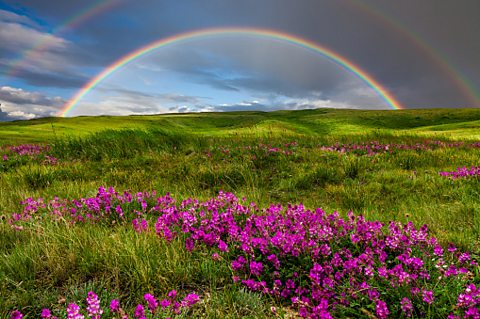
Professor Brian Cox explains how white light disperses into different colours
The white light of the sun is made up of all the colours of the rainbow. And when it reaches the Earth, those individual colours are revealed.
Photons from the sun rain down and enter water droplets. They reflect off the rear face, come out of the front again and into your eye. But the blue photons, the higher-energy ones, behave differently to the green ones and the yellow ones and the red ones. They come out at a shallower angle, and that's why you get the full spectrum of colours from the white light of the sun.
And it's this light that paints the Earth.
Colours of the visible spectrum
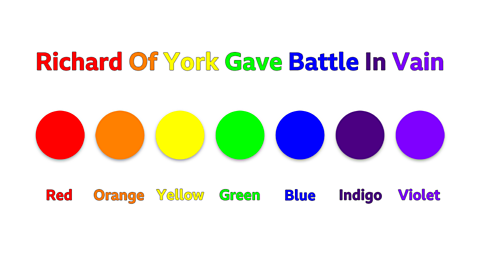
There are seven colours of the visible light spectrum. In order of their frequency, from the lowest frequency (fewest waves per second) to the highest frequency (most waves per second), they are:
RedOrangeYellowGreenBlueIndigoViolet
A mnemonic can be used to remember these colours in the correct order, for example:
| Richard | Red |
| Of | Orange |
| York | Yellow |
| Gave | Green |
| Battle | Blue |
| In | Indigo |
| Vain | Violet |
Dispersion
White light can be split up into a spectrum of these colours using a triangular block of glass or acrylic, known as a A piece of glass or transparent plastic with flat sides, which can be used to split light into a spectrum..
Light is refracted when it enters the prism, and each colour is refracted by a different amount. This means that the light leaving the prism is spread out into its different colours, a process called dispersion.
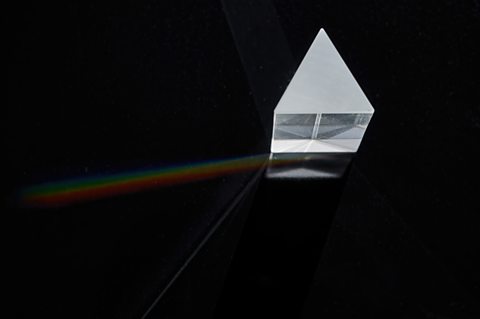
Who first carried out experiments with prisms and light?
This experiment is recorded as first being carried out by Isaac Newton, after an outbreak of bubonic plague led to Cambridge University closing in 1666. Newton purchased his first prism and returned to his home at Woolsthorpe Manor, where he carried out experiments with light in his bedroom, during the lockdown.
Primary and secondary colours of light
There are three Colours which cannot be produced by mixing other colours. of light: red, green and blue. Light in these colours can be added (combined) together to make the Colours which are produced by mixing primary colours.: magenta, cyan and yellow.
Did you know?
In art lessons, you might have learned about the three primary colours of paint which are different to the primary colours of light. In art they are: red, yellow and blue. Mixing the primary colours of paint produces the secondary colours of paint: orange, purple and green. These are different to the secondary colours of light.
Each secondary colour of light is produced by mixing two primary colours. It can be useful to think of these combinations as word equations:
red + blue = magenta
green + blue = cyan
red + green = yellow
All three primary colours add together make white light:
red + green + blue = white
Did you know?
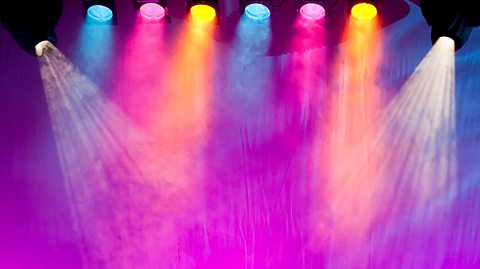
Many theatres use red, green and blue stage lights. By combining these colours in differing amounts, it is possible to produce a wide range of different colours.
Test your knowledge
Play the Atomic Labs game! game
Try out practical experiments in this KS3 science game.

More on Waves
Find out more by working through a topic
- count9 of 15
- count10 of 15
- count11 of 15
- count12 of 15