What is coastal deposition?
Many features of our coastline are created by deposition. This is when the sea drops sand, rocks and pebbles it has been carrying.
In this article you can learn:
- How deposition creates different coastal features
- What longshore drift is
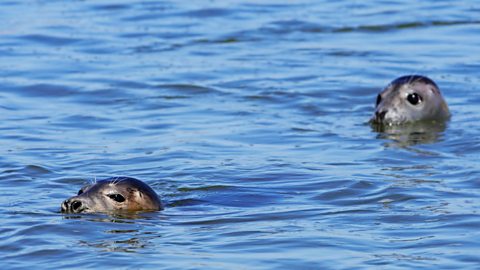
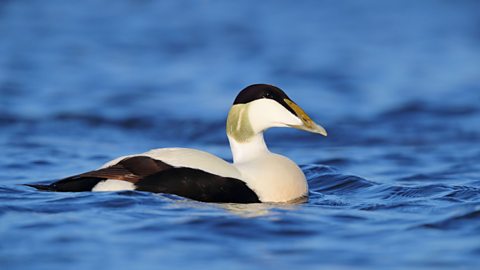
- Wildlife in Forvie National Nature Reserve
This resource is suitable for Landscapes topics for primary school learners.
Video - Coastal deposition
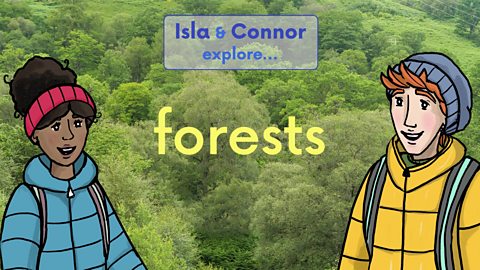
Join Isla and Connor as they explore features of coastal deposition along the coast around Aberdeen.
Watch this short video to find out about features of coastal deposition.
ISLA: Just my kind of place! A beautiful beach and nothing but the sea. And seals - and all the birds! Forvie Sands is a National Nature Reserve and brilliant bird habitat.
All these sand dunes make up one of the largest sand dune systems in Britain. The sands settled here in the sea after the end of the last ice age.
CONNOR: The ice age! Wow. I wonder how?
This says that the waves and the wind brought the sand up onto the land to create this beach. The waves carrying and depositing sand, pebbles and other material is called longshore drift.
ISLA: Longshore drift?
CONNOR: When you look at the sea, you can see that the waves come up the beach, and then roll back down again.
The swash - the waves coming up the beach - are pushed along by the wind direction, at an angle to the beach.
The backwash, the waves rolling back down again, are pulled by gravity down the natural slope of the beach.
ISLA: Oh, I see. The swash picks up sand or stones on the beach and moves them up and along the beach, while the backwash washes them back down again at right angles and deposits them again. That’s deposition.
So, over a long period of time, sediment moves along the coastline in a zig-zag motion.
So longshore drift has also helped to create the sand dunes by bringing all this sand here in the first place!
CONNOR: Yes, the wind blows the sand, which gets caught in sheltered areas or in vegetation and builds up into these mounds called dunes. It’s also helped create the saltmarsh, an important bird habitat, and other features too.
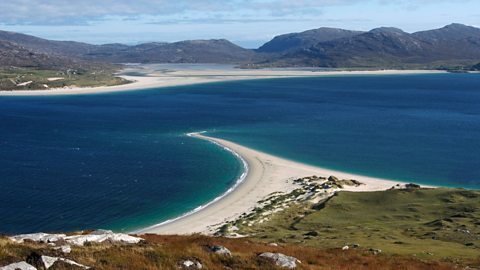
A feature called a spit can form where the coastline changes direction. Longshore drift still continues and starts to build up sand out into the sea - getting longer and longer forming the spit.
Because waves can’t get past the spit, a sheltered area develops behind it. The water isn't moving much here, so it deposits sand and silt, so mud flats or salt marshes form.
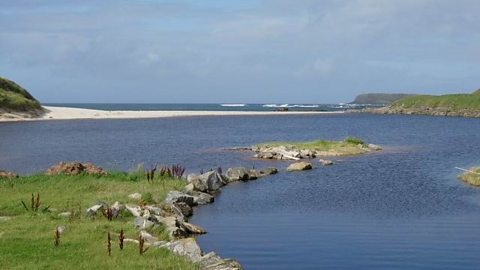
Spits can also form tombolos, sand or shingle that joins the mainland to an island. Or sometimes a spit stretches right across a bay and rejoins the coastline, forming a bar.
Behind a bar a lagoon forms, which is basically sea water separated from the sea. This stretch of coast is too rocky for lagoons but…there’s a popular lagoon at Pabay in the Hebrides.
ISLA: Right over on the other side of the country!
CONNOR: Oh wow! Just one more reason to love the beach.
ISLA: Yes, but I’m getting peckish. I’d like another seaside favourite now…
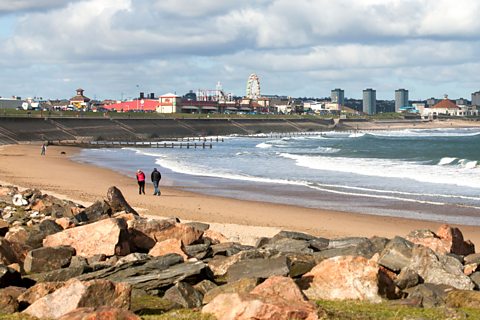
I love how different beaches can feel. The remote wilderness of Forvie Sands, and a city beach like Aberdeen.
CONNOR: Funny to think that some of the sediment from this part of the coast could have been carried all the way along to Forvie Sands.
ISLA: I’ve read about these wooden posts, they’re called groynes. Groynes act as barriers to stop the sediment from moving along the shoreline.
The sand or stones are trapped on the side of the groyne facing the wind, meaning that this part of the beach doesn’t erode, or wear away, as quickly. It does mean that the other side erodes more quickly, though.
CONNOR: Wow, so these really show the connection between erosion and deposition. Whenever land is eroded, it is deposited somewhere else.
ISLA: I wonder where the sand here started off…and where it will end up one day.
CONNOR: I don’t know - but, I do know there’s nothing better than a bag of chips on this beach!
Oh no, hey!
ISLA: Oh yeah, even the gulls know it!
Coastal deposition
- The coast is the land along a sea. The coastline is the boundary between land and water.
- Many features of the coast are created by deposition. This happens when the sea loses energy. Materials, like sand and pebbles, are transported by the sea and dropped when the sea doesn't have enough energy to carry them.
- Material from the sea bed, like sand and pebbles, is called sediment. This is picked up, transported by movement of the sea and dropped, or deposited.
- Beaches are formed from deposits of sediment. This is why they can be found on the coast. They separate the mainland from a body of water, like a sea or loch.
What is longshore drift?
Longshore drift is the name of the process where materials are moved along the coastline.
- Waves approach the coast at an angle.
- Swash carries sediment up the beach at an angle.
- Backwash carries sediment down the beach with gravity – at right angles to the beach.
- This creates a zig-zag movement of sediment along the beach.
Features of coastal deposition
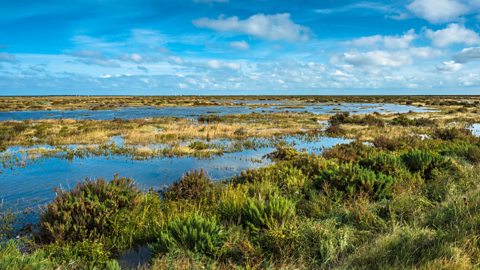
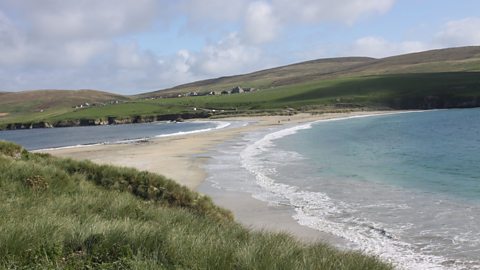
This slideshow shows different examples of coastal deposition features like sand dunes, salt marshes and tombolos.
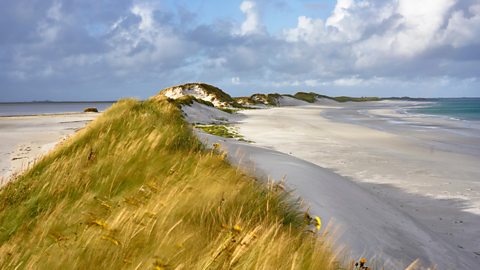
Image caption, Sand dunes
Sand dunes are formed when wind brings sand into sheltered areas. Scotland has more than 500 square kilometres of sand dunes, including these sand dunes in Orkney. (David Robertson / Alamy Stock Photo)
1 of 5
Forvie National Nature Reserve
Forvie is one of Scotland's National Nature Reserves. A nature reserve is an area of land set aside to protect Where an animal or plant lives. and wildlife.
Forvie National Nature Reserve is known for its huge sand dunes, wide mudflats and the River Ythan. The reserve is home to many different birds and other plants and animals.
Let's find out about animals in the Forvie National Nature Reserve.
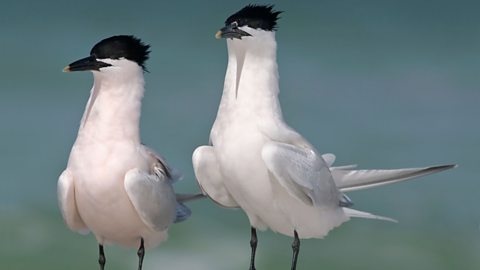
Image caption, Sandwich terns
Many birds rely on nature reserves, like Forvie Sands, to survive. Sandwich terns are a type of bird that can be found on the lookout for small fish to eat. (David Osborn / Alamy Stock Photo)
1 of 3

Key words about coastal deposition
- coast - Where land meets sea. Also known as coastline.
- beach - A piece of land which separates A place that is far away from the coast. area from from a body of water, like a sea or loch. Beaches are usually made up of sand.
- habitat - Where an animal or plant lives and grows.
- longshore drift - The movement of material, such as sand and stones, along a coastline caused by the movement of waves. The waves move materials along the coast in a zigzag movement.
- swash - Waves that are pushed up on to the beach by the wind at an angle.
- backwash - Waves that roll back down the natural slope of the beach towards the sea.
- deposition - When materials are dropped or left behind. When the sea loses energy, it drops the material it has been carrying.
- sand dunes - A mound or hill of sand which has been blown onto the land by the wind or waves.
- spit - An area of a beach that only joins to the main part of land at one end. They start to form where there is a change in the direction of the coastline.
- salt marsh - An area of the coast that is flooded and drained by salt water brought in by the tides. They form behind a spit when water movement slows down so more material is deposited.
- mudflat - An area of muddy coast where rivers meet the sea or ocean.
Test your knowledge
Quiz
Challenge

Create a leaflet about one of Scotland's coastal nature reserves.
We learned about Forvie National Nature Reserve in this article but there are many other A place that has been set aside to preserve and protect plants and animals. in Scotland.
Research a National Nature Reserve near you. Design a leaflet that would encourage people to visit and look after the reserve.
Here are some examples of nature reserves where you can find coastal deposition features.
- Tentsmuir National Nature Reserve
- Taynish National Nature Reserve
- Loch Fleet National Nature Reserve
- St Cyrus National Nature Reserve
Some ideas to get you started:
- Where is the nature reserve? Can you draw a map to show its location?
- Can you list its key features? Does it have sand dunes, salt marshes or unique wildlife?
- Find a list of Scotland's National Nature Reserves here: NatureScot - Scotland's National Nature Reserves
- If you need help making your leaflet, learn more here: How to create a leaflet
More on Landscapes
Find out more by working through a topic
- count19 of 25
- count20 of 25
- count21 of 25

- count22 of 25