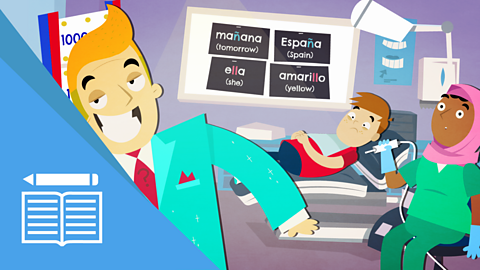
Punctuation in Spanish is a little bit different to English.
Learn about punctuation in Spanish with Burt Bessington
BURT: Hi! I’m your host Burt Bessington and welcome to Punctuation Prizes!
There’s 20 seconds on the clock.
In English we put punctuation marks at the end of sentences, but where do they go in Spanish?
All you have to do is put the punctuation in the correct place! Your time starts now!
That’s right but you also need one more. But where?
Correct! Now for the exclamation mark! Go!
Er, not quite!
Correct! Similarly to how we use quotation marks in English, in Spanish question and exclamation marks are also turned upside-down at the front of the sentence!
And that's the end of the quiz!
Congratulations! You’ve won our star prize - a signed basketball!
BOY: Ugh thanks?
BURT: Thanks for tuning in folks! See you next time!
Questions in Spanish
Questions in Spanish don’t just need a question mark at the end, they also need one at the beginning of the sentence.
The question mark at the beginning of the sentence must be upside down but the one at the end is just an ordinary question mark.
Here are some examples:
Check your connection, refresh the page and try again. - What is your name?
Check your connection, refresh the page and try again. - How old are you?
Check your connection, refresh the page and try again. - How are you?
Accents in questions
Another thing to remember about questions is that there is an accent on the question word, such as 'who', 'what' and 'where', eg:
Check your connection, refresh the page and try again. - What is your name?
Exclamations in Spanish
Any exclamation sentence in Spanish needs an upside down exclamation mark at the beginning and a normal exclamation mark at the end.
Here are some examples:
Check your connection, refresh the page and try again. - Hello!
Check your connection, refresh the page and try again. - I’m hungry!
Check your connection, refresh the page and try again. - I’m fantastic!
Did you know?
Upside down question marks are a way of saying 'question coming up', because the word order for a question and a non-question are the same.
For example:
Check your connection, refresh the page and try again. - You are eight years old
Check your connection, refresh the page and try again. - Are you eight years old?
They also tell the speaker to change their intonation - this means that their voice should go up at the end of the question.
Race Across the Continents game - new update! game
Help this team of adventurers race their way to victory. Explore the globe in this exciting game update to discover new audio voiced by Ade Adepitan and fun animations. Challenge yourself with brand-new achievements and become a high-flyer!

More on Spanish skills
Find out more by working through a topic
- count5 of 5
- count2 of 5
- count3 of 5