Overview of characters
There are lots of characters in Macbeth, but it is okay to concentrate on the ones that play the biggest part in the story. You just need to know what their relationship is to Macbeth and the important parts they play in the story.
The Scottish noblemen are called Thanes, this is a Scottish word, which means Lord.
The four most important characters are:
- Macbeth
- Lady Macbeth
- Banquo
- Macduff
Macbeth
At the beginning of the play, Macbeth is the Thane of Glamis. He is famous throughout Scotland for being a tough soldier. King Duncan likes him and promotes him. But Macbeth meets three Witches who predict this promotion and tell him that he will be king in the future. Macbeth is too ambitious to wait and see if this will happen. Instead he kills King Duncan with some help from Lady Macbeth. He becomes King of Scotland, but his troubles don’t end there. In fact, this is only the beginning.
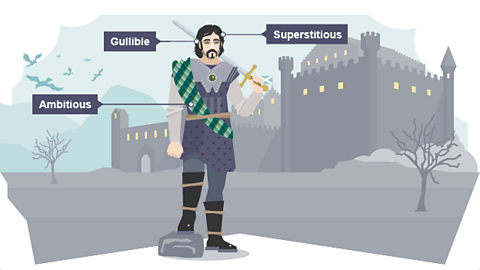
Image caption, Character attributes
Ambitious; Gullible; Superstitious

1 of 3
Did you know?
Macbeth is the tragic hero of the play. Ambition is his fatal flaw. Tragic heroes start off nice, then a bad part of their personality kicks in (a fatal flaw) to make them not so nice. In the end, there is always a glimmer of the good person they were…before they die. Shakespeare wrote plenty of stories about tragic heroes, eg Othello, Hamlet, Julius Caesar. He got his idea from Greek stories. Sometimes, when you watch modern films, the film maker uses the idea of a tragic hero too.
Character attributes
- Ambitious - one promotion is not enough. He can’t wait to be king and once he’s king, he doesn’t want anyone around who might threaten his position.
- Superstitious - he believes the Witches when he first meets them on the heath, and returns to their lair for more predictions later in the play.
- Gullible - he allows Lady Macbeth to bully him into murdering King Duncan, and later he believes what the Witches have told him makes him invincible.
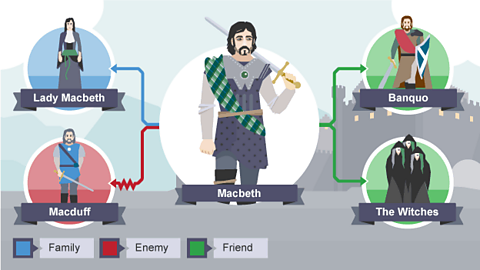
Friends and enemies
Macbeth's friends are:
- Banquo - starts off as Macbeth’s friend. Macbeth has him assassinated in case Banquo’s children threaten his position as king.
- Lady Macbeth - is on Macbeth’s side, but she gradually goes mad with guilt so he loses her.
- The Witches - seem like they are Macbeth’s friends, but they actually contribute to his downfall.
Macbeth has lots of enemies but the main one is:
- Macduff - Macbeth kills his family. Macduff kills Macbeth so that the true king of Scotland can take over.
Changes in character
- Macbeth is admired because he’s a brave warrior and loyal friend to Duncan and Banquo, but he kills them both to satisfy his ambition.
- He has a very close relationship with Lady Macbeth, but guilt drives them apart and when she dies, it’s as if he doesn’t have time to care.
- At the end he is a hated tyrant, but he is still brave, and he refuses to die like a coward.
Character analysis
Question
What drives Macbeth to kill the king?
Ambition. Duncan is a good king and Macbeth likes him. Macbeth knows he can’t find any good reasons to justify killing the king. His ambition is the only thing driving him on, as though he is racing to win on his horse.
Macbeth admits to himself:
MACBETH
I have no spur
To prick the sides of my intent, but only
Vaulting ambition…
Act 1 Scene 7
Question
How does Shakespeare show that Macbeth becomes more and more superstitious as the play goes on?
When Macbeth’s hired murderers manage to kill Banquo, but Fleance, his son escapes, his thoughts turn to the Witches. It’s as though he can no longer act without their predictions to guide him.
Macbeth tells his wife:
MACBETH
I will - to the weird sisters.
More shall they speak. For now I am bent to know
Act 3 Scene 4
Question
How does Shakespeare show that Macbeth is gullible?
Before Macbeth arrives back at the castle, Lady Macbeth worries that although he is ambitious, he isn’t nasty enough to kill King Duncan. Therefore she’ll have to talk him into it. She uses a <glossaryterm id=">metaphor<\glossaryterm> pour my spirits in thine ear, as if what she has to say is like a potion that will make him do her bidding.
MACBETH
none of woman born
Shall harm Macbeth.
Act 4 Scene 1
Macbeth thinks this means that no one can defeat him. On the battlefield, Macduff tells Macbeth that he was delivered by Caesarean, meaning that Macduff was cut from his mother’s stomach rather than being born in the usual sense of the word. The Witches tricked Macbeth: Macduff is able to kill Macbeth.
In Act 1 Scene 2, an injured soldier, The Captain, reports back to King Duncan from the battle where Macbeth has been fighting with great bravery.
CAPTAIN
For brave Macbeth — well he deserves that name —
Disdaining Fortune, with his brandish'd steel,
Which smoked with bloody execution,
Like Valour's minion carved out his passage
Till he faced the slave,
Which ne'er shook hands, nor bade farewell to him,
Till he unseam'd him from the nave to th’ chaps
And fixed his head upon our battlements.
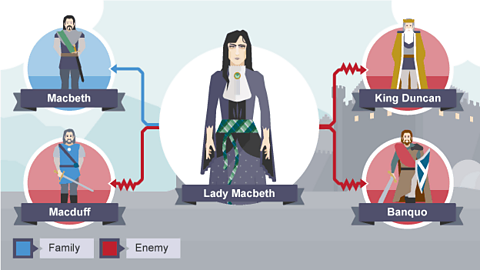
Lady Macbeth
Lady Macbeth’s behaviour would have seemed shocking to an audience in Shakespeare’s day. She pushes her husband around. She is hungry for power. She asks evil spirits to make her more like a man so that she can play her part in killing the king. The audience would have thought her behaviour was unnatural for a woman.
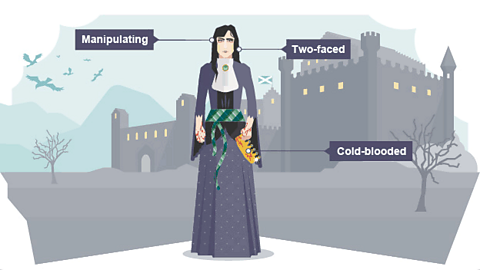
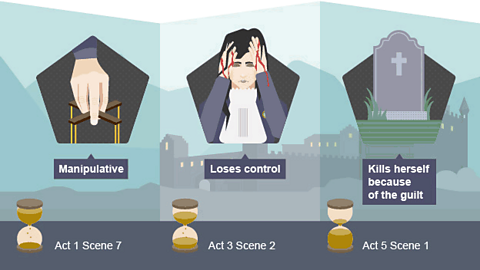
Image caption, Character attributes
Manipulating, two-faced and cold-blooded
1 of 3
Character attributes
- Controlling – she knows her husband won’t want to murder the king so she manipulates him. She plans the murder and takes control of events when Macbeth loses the plot.
- Cruel – she is violent, cold-blooded and happy to be a part of the murder. She ridicules Macbeth when he won’t join in with her cold-blooded plans.
- Two-faced – she welcomes King Duncan warmly even though she plans his death. She advises Macbeth to be two-faced too.
Friends and enemies
Lady Macbeth is friends with:
Macbeth - they share a terrible secret and she supports him until her untimely end.Her enemies are:
Macduff, Banquo and King Duncan - no one threatens her directly. Although she helps to murder Duncan, they’re not her enemies; they just stand in the way of what she wants: the throne.
Changes in character
- Lady Macbeth makes fun of Macbeth for not having the courage to kill Duncan – but when it comes to it, she can’t kill him herself, and Macbeth has to do it.
- Although Lady Macbeth seems to be the one in control, in the middle of the play Macbeth begins to make decisions without her knowledge. She loses control.
- She starts off not caring about murder but in the end she goes mad with guilt. She starts sleep-walking and talking about Duncan’s murder in her sleep. In the end, she kills herself.
Character analysis
Question
How does Shakespeare show Lady Macbeth behaving in a controlling way?
Before Macbeth arrives back at the castle, Lady Macbeth worries that although he is ambitious, he isn’t nasty enough to kill King Duncan. Therefore she’ll have to talk him into it. She uses a A comparison made without using 'like' or 'as', eg 'sea of troubles' and 'drowning in debt'.pour my spirits in thine ear, as if what she has to say is like a potion that will make him do her bidding.
LADY MACBETH
Hie thee hither,
That I may pour my spirits in thine ear
Act 1 Scene 5
Question
How is Lady Macbeth shown to be two-faced?
She intends to get everyone’s trust by pretending to be innocent, whilst beneath it all, she and Macbeth are committing evil deeds together.
She advises Macbeth to:
LADY MACBETH
look like th’innocent flower,
But be the serpent under't.
Act 1 Scene 5
Question
How is Lady Macbeth shown to be cruel, cold-blooded and violent?
Lady Macbeth says that she knows how nice it is to feed a baby and love it, but she would bash the baby’s brains in if she’d promised Macbeth that she was going to do it… and so she says Macbeth should kill the King, because he promised her. Is it a persuasive argument? Or just a frightening one? Whatever, it seems to work.
In trying to persuade Macbeth to murder the King, she tells him:
LADY MACBETH
I have given suck and know
How tender 'tis to love the babe that milks me:
I would, while it was smiling in my face,
Have plucked my nipple from his boneless gums
And dashed the brains out, had I so sworn
As you have done to this.
Act 1 Scene 7
Did you know? Lady Macbeth’s suggestion of bashing the baby’s brain out is horrifying isn’t it? There’s no mention in the play of whether the Macbeths have children or not, so there’s no evidence that she has actually murdered a baby in the past. But remember, back in Act 1 Scene 5, Lady Macbeth asked evil spirits to unsex her, ie take away all of her female traits. Surely this is the ultimate example of this. Lady Macbeth has no human sympathy at all. She is ready to kill the King.
In Act 5 Scene 1, Lady Macbeth is so disturbed by the murders that she and Macbeth have committed that she walks and talks in her sleep, giving far too much away. She is dreaming that there’s a spot of blood on her hand that won’t wash off. Her maid (Gentlewoman) is so worried, she has called the doctor.
LADY MACBETH
Yet here's a spot.
DOCTOR
Hark, she speaks; I will set down what comes from her tosatisfy my remembrance the more strongly.
LADY MACBETH
Out, damned spot! Out, I say! One, two. Why
then 'tis time to do't. Hell is murky. Fie, my lord, fie, a soldier,
and afeard? What need we fear? Who knows it, when none can call our power to
account? Yet who would have thought the old man
to have had so much blood in him?
DOCTOR
Do you mark that?
LADY MACBETH
The Thane of Fife had a wife. Where is she now?
What, will these hands ne'er be clean? No more o' that,
my lord, no more o' that. You mar all with this starting.
DOCTOR
Go to, go to; you have known what you should not.
GENTLEWOMAN
She has spoke what she should not, I am sure of
that. Heaven knows what she has known.
LADY MACBETH
Here's the smell of the blood still; all the
perfumes of Arabia will not sweeten this little hand. O, O, O.
DOCTOR
What a sigh is there! The heart is sorely charged.
GENTLEWOMAN
I would not have such a heart in my bosom for the
dignity of the whole body.
DOCTOR
Well, well, well,—
GENTLEWOMANPray God it be, sir.
DOCTOR
This disease is beyond my practise; yet I have known
those which have walked in their sleep who have died holily in their beds.
LADY MACBETH
Wash your hands, put on your night-gown, look not so
pale. I tell you yet again, Banquo's buried; he cannot come out on's grave.
DOCTOR
Even so?
LADY MACBETH
To bed, to bed; there's knocking at the gate.
Come, come, come, come, give me your hand; what's
done cannot be undone. To bed, to bed, to bed.
Question
How many murders does Lady Macbeth mention, in this exchange?
Duncan, Lady Macduff (the wife of the Thane of Fife) and Banquo. That’s three.
Question
Does the Doctor think he can cure her?
The Doctor says that he can’t cure her. He’s hinting that it’s her soul that needs help, not her body.
Banquo
Banquo is Macbeth’s best friend, and the Witches promise him that his descendants will be future kings of Scotland. This prediction puts him in mortal danger with Macbeth. Macbeth is so worried about losing the throne that he is willing even to kill his best friend in an attempt to cheat fate. Banquo reappears after his death as a disapproving ghost at Macbeth’s banquet.
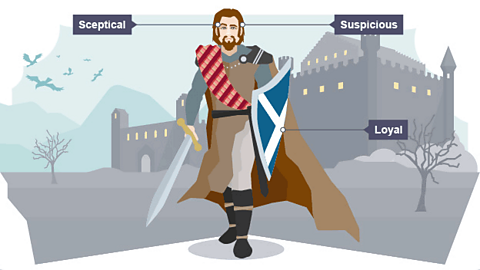
Image caption, Character attributes
Sceptical, suspicious and loyal
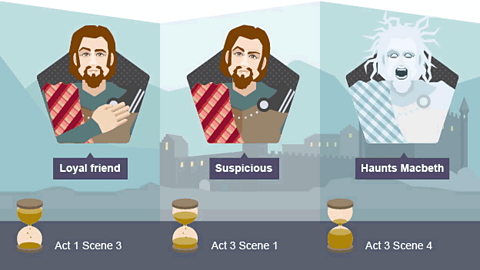
1 of 3
Character attributes
- Sceptical – he doesn’t trust the Witches’ predictions.
- Suspicious – he suspects Macbeth of murder and is worried about his own safety around his old friend.
- Loyal – he doesn’t tell anyone else about the Witches’ predictions, even when King Duncan is killed.
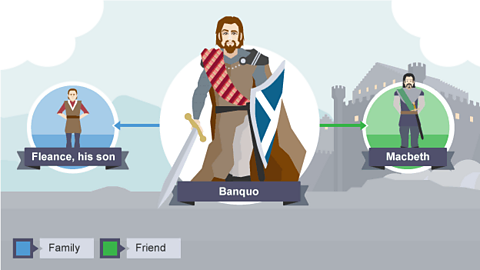
Friends
Banquo is friends with:
- Macbeth - is a great friend to begin with. They have fought bravely beside each other in battle. Macbeth doesn’t want to kill Banquo, but the Witches have said that Banquo’s children will be kings. This threatens Macbeth’s position as king. He sees Banquo’s murder as the only way to cheat fate.
- Fleance – his son.
Changes in character
- Banquo begins as Macbeth’s loyal friend, but he begins to suspect that Macbeth is up to no good after he becomes king.Alive, Banquo is a good man, but his ghost haunts Macbeth at the banquet, frightening him terribly. The ghost might not really be - - – Banquo, but a figment of Macbeth’s imagination.
- Banquo begins as a humble thane, but his descendants become kings of Scotland – leading down to King James himself.
Character analysis
Question
How does Shakespeare show that Banquo is sceptical?
Banquo warns Macbeth:
BANQUO
oftentimes, to win us to our harm,
The instruments of darkness tell us truths;
Win us with honest trifles, to betray’s
In deepest consequence.
Act 1 Scene 3
Banquo’s warning is a prediction in itself. This is what happens to Macbeth. Some of the predictions come true, so Macbeth is taken in even more by the Witches, and this leads to his eventual destruction. In plays, this kind of innocent insight into the future events of the play is called dramatic irony.
Question
Where do we see Banquo becoming suspicious of Macbeth?
Banquo thinks to himself that Macbeth played‘st most foully (Act 3 Scene 1) for the throne.
Banquo has good reason to suspect Macbeth of murder. He knows that the Witches’ predictions would have given Macbeth a motive for murdering King Duncan.
Question
Is Banquo a loyal character?
Banquo is loyal to Macbeth until his death. He is also more loyal to Duncan than Macbeth is.
Minutes before Macbeth murders the King, he makes a vague promise to Banquo:
MACBETH
If you shall cleave to my consent, when ‘tis,
It shall make honour for you.Act 2 Scene 1
Banquo replies that he will always be loyal to Macbeth as long as he’s not asked to do anything that goes against his heart and conscience. This puts him in direct contrast with Macbeth. The Witches made Banquo promises too, but he did nothing in response to those promises, so he seems far more noble than his friend.
In Act 3 Scene 1, Macbeth mulls over his personal reasons for having his good friend, Banquo murdered.
MACBETH
Our fears in Banquo
Stick deep, and in his royalty of nature
Reigns that which would be feared. 'Tis much he dares,
And to that dauntless temper of his mind,
He hath a wisdom that doth guide his valour
To act in safety. There is none but he,
Whose being I do fear; and under him
My genius is rebuked, as it is said
Mark Antony's was by Caesar. He chid the sisters
When first they put the name of king upon me
And bade them speak to him. Then prophet-like,
They hailed him father to a line of kings.
Upon my head they placed a fruitless crown
And put a barren sceptre in my gripe,
Thence to be wrenched with an unlineal hand,
No son of mine succeeding. If 't be so,
For Banquo's issue have I filed my mind;
For them, the gracious Duncan have I murdered,
Put rancours in the vessel of my peace
Only for them, and mine eternal jewel
Given to the common enemy of man,
To make them kings, the seeds of Banquo kings.
Question
Can you find words or phrases that tell you that Macbeth knows that Banquo is a respected and noble person?
Macbeth says that Banquo has a noble heart:
MACBETH
in his royalty of nature
Reigns that which would be feared.Act 3 Scene 1
Macbeth is afraid of Banquo’s goodness because he himself has done something that he knows would appal his friend.
Question
Does Macbeth think that Banquo is going to kill him?
Macbeth is fairly certain that Banquo won’t kill him. He says:
MACBETH
He hath a wisdom that doth guide his valour
To act in safety
Act 3 Scene 1
This means that Macbeth believes that Banquo won’t do anything rash and will tread carefully to keep himself safe. He still remains a threat though, and so do his children.
Macduff
Macduff is loyal to King Duncan, even after he is murdered. He loves Scotland and puts his family at risk to help raise an army to topple Macbeth’s Cruel and oppressive. rule. Macbeth kills his wife and young family. Macduff fights and kills Macbeth by To cut someone’s head off. him. True to the Witches’ prediction, he is "not of woman born". He was born by way of Caesarean section, so was not "born" in the normal sense of the word.
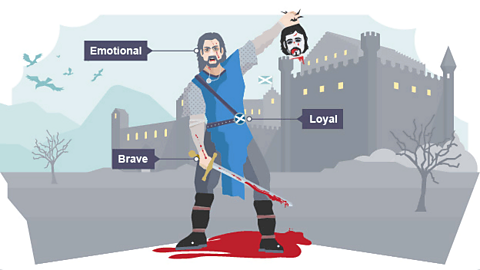
Image caption, Character attributes
Emotional; Brave; Loyal
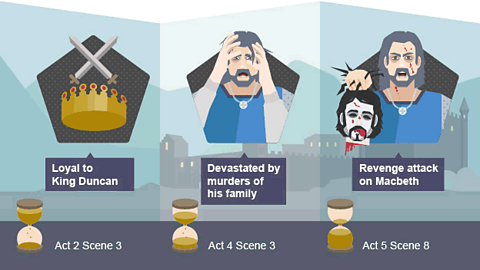
1 of 3
Character attributes
- Loyal – he risks his life and that of his family for his country.
- Emotional – when Malcolm tests his loyalty, he becomes very upset. He is devastated by the death of his family. He kills Macbeth in a rage of revenge.
- Brave – He fights fearlessly, even when Macbeth tries to warn him that he is invincible.
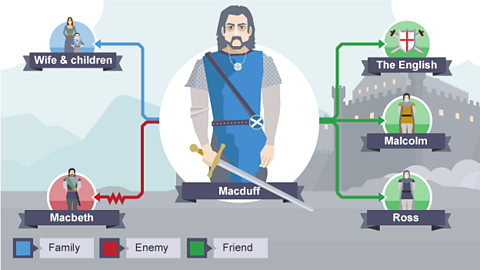
Friends, family and enemies
Macduff’s friends are:
- The English - the army help him topple Macbeth
- Malcolm – Macduff is determined to make him the rightful king
- Ross – is Lady Macbeth’s cousin but helps Macduff topple Macbeth
Macduff’s family include:
- Wife and family - killed by Macbeth
Macduff only has one enemy:
- Macbeth - Macduff suspects that Macbeth killed Duncan – he risks everything to raise the alarm against him
Changes in character
- Macduff is devastated when he finds Duncan’s body, but once he suspects Macbeth of murder he risks everything to raise an army against him.
- Although he begins as a loyal subject of Scotland, Macduff has nothing to lose in the end. Macbeth has taken everything from him. He is seething with bloody revenge and cuts off Macbeth’s head.
Character analysis
Question
How is Macduff shown to be loyal to his king and country?
He is prepared to risk his own life and those of his family to raise an army to topple Macbeth. He truly believed that Duncan was not only a good king, but saintly, in effect, next only to God.
MACDUFF
Thy royal father
Was a most sainted king
Act 4 Scene 3
Question
Is Macduff an emotional character?
Macduff feels guilty for leaving his wife and children unprotected. He can’t believe that heaven would look on and let it happen. Macduff is very human. He feels pain deeply. He had no choice but to try and save his beloved Scotland, and this sacrifice makes him noble.
When Macduff hears that his family has been killed, Malcolm tells him to be a man and fight. Macduff says:
MACDUFF
I shall do so;
But I must also feel it as a man
Act 4 Scene 3
Question
Is Macduff a brave character?
Although Macduff kills a king, just as Macbeth did, this is not considered a sin. Macbeth is a villain and took the throne by foul means. Macduff has already shown himself to be a noble God-fearing character, loyal to God’s chosen monarch. Macduff is prepared to fight to the death. He says if Macbeth should kill him "Heaven forgive him too". Act 4 Scene 3
He declares:
MACDUFF
Front to front
Bring thou this fiend of Scotland and myself
Act 4 Scene 3
In Act 5 Scene 8, Macduff and Macbeth face each other on the battleground.
MACDUFF
Turn, hell-hound, turn
MACBETH
Of all men else I have avoided thee,
But get thee back, my soul is too much charged
With blood of thine already.
MACDUFF
I have no words,
My voice is in my sword, thou bloodier villain
Than terms can give thee out.
[They fight]
MACBETH
Thou losest labour.
As easy mayst thou the intrenchant air
With thy keen sword impress as make me bleed.
Let fall thy blade on vulnerable crests;
I bear a charmèd life which must not yield
To one of woman born.
MACDUFF
Despair thy charm,
And let the angel whom thou still hast served
Tell thee, Macduff was from his mother's womb
Untimely ripped.
MACBETH
Accursèd be that tongue that tells me so,
For it hath cowed my better part of man;
And be these juggling fiends no more believed
That palter with us in a double sense,
That keep the word of promise to our ear
And break it to our hope. I'll not fight with thee.
MACDUFF
Then yield thee coward,
And live to be the show and gaze o’ th’ time.
We'll have thee, as our rarer monsters are,
Painted on a pole, and underwrit,
'Here may you see the tyrant.'
MACBETH
I will not yield
To kiss the ground before young Malcolm's feet
And to be baited with the rabble's curse.Though Birnam Wood be come to Dunsinane
And thou opposed being of no woman born,
Yet I will try the last. Before my body,
I throw my warlike shield. Lay on, Macduff,
And damned be him that first cries, 'Hold, enough!'
Question
Is Macbeth afraid of Macduff?
First of all, Macbeth won’t fight Macduff because he feels guilty about having murdered Macduff’s family and doesn’t want to take his life too. When he realises that Macduff is the one man who can harm him, for a moment he is a bit afraid. He says what Macduff has told him "hath cowed my better part of man". When Macduff calls him a "coward", he decides to fight anyway, even though he knows that he is going to die.
Question
What makes Macduff so sure that he will be able to kill Macbeth?
When Macbeth warns Macduff that he has a "charmèd life" and can’t be killed by any man born, Macduff tells him: "Macduff was from his mother's womb/Untimely ripped". This means that Macduff was born by Caesarean section, so wasn’t born in the usual sense of the word. Macduff is the one man that can harm Macbeth! The so-called charm was just a trick.
Additional characters
Three Witches
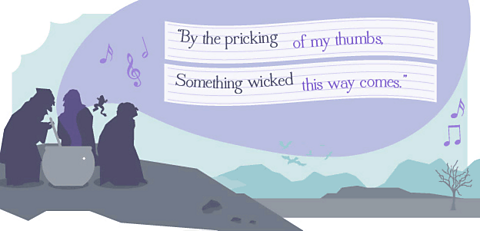
The Witches rhyme their way through the play causing mayhem wherever they can. They make promises to Macbeth that come with a heavy price. They use words cleverly to mislead Macbeth. They’re not pretty. Banquo mentions that they have beards.
When Macbeth greets the Witches he says:
MACBETH
How now, you secret, black, and midnight hags!
Act 4 Scene 1
Character attributes
- Evil
- Unearthly
Hecate
Hecate is the Witches’ mistress. She appears briefly to scold them for dealing with Macbeth without her say so. She thinks Macbeth is ungrateful and doesn’t deserve their help. She warns the Witches that she will set up illusions to confuse Macbeth and give him a false sense of security.
She says that Macbeth will:
HECATE
spurn fate, scorn death, and bear
His hopes 'bove wisdom, grace, and fear.
And you all know, security
Is mortals' chiefest enemy.
Act 3 Scene 5
Character attributes
- Controlling
- Merciless
Duncan - King of Scotland
He rewards Macbeth for his loyalty and Macbeth returns the favour by murdering him. Duncan is a good and popular king until his death.
Macbeth says:
MACBETH
Duncan
Hath borne his faculties so meek, hath been
So clear in his great office, that his virtues
Will plead like angels, trumpet-tongued against
The deep damnation of his taking-off.
Act 1 Scene 7
Character attributes
- Noble
- Trusting
Malcom
Malcolm is Duncan’s son and the heir to the throne. He runs away to England when his father is murdered. He returns with an army to retake the throne at the end.
He tests Macduff’s loyalty to him because he’s worried that Macduff is a spy. When Macduff finds out that his family has been killed, he says:
MALCOM
Dispute it like a man
Act 4 Scene 3
Character attributes
- Wary
- Unsympathetic
Donalbain
Donalbain is Duncan’s youngest son. He runs away to Ireland when his father is murdered.
He realises that he and his brother are in grave danger of being the next victims. He says:
DONALBAIN
There’s daggers in men’s smiles
Act 2 Scene 3
Character attributes
- Scared
- Wise
Lady Macduff
Lady Macduff is Macduff’s wife and Ross’s cousin. She is angry with Macduff when he leaves for England to raise an army because he has put his country before his family. When she is warned that she is in danger, she refuses to run away because she knows that she has done nothing wrong. Macbeth’s henchmen kill her child, and then kill her.
She tells Ross that unlike her husband, a woman would never leave her children, but would fight to protect them:
LADY MACDUFF
the poor wren,
The most diminutive of birds, will fight,
Her young ones in her nest, against the owl.
Act 4 Scene 2
Character attributes
- Resentful
- Proud
Son
The boy is Lord and Lady Macduff’s son. He is cheeky to his mum and obviously quite clever even though he is still very young. He defends his father’s reputation against Macbeth’s henchmen and they kill him.
When Macbeth’s henchman says that Macduff is a traitor, the boy says:
SON
Thou liest, thou shag-haired villain.
Act 4 Scene 2
Character attributes
- Cheeky
- Fearless
Lennox
A Scottish nobleman, Lennox comes with Macduff to fetch Duncan on the morning after the King is killed. He loses faith in Macbeth and suspects him of the murders fairly early on but cannot confront Macbeth. He sees Macbeth after the Witches’ final predictions. He has to tell Macbeth that Macduff has fled to England. He joins in the rebellion against Macbeth.
About deposing Macbeth and making Malcolm the new king, Lennox says:
LENNOX
dew the sovereign flower and drown the weeds
with as much of our blood as is necessary.
Act 5 Scene 2
Character attributes
- Two-faced
- Non-confrontational
Ross
Ross is a Scottish nobleman and Lady Macduff’s cousin. He brings Macbeth the news that Duncan has made him Thane of Cawdor. He tries to comfort Lady Macduff when her husband leaves for England. He has to tell Macduff the sad news that his family has been murdered. He joins Malcolm and the English army in toppling Macbeth towards the end.
When he has to tell Macduff that his family has been slaughtered he says:
ROSS
Let not your ears despise my tongue forever
Which shall possess them with the heaviest sound
Her young ones in her nest, against the owl.
Act 4 Scene 3
Character attributes
- Kind
- Tactful
Test yourself
More on Macbeth
Find out more by working through a topic
- count4 of 5
- count5 of 5
- count1 of 5
- count2 of 5