Key points about describing eating out
Use partitive articles to mean 'some' or 'any' when talking about food and drink.
Partitive articles are formed of the word de and the Means 'the'. Definite articles change depending on whether the noun it goes with is masculine, feminine, singular or plural..
This guide contains listening and reading activities as well as two video comprehensions.
Vocabulary - Food and drink
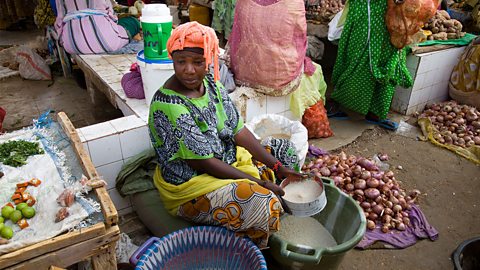
Useful nouns for describing food (Check your connection, refresh the page and try again.) include:
| French | English |
|---|---|
| Check your connection, refresh the page and try again. | chips |
| Check your connection, refresh the page and try again. | cheese |
| Check your connection, refresh the page and try again. | fruit |
| Check your connection, refresh the page and try again. | cake |
| Check your connection, refresh the page and try again. | ice-cream |
| Check your connection, refresh the page and try again. | vegetables |
| Check your connection, refresh the page and try again. | bread |
| Check your connection, refresh the page and try again. | fish |
| Check your connection, refresh the page and try again. | meat |
For example:
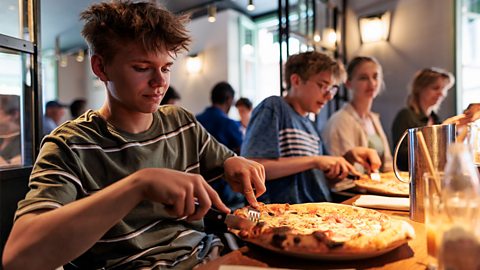
Le serveur a recommandé le poisson. - The waiter recommended the fish.
Il n’y a pas beaucoup de choix pour les entrées. - There is not a lot of choice for the starters.
Useful nouns for describing drinks (Check your connection, refresh the page and try again.) include:
| French | English |
|---|---|
| Check your connection, refresh the page and try again. | coffee |
| Check your connection, refresh the page and try again. | hot chocolate |
| Check your connection, refresh the page and try again. | cola |
| Check your connection, refresh the page and try again. | water |
| Check your connection, refresh the page and try again. | fruit juice |
| Check your connection, refresh the page and try again. | milk |
| Check your connection, refresh the page and try again. | tea |

For example:
Comme boisson, j’aime le thé noir. - I like black tea as a drink.
Je bois du lait avec mon petit déjeuner. - I drink milk with my breakfast.

Did you know?
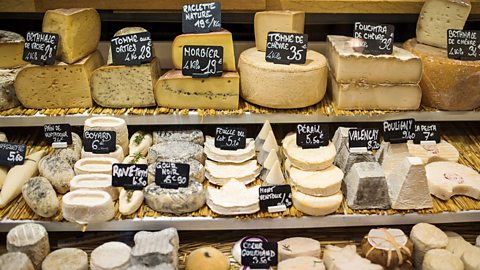
There are hundreds of different types of cheese in France – some say over a thousand!
Grammar - Using partitive articles
When talking about food and drink, you can use one of the following:
the indefinite article un or une - 'a' or 'an'
the definite article le, la, l’, les - 'the'
the partitive article du, de la, des, de l’ - 'some' or 'any'.
For example:
Chaque jour, je bois un café au lait. – Every day I drink a white coffee.
Les glaces ici sont trop bonnes. – The ice-creams here are too good.
Partitive articles
‘Some’ and ‘any’ are partitive articles and are used to refer to an unknown quantity of something.
In French, the partitive article is formed with de (‘of’) and the definite article (‘the’).
The partitive article changes depending on whether the The name of a thing such as an object, a place or a person. Nouns are often described as naming words. it goes with is masculine, feminine, starts with a vowel or a silent 'h' or is plural.
| masculine | feminine | before a vowel or silent 'h' | plural |
|---|---|---|---|
| de + le → du | de la | de l' | de + les → des |
Partitive articles are often used to talk about food and drink, with verbs including:
| Verb in the infinitive | English | Example | English |
|---|---|---|---|
| Check your connection, refresh the page and try again. | to eat | Je mange du poulet. | I eat (some) chicken. |
| Check your connection, refresh the page and try again. | to drink | Elle a bu de l’eau. | She drank (some) water. |
| Check your connection, refresh the page and try again. | to take/have | On va prendre des boissons. | We are going to take (some) drinks. |
| Check your connection, refresh the page and try again. | to do | J’ai fait des gâteaux. | I made (some) cakes. |
| Check your connection, refresh the page and try again. | to have | Nous avons de la glace pour ce soir. | We have (some) ice cream for tonight. |
| Check your connection, refresh the page and try again. | to prepare | Ils ont préparé du poisson. | They have prepared (some) fish. |
| Check your connection, refresh the page and try again. | to buy | Je voudrais acheter du fromage. | I would like to buy (some) cheese. |
Using 'de' after a verb in the negative
When using negative expressions such as ne … pas (not any), ne … jamais (never), use de without the definitive article (le, la, l’ or les).
Using 'de' after expressions of quantity
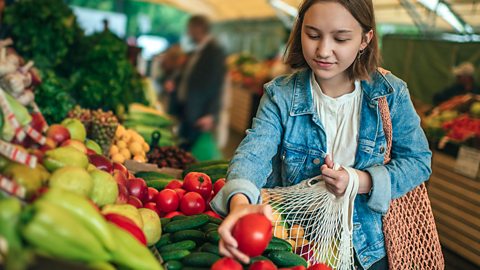
With expressions of quantity such as beaucoup de (a lot of), trop de (too much), plus de (more), de is not followed by an article (le, la, l’ or les).
For example:
Il y a beaucoup de légumes au marché. – There are a lot of vegetables in the market.
J’ai bu trop de café aujourd’hui. – I have drunk too much coffee today.
Partitive articles - Mini quiz
Choose the correct partitive article to complete the following sentences
Je vais manger [des / les / d'] fruits.
Je vais manger des fruits.
I am going to eat some fruit.
Fruits is a plural noun and so des is used.
Ma mère ne boit pas [de l' / l' / du] alcool.
Ma mère ne boit pas d’alcool.
My mum doesn’t drink alcohol.
Use d’ after a negative expression and in front of a noun starting with a vowel.
J’adore [de le / le / du / des] fromage suisse.
J’adore le fromage suisse.
I love Swiss cheese.
Use the definite article le after a verb of preference and in front of a singular, masculine noun.
Find out more about partitive articles in the Partitive articles in French guide.
Listening practice
Listen to the extracts of a waitress explaining different options on the menu and choose the correct option. You will not need all the options.
Vocabulary - Eating out preferences
Useful phrases for describing food and drink preferences include:
| French | English |
|---|---|
| Je n’aime pas trop manger du fast-food en vacances. | I don’t really like eating fast food on holiday. |
| Je cherche toujours un restaurant végétarien. | I always look for a vegetarian restaurant. |
| Ma nourriture préférée en vacances, c’est la glace. | My favourite food on holiday is ice cream. |
| Il n’y a pas souvent beaucoup de choix pour les végans. | There is not often a lot of choice for vegans. |
| Comme boisson, je prends de l’eau. | As a drink, I have water. |
| Ma mère a bu du vin rouge avec l’entrée. | My mum drank red wine with the starter. |
| On boit du thé ou du café au lait après le dîner. | We drink tea or coffee with milk after dinner. |

People eat in different places on holiday, for example:
Nous avons réservé une table dans un restaurant. - We booked a table in a restaurant.
Il faut essayer ce petit café pour le déjeuner. - You must try this little café for lunch.
All Foundation Tier vocabulary listed in this guide can be found on the vocabulary sheet below.
Reading practice
Look at the following adverts, then read the reviews and work out which restaurant each reviewer went to.
Advert A - Bistrot de Paris
Cuisine française de campagne.
Inspirée des recettes de nos grands-mères.
Vins de Pays.
Menu déjeuner rapide: 15 euros
Advert B - La Chine en France
Pour goûter* à la meilleure cuisine chinoise.
Spécialités véganes.
Cuisine traditionnelle !
*goûter - to try (food), to taste

Advert C - Le Petit Bateau
Poisson frais, frites à emporter.
Restaurant à cinquante places.
Situé près du port.
Advert D - Chez Luigi
La meilleure pizza végétarienne de la région - selon les journaux !
Sur place ou à emporter.
Reviewer 1
Comme je ne mange ni viande ni fromage, ce n’est pas toujours facile à trouver un bon restaurant ici.
Cependant, hier j’ai mangé dans le nouveau restaurant chinois et c’était parfait. Je recommanderais ce restaurant à tout le monde.
The answer is B - La Chine en France
… hier j’ai mangé dans le nouveau restaurant chinois … - Yesterday, I ate at the new Chinese restaurant.
Reviewer 2
Je suis allé dans ce restaurant, mais il n’y avait pas de place. Ce n’était pas un problème – j’ai emporté mon repas pour manger chez moi.
Je n’ai jamais mangé une pizza aux légumes aussi bonne. Cinq étoiles.
The answer is D - Chez Luigi
J’ai emporté mon repas pour manger chez moi. Je n’ai jamais mangé une pizza aux légumes aussi bonne. - I took my pizza away to eat at home. I have never eaten a vegetable pizza as good.
Reviewer 3
Mes copains et moi, nous avons mangé dans ce restaurant récemment. On a beaucoup apprécié la vue sur la mer en mangeant.
J’ai mangé trop de frites ! Elles étaient vraiment super bonnes. L’idéal.
The answer is C - Le Petit Bateau
On a beaucoup apprécié la vue sur la mer en mangeant. J’ai mangé trop de frites ! - We really appreciated the sea view whilst eating. I ate too many chips!
Reviewer 4
Il faut dire que le prix à midi n’est pas du tout cher. Si vous aimez les plats français du passé, vous allez adorer ce restaurant. La carte des vins est excellente aussi. Compliments aux chefs !
The aswer is A - Bistrot Blanc
Si vous aimez les plats français du passé, vous allez adorer ce restaurant. - If you like French dishes from the past, you are going to love this restaurant.
Video comprehension
Watch the video of Michel and Amélie discussing what they eat and answer the questions below.
Michel and Amélie discuss what they like and don't like eating
Now have a go at answering the following questions.
Click or tap on Show more to read a transcript and translation.
Amélie - J’ai faim… tu as faim?
Michel - Oui… un peu… j’ai faim.
Amélie - Qu’est-ce que tu aimes manger ?
Michel - J’aime manger les hamburgers et les frites, mais j’aime manger aussi les légumes, j’aime les carottes et les petits pois. Et toi ? Qu’est-ce que tu aimes manger ?
Amélie - Je ne mange pas de viande parce que je suis végétarienne.
Michel - Alors, que manges-tu ?
Amélie - Pour le petit déjeuner je mange des céréales ou des oeufs et je bois du thé. Et toi ? Qu’est-ce que tu manges pour le petit déjeuner ?
Michel - Pour le petit déjeuner, je mange du pain grillé avec de la confiture et je bois du jus d’orange. Pour le déjeuner je mange une pizza ou des pâtes. Et toi ? Qu’est ce que tu manges pour le déjeuner ?
Amélie - Normalement, je mange des pâtes aussi. Et pour le dîner ?
Michel - Aujourd’hui pour le dîner je vais manger du curry et du riz.
Amélie - Il y a des choses que tu ne manges pas ?
Michel - Je ne mange pas de poisson parce que ça pue! Il y a des choses que tu ne manges pas ?Amélie - Je n’aime pas manger des frites parce qu’elles sont mauvaises pour la santé. Je suis végétarienne parce que, à mon avis, c’est meilleur pour la santé et meilleur pour la planète ! Mais j’adore le chocolat. Je ne suis pas végane !
Michel - Tout le monde adore le chocolat !
Amélie - Merci beaucoup!
Translation:
Amélie - I’m hungry… are you hungry?
Michel - Yes, I’m a bit hungry.
Amélie - What do you like to eat?
Michel - I like to eat hamburgers and chips, but I like to eat vegetables too, I like carrots and peas. And you? What do you like to eat?
Amélie - I don’t eat meat because I’m vegetarian.
Michel - So what do you eat?
Amélie - For breakfast I eat cereal or eggs and I drink tea. And you? What do you eat for breakfast?
Michel - For breakfast, I eat toast with jam and I drink orange juice. For lunch I eat pizza or pasta. And you? What do you eat for lunch?
Amélie - Usually I eat pasta too. And for dinner?
Michel - Today for dinner, I’m going to eat curry and rice.
Amélie - Are there things that you don’t eat?
Michel - I don’t eat fish because it stinks! Are there things that you don’t eat?
Amélie - I don’t like eating chips because they are bad for your health. I’m vegetarian because, in my opinion, it’s better for your health and better for the planet! But I love chocolate. I’m not vegan!
Michel - Everyone loves chocolate.
Amélie - Thank you very much!
Video comprehension - Favourite food
Watch the short video of Bilal, a Chelsea Football Club academy player, talking about his favourite meal then answer the question.
Bilal talks about his favourite food
What does Bilal say is his favourite meal?
Salad, pasta and rice and yoghurt and fruit.
Pour commencer, un peu de salade, après des pâtes avec du riz et finalement un yaourt avec des fruits.
To start a bit of salad, afterwards some pasta and rice and finally a yoghurt with fruit.
Vocabulary sheet
Click or tap on the image below for a list of useful vocabulary to use when talking about eating out.

Higher Tier - Vocabulary - Food preferences
Useful vocabulary and phrases include:
| French | English |
|---|---|
| le poulet | chicken |
| J’adore la cuisine chinoise. | I love Chinese cooking. |
| Mes parents veulent manger les plats traditionnels de la région. | My parents want to eat the traditional dishes of the region. |
| Mon frère préfère un repas qu’il connaît, comme du poulet avec des légumes. | My brother prefers a meal he is familiar with, like chicken with vegetables. |
| Nous aimons commander du poisson et des frites à emporter. | We like to order fish and chips to take away. |
| Les touristes apprécient le pain et le fromage en France. | Tourists appreciate the bread and the cheese in France. |
All Higher Tier vocabulary listed in this guide can be found on the vocabulary sheet below.
Higher Tier - Grammar - Using 'de' before nouns
When using negative expressions such as ne … plus (no more), use de without an article (le, la, l’ or les).
For example:
Il n’y a plus de lait. - There is no more milk.
Remember that before a vowel or a silent h, de becomes d’.
Partitive articles with uncountable nouns
Countable nouns are objects that can be counted, such as ‘brother’. You can say 'I have one brother' or 'I have two brothers'.
Uncountable nouns are nouns that cannot be counted, such as ‘water’, and they are usually in the singular form.
For example, you can’t say “I am going to drink two waters”, you need to say “I am going to drink some water”.
The partitive articles ‘some’ and ‘any’ need to be used with uncountable nouns.
This is the same in French. Use de, de la or de l’ with uncountable nouns to mean ‘some’ or ‘any’.
For example:
Je vais manger du chocolat. – I am going to eat some chocolate.
Tu as de l’eau ? – Do you have any water?
Higher Tier - Vocabulary sheet
Click or tap on the image below for a list of Higher Tier useful vocabulary to use when talking about eating out.
Now you have learned about describing eating out, have a look at the Describing countries and their features in French guide.
Revise for your exams with BBC Bitesize
Get ready for the GCSEs with quizzes, past papers, flashcards, podcasts and more resources!

More on Travel, tourism and places of interest
Find out more by working through a topic
- count1 of 5

- count2 of 5