Kwame Alexander's book The Crossover is about twin basketball players called Josh and Jordan. Josh uses the sport as a way of thinking about himself and his relationships with his family and friends.
It can also help us learn about:
how to tell a story in verse and what that means
effects created by how writing appears on the page
how rhyme and rhythm work with the themes of what we're writing about
Title and cover
It's not always a bad idea to judge a book by its cover - and its title. Writers choose their titles very carefully to tell readers what to expect when they open the book.
For The Crossover, Kwame Alexander has used the name of a basketball move for his title. A crossover is where the player switches the ball quickly from one hand to the other, often to trick their opponent into thinking they're going to pass it in the opposite direction.
Activity 1 - Cover
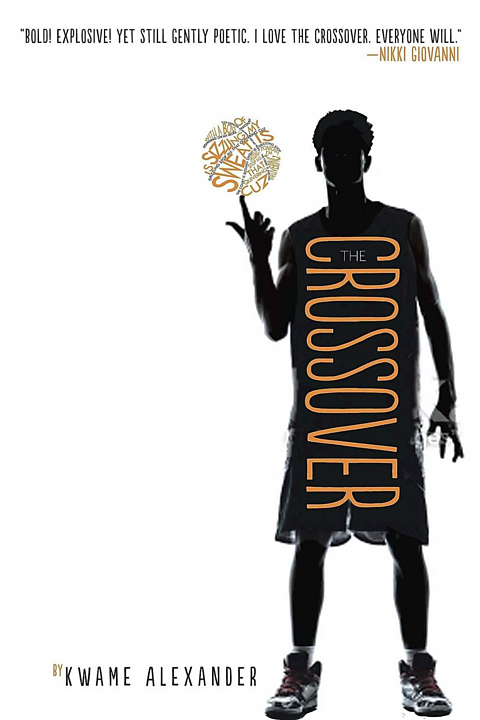
Think about the title, and the above cover illustration of Kwame Alexander's The Crossover.
Why would the author choose the name of a tricky basketball move for this book?
Why has the designer of this cover made the basketball out of words?
What do you think this tells us about what is in the book? What do you expect from this cover and title?
What's the story?
The Crossover is the story of Josh and Jordan Bell, basketball-playing twins, and how their lives play out both on and off the court.
Basketball is used as an Metaphors are a way of describing something by directly comparing it to something else. An extended metaphor takes this comparison and builds it over several paragraphs or poems, so it becomes a theme of the piece of writing. throughout the book for the different situations the boys find themselves in, and particularly at crucial moments in the story.
Watch Kwame read from The Crossover on Authors Live:
Kwame reads from The Crossover
So I'll read about Josh and JB, twin brothers, you can tell them apart because Josh has long hair and JB has no hair.And one day this happens.
The Bet, Part One.
We’re down by sevenat halftime.Trouble owns our facesbut my Coach isn’t worried.Says we haven’t found our rhythm yet.Then, all of a sudden, out of nowheremy best friend Vondie starts dancing the Snake,only he looks like a seal.Then Coach blasts his favorite dance music,and before you know itwe’re all doing the Cha-Cha Slide.JB high-fives me, with a familiar look.You want to bet, don’t you? I ask.Yep, he says,then touchesmy hair.
If my hair were a treeI’d climb it.I’d kneel down beneathand enshrine it.I’d treat it like goldand then mine it.Each day before schoolI unwind it.And right before gamesI entwine it.These locks on my head,I designed it.And one last thing ifyou don’t mind it:That bet you just made?I DECLINE IT.
The Bet. Part Two
IF. I. LOSE.THE. BET.YOU. WANT. TO.WHAT?If the score gets tied, he says, andif it comes down to the last shot, he says, andif I get the ball, he says, andif I don’t miss, he says,I get to cut offyour hair.Sure, I say, as seriousas a heart attack.You can cut my locks off,but if I win the betyou have to walk aroundwith no pants onand no underweartomorrowin schoolduring lunch.Vondieand the restof the fellaslaugh like hyenas.Not to be outdone,JB revises the bet:Okay, he says.How about if you loseI cut one lockand if you winI will moonthat nerdy groupof sixth-gradersthat sitnear our tableat lunch?Even though I used to be one of those nerdy sixth-graders,even though I love my hair the way Dad loves Krispy Kreme,even though I don’t want us to lose the game,odds are this is one of JB’s legendary bets I’ll win,becausethat’s a lot of ifs.
The game is tiedwhen JB’s soft jumper sailstickthrough the air.tockThe crowd stills,tickmouths drop,tockand when his last-second shottickhits net,tockthe clock stops.The gym explodes.Its hard bleachersemptyand my headaches.
after the game,JB cackles like a crow.He walks up to megrinning,holds his hand outso I can seethe red scissors from Coach’s desksmiling at me, theirsteel blades sharpand ready.I love this gamelike the winter loves snoweven though I spentthe final quarterin foul troubleon the bench.JB was on fireand we wonand I lostthe bet.
Time to pay up, Filthy, JB says,laughingand wavingthe scissorsin the airlike a flag.My teammates gather aroundto salute.FILTHY, FILTHY, FILTHY (FILTHY, FILTHY, FILTHY)He opens the scissors,grabs my hairto slash a strand.I don’t hearmy golden lockhit the floor,but I do hearthe soundof calamitywhen Vondiehollers,OH, SNAP!
Calamity,An unexpected,undesirable event;often physically injurious.As in: If JB hadn’t been actingso silly andplaying around,he would have cutone lockinstead of fivefrom my headand avoidedthis calamity.As in: The HUGE bald patchon the sideof my headis a dreadfulcalamity.As in: After the gameMom almost has a fitWhen she sees my hair,What a calamity, she says,shaking her headand telling Dad to take meto the barber shopon Saturdayto have the restcut off.
What is a verse novel?
The Crossover is a verse novel.
Novels, or fiction books, are usually written in what is called A type of spoken or written language that has no rhythm or rhyme..This means that the text isn't deliberately trying to include Rhythm can be described as the beat and pace of a poem. Rhythm is created by the pattern of stressed and unstressed syllables in a line or verse. or When words have the same sound e.g. cat/hat or line/sign. throughout. (This article is written in prose!)
A verse novel, on the other hand, is a novel that does make use of poetic forms, rhythms and rhymes.
Kwame talks about poetry and why it's different to tell a story in this way
Poetry is the right words in the right order.So you're not just putting down words, you're choosing the right words that are going to work. And then the words have to be in the correct order. And then you're getting rid of the words that don't need to be there. And then in addition to that, you've got to have your, your, your simi, simi - similes. Right. And you've got to have your meta (phors!) say it like you mean it, meta- (phors!) You've got to have your metaphors. You’ve got to have your alliter- ation and you got to have your hyper- bole. I mean, you got to have all these themes that you're thinking about and it's still a novel, so you're still trying to tell a stor- (y!) with a beginning, middle and… (end). So you're still doing all this stuff and you're only using a very few words to do that.
It's the hardest thing to do, but it's easy for me because I'm a genius. Yeah.
Sight and sound
Each scene or event in The Crossover is presented in a single poem:
Some using common poetic structures like a form of poem, three lines long, using 17 syllables. The first line contains five syllables, the second line, seven syllables, and the third line five syllables. and A pair of lines that rhyme. (where two lines of poetry rhyme). Others are in Poetry that doesn't have an intentional rhythm or rhyme, but instead can sound more like speech, or use rap rhythms. You can learn more about how to rap here.
Writing The Crossover in a wide variety of verse forms means that each individual poem can have a different effect on the reader. This allows Kwame Alexander to experiment with How an author shows their feelings, or their character’s feelings about something. For example, a happy, sad or excited tone., and include a wide range of emotions in the book. The sections where Josh is playing basketball are often very rhythmic, and full of action.
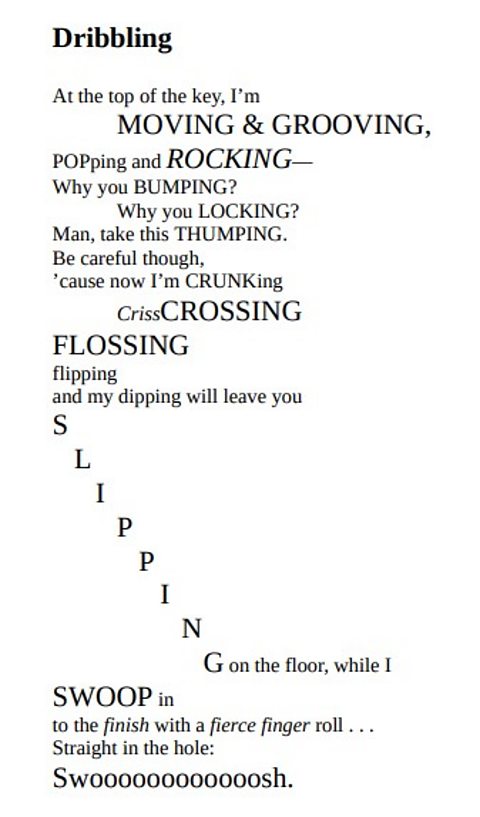
In this opening poem, called 'Dribbling', the words of the poem appear on the page in a way we might not expect.
When read aloud the sound of the words has a rhythm or a beat, because of the rhyme. Kwame has done this by using lots of A verb is a word used to describe an action (doing something) or state (being something). ending in '-ing', so it feels very active. This helps the reader imagine the pace and beat of basketball - players' steps hitting the court, dribbling and passing with a ball, different movements.
The use of UPPER-CASE letters tells us where words or syllables should be A stressed syllable is said louder or with extra emphasis than the other syllables in the word. and this helps us to find the intended rhythm of the poem when we read it aloud. We can also see that how the words are laid out on the page helps us imagine the action taking place in this scene.
Look at the word 'SLIPPING'. The way it is written as if slipping down the page mimics the opponent slipping down. It also encourages us to read it aloud more slowly, like a slipping movement. All of this adds to our complete picture of what is happening in the scene - images, sounds and actions.
Thinking about the rhythm of words and how they appear on the page as well as their meaning is a huge part of writing poetry.
Activity 2 - Find your rhythm
Think about one of your hobbies or something you like to do regularly. In The Crossover, it's basketball, but it could be anything - a sport, a craft, gaming, reading.
Think about the rhythm of any actions involved, maybe it's the thud of a ball, the scratch of a pen drawing on paper, or a knife chopping or spoon stirring while you cook.
How could you capture this movement in writing? What
You could:
Try making a few notes about the rhythms of your chosen activity. These can be sounds rather than actual words!
Think about word lengths and what kind of effect they have. For example, shorter words together, especially with lots of consonant sounds, can create a quick, tapping rhythm called The repetition of similar consonant sounds in nearby words..
Read aloud and listen to the sounds you've chosen. Techniques like When the beginning sound of words is repeated in nearby words. and When a word sounds like the word it is describing. For example, ‘buzz’ or ‘hiss’. can be very helpful in creating a rhythm and an atmosphere. (For example 'rat-a-tat-tat' is a short rhythm that sounds like knocking - this is onomatopoeia as it sounds like the action it's describing).
Think about line breaks and punctuation to create rhythm. For example, you could encourage readers to pause by putting in a A punctuation mark (,) indicating a pause between parts of sentence or separating items in a list. or a full stop. Like Kwame, could you use capital letters to emphasise certain parts?
Themes in The Crossover
Watch Kwame read from 'Who is Josh Bell?', one of the first poems in the book, where we are introduced to Josh, the The main character in a novel, film or play. of the story. Listen to the information he chooses to include and how Josh describes himself.
Kwame reads 'Who is Josh Bell?'
Josh Bell is my name. But Filthy McNasty is my claim to fame. Folks call me that ’cause my game’s acclaimed, so downright dirty, it’ll put you to shame. My hair is long, my height’s tall. I’m the next Kevin Durant, LeBron, and Chris Paul. 'Remember the greats', my dad likes to gloat, 'I balled with Magic and the GOAT'. 'But tricks are for kids', I reply. 'Don’t need your pets, my game’s so fly'.Mom says, 'Your dad’s old school, like an ol’ Chevette. You’re fresh and new, like a red Corvette. Your game's so sweet, it’s a crêpes suzette.' Each time you play, it’s ALL net.'Call me fresh and sweet, I’d burn mad as a flame. But I know she’s only talking about my game. See, when I play ball, I’m on fire. When I shoot, I inspire. The hoop’s for sale, and I’m the buyer.
The themes in The Crossover all work together, like players on a basketball team, or words in a sentence. They play with metaphor and combine to create a complete picture. Here are a few of the major themes that you'll notice as you go through the book:
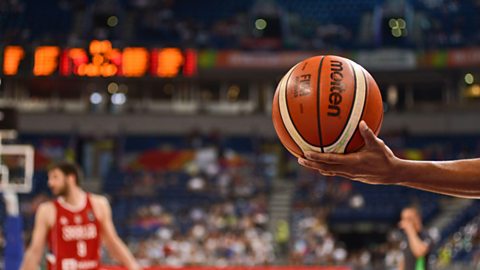
Image caption, Basketball is core to The Crossover
We find out that Josh and Jordan's dad was a famous basketball player, and his wise words of encouragement for on the court are also his life lessons for his sons. The book is broken up like a basketball game - the warm up, the four quarters, and overtime, so the reader is even immersed in the structure of a game from the beginning. (Mariano Garcia / Alamy Stock Photo)


1 of 3
The way these themes work together creates patterns of extended metaphor throughout the book.
In the poem 'Basketball Rule #1' this is made very clear in only a few short lines, but the ideas of basketball, family and talent continue to play off against each other for the rest of the story.
In this game of life
your family is the court
and the ball is your heart.
No matter how good you are,
no matter how down you get,
always leave
your heart
on the court.
Activity 3 - Your story in verse
Try and put together a short poem that brings together:
- the hobby, or thing you do regularly, you thought about in the last activity.
- the sounds you imagined that give us the rhythm of the action.
- how you feel doing this hobby, or what you're thinking about when you take part in it.
Here are some things you might use:
- use pieces of the sounds between lines of description - Kwame uses 'SWOOP' and 'Swooooooosh' as sounds that demonstrate the action.
- if you have a steady rhythm, you can think about how you might use that rhythm, but substitute words in its place. (The example we used earlier, 'rat-a-tat-tat' could become 'rat-a-tat-tat, playing the drums', because saying the words 'playing the drums' aloud has the same rhythm as 'rat a tat tat', but describes the action even further).
- how does this hobby or activity make you feel, or what are you thinking about when you take part in it? Are there sounds or rhythms that fit with that to help the reader understand?
This is just a first go, and it's meant to be fun, so it doesn't have to be perfect, finished, or even include all of these elements!
But if you're already thinking about sound, and action, and the rhythm of your words as well as their meaning, you're on your way to writing something special. Keep writing!
Hear more from Kwame
After Kwame's brilliant Authors Live event, pupils from Boclair Academy in Bearsden interviewed him with the help of the LAB team. Here are some more of his thoughts on being a writer.
Pupils from Boclair Academy interview Kwame Alexander
So, who are you. And what do you do?
Who are you? And what do you do? I'm Kwame. Nice to meet you.
And you are.?.. Evan. And?.. Imogen.
Very cool. I write books, I travel around the world speaking to kids, to young people about why books are cool. I think I'm the coolest guy to do that I love my job and I basically want to change the world. One word at a time.
Can you tell us about any books that inspired you, or that are similar to ones when you were younger?
When I was younger… I read a lot of books by poets, Nikki Giovanni and Lucille Clifton who are really dynamic poets. They wrote a lot of short, powerful poems and I think when I was three or four years old, my favourite poet was Dr Seuss who wrote some really cool book, 'Fox in Socks'. Socks in fox. Socks box knocks fox. I love that book! You should read it.
Can you tell us why you choose to write in verse about sport?
I think basketball is poetry in motion. I've always written in verse. I learned how to read by reading poetry. I think poetry is about the words that are on the page, but it's also about the words that aren't there and I find that to be pretty cool.
How do you respond to criticism?
Are you going to criticise me?
I don't think so!
I love criticism… and I hate it. I think it's important. If you're going to be better, you have to be able to take feedback, but I like criticism that is thoughtful. When I wrote 'The Crossover', the first review I got had two words in the review. Would you like to hear them? These were the two words. 'This sucks'. That was my first review ever for 'The Crossover'. That was a horrible review.
How do you feel when someone loves your book? How do you react?
How do I react… yeah, that's what I expected? And I'm also like… 'wow!' You know? And I'm also like, 'that's pretty cool'. And if it's a young person, it's the best feeling in the world. It's like, I don't care how many awards that I win the real reward is for a young person to say 'Hey. Hey, your book was cool, man'. That's… that's the best.
Thank you very much.Thank you.