Key points about the advantages and disadvantages of social media
Use comparative adjectives to compare different types of social media.
A verb that is usually followed by an infinitive, such as pouvoir (to be able to), vouloir (to want to), and devoir (must). can be used to say what you can, should or must do or what you should not do hen using social media.
This guide contains listening practice and a Higher Tier reading activity.
Vocabulary - Useful adjectives
Useful positive adjectives to describe the advantages of social media include:
| French | English | French | English |
|---|---|---|---|
| amusante | funny, fun, enjoyable, amusing | original | original |
| célèbre | famous | parfait(e) | perfect |
| étonnant(e) | surprising, amazing, incredible | populaire | popular |
| extraordinaire | extraordinary | positif/positive | positive |
| génial(e) | great, brilliant | préféré(e) | favourite |
| intéressant | interesting | utile | useful |
| nouveau/nouvelle | new | vrai(e) | true |

For example:
Je trouve les réseaux sociaux amusants et intéressants. - I find social media funny and interesting.
Useful adjectives to describe the negative aspects of social media include:
| French | English | French | English |
|---|---|---|---|
| dangereux/dangereuse | dangerous | mauvais(e) | bad, wrong |
| ennuyeux/ennuyeuse | boring | négatif/négative | negative |
| énorme | enormous | nul/nulle | rubbish, bad |
| faux/fausse | false | ordinaire | ordinary |
| fou/folle | crazy/wild | pire | worse, less well |
| grave | serious, important, grave | terrible | terrible |
For example:
À mon avis, les réseaux sociaux sont terribles. - In my opinion, social media is terrible.
Il y a des gens qui écrivent des commentaires fous. - There are people who write crazy comments.
Remember
You can use adjectives like these across different topics, so it’s worth learning some for your own speaking and writing.
For example:
J’adore le sport parce que c’est intéressant et positif. - I love sport because it’s interesting and positive.
Grammar - Comparatives
Comparing nouns
To compare two nouns, use the comparatives plus … que (more … than), moins … que (less … than) or aussi … que (as … as).
For example:
Cet influenceur est plus amusant que les autres. - That influencer is more amusing than the others.
Ton équipe est moins travailleuse que mon équipe. - Your team is less hard-working than my team.
Les blogs sont aussi populaires que les journaux. - Blogs are as popular as newspapers.
Remember
Adjectives need to agree with the first noun that is being compared.
For example:
Ma sœur est plus indépendante que moi. - My sister is more independent than me.
Sœur (sister) is feminine and singular, so indépendante needs an e.
Irregular comparatives
‘Better’ and ‘worse’ are irregular comparatives:
bon (good) → à meilleur (better)
mauvais (bad) → à pire (worse)
For example:
La chanson était meilleure en concert. - The song was better in concert/ live.
Ce groupe de musique est pire que l’année dernière. - This band is worse than last year.
Comparative adjectives – Mini quiz
Translate the following sentences into English.
Il est moins travailleur que toi.
He is less hard-working than you.
Elle est plus forte que moi.
She is stronger (more strong) than me.
Leur film récent était mieux.
Their recent film was better.
To find more about comparative adjectives have a look at the Comparatives and superlatives in French guide.
Listening practice
Listen to the podcast about social media and choose the correct option to complete each sentence below.
First, listen to Émilie, a 16-year-old from Martinique.
- Émilie believes social media to be …
| A | useful |
| B | great |
| C | funny |
The answer is C.
- She likes to …
| A | connect with friends |
| B | follow current celebrities |
| C | ost positive messages |
The answer is B.
Click or tap on Show more to read the transcript and a translation of what Émilie says.
Transcript
Je sais que ma mère pense que les réseaux sociaux ne sont pas géniaux ou utiles pour moi et mes amis.
Cependant, moi, je les trouve drôles.
J’aime suivre des célébrités actuelles et je trouve que leurs messages sont souvent positifs.
Translation
I know that my mum thinks that social media is not great or useful for me and my friends.
However, I find it funny.
I like following current celebrities and I find that their messages are often positive.
Now listen to Rahul, a 17-year-old from Marseille.
- According to Rahul, social media is …
| A | popular |
| B | original |
| C | interesting |
The answer is A.
- He says that his favourite influencer …
| A | is an important person |
| B | shares their real life |
| C | posts perfect photos |
The answer is B.
Click or tap on Show more to read the transcript and a translation of what Rahul says.
Transcript
C’est vrai que les réseaux sociaux sont populaires.
Par contre, beaucoup de gens célèbres ne sont pas très originaux ou intéressants.
Mon influenceuse préférée est une adolescente normale qui partage sa vie réelle.
Ses photos ne sont jamais parfaites et pour moi, c’est ça qui est important.
Translation
It’s true that social media is popular.
On the other hand, lots of famous people are not very original or interesting.
My favourite influencer is a normal teenager who shares her real life.
Her photos are never perfect and for me, that’s what is important.
Vocabulary - The advantages and disadvantages of social media
Useful phrases to describe the advantages of posting on social media include:
| French | English | French | English |
|---|---|---|---|
| suivre sa passion | follow one’s passion | apprendre de nouvelles compétences | learn new skills |
| gagner beaucoup d’argent | earn a lot of money | inspirer les autres | inspire others |
| avoir une carrière intéressante | have an interesting career | être un bon exemple pour les jeunes | be a good example for young people |
| avoir de l’influence culturelle | have some cultural influence | recevoir des messages positifs de ses fans | get positive messages from one’s fans |

All the phrases above can follow the modal verb on peut meaning ‘you can’.
For example:
Un avantage des réseaux sociaux, c’est qu’on peut gagner beaucoup d’argent. - One advantage of social media is that you can earn a lot of money.
Je veux suivre ma passion et inspirer les autres. - I want to follow my passion and inspire others.
Useful phrases to describe the disadvantages of posting on social media include:
| French | English |
|---|---|
| On peut perdre sa vie privée. | You can lose your private life. |
| On peut avoir des problèmes avec la sécurité en ligne. | You can have problems with online security. |
| Ce n’est pas bon pour sa santé mentale. | It is not good for your mental health. |
| Il y a des virus virtuels. | There are virtual viruses. |
All Foundation Tier vocabulary listed in this guide can be found on the vocabulary sheet below.
Grammar - Modal verbs
Modal verbs verbs indicate modality, ability, necessity, possibility, obligation and permission.
Modal verbs can work on their own, or with another verb that is always in the infinitive. Useful modal verbs in French include:
| French | English |
|---|---|
| devoir | to have to, must |
| pouvoir | to be able to, can |
| vouloir | to want |
| savoir | to know how to |
Click or tap on the Show more button to find out how to conjugate these key modal verbs and to see examples of how they can be used.
devoir - to have to, must
| French | English |
|---|---|
| Check your connection, refresh the page and try again. | I have to/I must |
| Check your connection, refresh the page and try again. | you have to/you must (singular, informal) |
| Check your connection, refresh the page and try again. | he/it has to/he/it must |
| Check your connection, refresh the page and try again. | she/it has to/she/it must |
| Check your connection, refresh the page and try again. | one has to/we have to/one must/we must |
| Check your connection, refresh the page and try again. | we have to/we must |
| Check your connection, refresh the page and try again. | you have to/you must (singular formal or plural) |
| Check your connection, refresh the page and try again. | they have to/they must (masculine or mixed) |
| Check your connection, refresh the page and try again. | they have to/they must (feminine) |
For example:
Je dois vérifier mes réseaux sociaux tous les jours - I have to check my social media every day.
pouvoir - to be able to, can
| French | English |
|---|---|
| Check your connection, refresh the page and try again. | I can/I am able to |
| Check your connection, refresh the page and try again. | you can/you are able to (singular, informal) |
| Check your connection, refresh the page and try again. | he/it can/he/it is able to |
| Check your connection, refresh the page and try again. | she/it can/she/it is able to |
| Check your connection, refresh the page and try again. | one can/one is able to |
| Check your connection, refresh the page and try again. | we can/we are able to |
| Check your connection, refresh the page and try again. | you can/you are able to (singular formal or plural) |
| Check your connection, refresh the page and try again. | they can/they are able to (masculine or mixed) |
| Check your connection, refresh the page and try again. | they can/they are able to (feminine) |
For example:
Je peux passer toute la journée en ligne. - I can spend all day online.
vouloir - to want
| French | English |
|---|---|
| Check your connection, refresh the page and try again. | I want |
| Check your connection, refresh the page and try again. | you want (singular, informal) |
| Check your connection, refresh the page and try again. | he/it wants |
| Check your connection, refresh the page and try again. | she/it wants |
| Check your connection, refresh the page and try again. | one wants/we want |
| Check your connection, refresh the page and try again. | we want |
| Check your connection, refresh the page and try again. | you want (singular formal or plural) |
| Check your connection, refresh the page and try again. | they want (masculine or mixed) |
| Check your connection, refresh the page and try again. | they want (feminine) |
For example:
Je veux lire les commentaires. - I want to read the comments.
You can also use the modal verb vouloir in the conditional tense to say what you would like to do.
For example:
Je voudrais un nouveau portable. - I would like a new phone.
savoir - to know, to know how to
| French | English |
|---|---|
| Check your connection, refresh the page and try again. | I know |
| Check your connection, refresh the page and try again. | you know (singular, informal) |
| Check your connection, refresh the page and try again. | he/it knows |
| Check your connection, refresh the page and try again. | she/it knows |
| Check your connection, refresh the page and try again. | one knows |
| Check your connection, refresh the page and try again. | we know |
| Check your connection, refresh the page and try again. | you know (singular formal or plural) |
| Check your connection, refresh the page and try again. | they know (masculine or mixed) |
| Check your connection, refresh the page and try again. | they know (feminine) |
For example:
Elle sait communiquer avec les adolescents. - She knows how to communicate with teenagers.
Mini quiz - Modal verbs
Translate the following sentences into French.
I must go online.
Je dois aller en ligne.
They can share some photos.
Ils/Elles peuvent partager des photos.
We want to see.
Nous voulons / On veut voir.
I know that it’s true.
Je sais que c’est vrai.
Find out more about using modal verbs in the Infinitives in French guide.
Vocabulary sheet
Click or tap on the image below for a list of useful vocabulary to use when talking about the advantages and disadvantages of social media.

Higher Tier - Vocabulary - Useful adjectives
| French | English |
|---|---|
| actuel(le) | current |
| global(e) | global |
| réel(le) | real |
| évident(e) | obvious |
| inquiétant(e) | worrying |
Disadvantages of social media
| French | English |
|---|---|
| On peut voler ton identité. | Your identity could be stolen. |
| Il faut être très prudent. | You have to be very careful. |
| Il faut surveiller ses followers. | You have to keep an eye on your followers. |
| Il y a un risque de harcèlement. | There is a risk of bullying/harassment. |
| On peut recevoir des critiques ou des menaces. | You can receive criticism or threats. |
| On peut être victime de cybercriminalité. | You can be a victim of cyber crime. |
All Higher Tier vocabulary listed in this guide can be found on the vocabulary sheet below.
Higher Tier - Grammar – Superlative adjectives
Use superlatives to say something is 'the most' or 'the least' 'interesting/exciting', 'the biggest/smallest' or 'the best/worst', and so on.
In French, use the definite article, (le/la/les) then plus or moins. The adjective must still agree with the noun.
For example, the superlatives of intéressant are:
| Masculine singular | Feminine singular | Masculine plural | Feminine plural |
|---|---|---|---|
| le plus intéressant | la plus intéressante | les plus intéressants | les plus intéressantes |
| le moins intéressant | la moins intéressante | les moins intéressants | les moins intéressantes |
Irregular superlatives
‘Best’ and ‘worst’ are irregular superlatives in French.
| Masculine singular | Feminine singular | Masculine plural | Feminine plural |
|---|---|---|---|
| le meilleur | la meilleure | les meilleurs | les meilleures |
| le pire | la pire | les pires | les pires |
For example:
Elle est la meilleure footballeuse dans l’équipe. – She’s the best football player in the team.
C’était le pire moment de l’année. – It was the worst time of the year.
Ce sont les meilleures danseurs au monde. – They are the best dancers in the world.
To find more about superlative adjectives have a look at the Comparatives and superlatives in French guide.
To find more about superlative adjectives have a look at the Comparatives and superlatives in French guide.
Higher Tier – Grammar – Modal verbs
To use modal verbs in the perfect tense, use the auxiliary verb avoir and the past participle of the modal verb.
| Infinitive | Past participle |
|---|---|
| Check your connection, refresh the page and try again. - to be able to | Check your connection, refresh the page and try again. - was able to |
| Check your connection, refresh the page and try again. - to have to | Check your connection, refresh the page and try again. - had to |
| Check your connection, refresh the page and try again. to want | Check your connection, refresh the page and try again. - wanted |
| Check your connection, refresh the page and try again. - to know how to | Check your connection, refresh the page and try again. - knew how to |
This construction is often followed by an infinitive.
For example:
Elle a dû essayer. - She had to try.
J’ai pu atteindre plus de gens. - I was able to reach more people.
Ils ont voulu créer une nouvelle marque. - They wanted to create a new brand.
J’ai su immédiatement. - I knew immediately.
Higher Tier - Reading practice
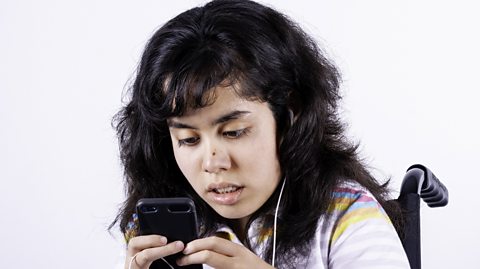
Read the article on the impact of social media on teenage mental health and complete the gaps in the sentences below with phrases in English to summarise the article.
Les études récentes ont montré que les réseaux sociaux peuvent avoir des effets inquiétants sur la santé mentale des adolescents.
Les experts pensent que certains sites encouragent les jeunes à se comparer avec les autres d’une façon négative. Beaucoup de célébrités savent présenter une image de leur vie qui est parfaite mais loin de la réalité.
Les jeunes qui veulent poster des photos en ligne risquent de recevoir des commentaires négatifs, ce qui est très grave pour leur bien-être.
Il y a aussi des problèmes énormes avec la quantité d’informations fausses et même dangeureuses que les gens partagent sur ces sites.
- Social media can have __________ on teenage mental health.
Social media can have worrying effects on teenage mental health.
- Certain sites encourage young people to __________ with others.
Certain sites encourage young people to compare themselves (negatively) with others.
- Many celebrities know how to present an image of their life which is __________
Many celebrities know how to present an image of their life which is perfect but far from reality.
- Young people who want to post photos online risk __________ which is bad for their well-being.
Young people who want to post photos online risk receiving nasty comments which is bad for their well-being.
- There are huge problems with the amount of __________ that people share on these sites.
There are huge problems with the amount of false and even dangerous information that people share on these sites.
Click or tap on Show more to read a translation.
Recent studies have shown that social media can have worrying effects on teenagers’ mental health.
Experts think that certain sites encourage young people to compare themselves with other in a negative way. A lot of celebrities know how to present an image of their life which is perfect but far from reality.
Young people who want to post photos online risk receiving negative comments, which is very serious for their wellbeing.
There are also huge problems with the amount of false and even dangerous information/news that people share on these sites.
Higher Tier - Vocabulary sheet
Click or tap on the image below for a list of useful Higher Tier vocabulary to use when talking about the advantages and disadvantages of social media.
Now you have revised the important vocabulary and key grammar points for describing the advantages and disadvantages of social media, why not have a look at the Describing relationships in French guide.
More on Social media and gaming
Find out more by working through a topic
- count1 of 2