Key points about Seven Seas of Rhye
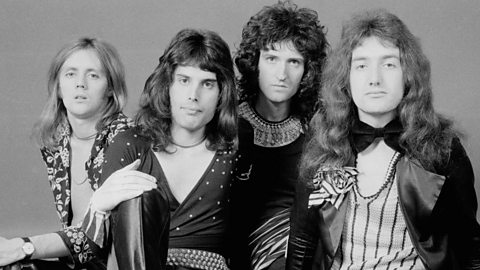
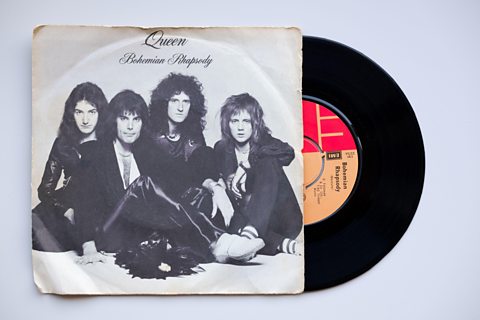
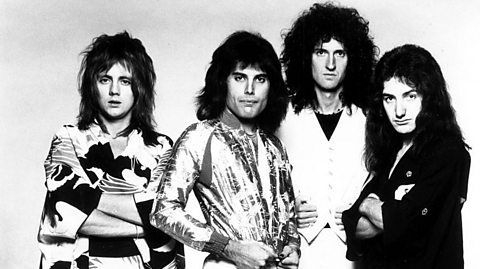
Queen were a well-known British rock band known for their close-harmony singing and guitar solos.
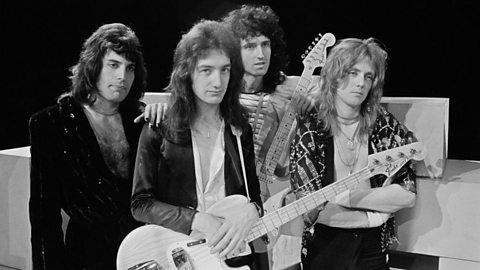
The four members of the band Queen were Freddie Mercury on lead vocals and piano, Brian May on lead guitar and vocals, Roger Taylor on drums and vocals and John Deacon on bass guitar.
Seven Seas of Rhye was mainly written by Freddie Mercury, with Brian May contributing the second middle eight. An initial instrumental version appears as the final track on the group’s self-titled debut album in 1973, with this version appearing on Queen II (1974).
Seven Seas of Rhye is a hard rock song.

Remember
The studio version of Seven Seas of Rhye, not the live version, is one of the three songs which are the study pieces for Area of Study 2 for your AQA GCSE listening exam.
The other two are:
Question and answer
What are the characteristics of a hard rock song?
fast tempo
strong vocal part which covers a wide vocal range
one or more electric guitars playing lead and/or rhythm parts
driving rhythms from the drum kit
electric bass which provides a strong backing
Video
Watch the video below to find out more about the structure, vocal, instrumental and other musical features of Queen's Seven Seas of Rhye.
Presenter: Seven Seas of Rhye is a track by Queen, one of the most successful rock bands of the 1970s. Written by lead singer Freddie Mercury in 1974, the song is about his imaginary fantasy land, the Kingdom of Rhye. Mercury wrote this song for piano, bass, electric guitar and drums. The song is in D major and 4/4 time. The piano introduction uses a syncopated three notes semiquavers pattern to add to the pace.
The structure is simple AABA, outro, and there are short bridges before and after the B section. Section A features a vocal melody accompanied by the band, so it has a homophonic texture.
Singer:Fear me you loathsome, lazy creatures, I descend upon your…
Presenter: The addition of a 2/4 bar and the chorus pushes the emphasis onto the name Rhye every time. Let's hear it.
Singer: Bring before me what is mine. The Seven Seas of Rhye.
Presenter: Section B modulates to B-flat major and features a guitar solo. Listen out for guitarist Brian May's typical techniques like slides and pitch bends. This section ends with the delay effect on the guitar, which repeats.
Take it away.
The song ends with four repeating chords and you can hear the band singing, 'oh, I do like to be beside the seaside'.
Singer: Oh, I do like to be beside the seaside. Oh, I do…
Presenter: They were accompanied by a stylophone, a mini analog keyboard invented in the late 60s. Adds some humor to the end of the track.
Singer: …where the brass bands play "Tiddely-om-pom-pom!"
Structure
The song includes different sections, including an introduction, verses, bridges and an instrumental.
There is no chorus in the Seven Seas of Rhye, instead there is a vocal hook sung at the end of each verse.
The song begins and ends in D major.
| Section | Bars and lyrics | Features |
|---|---|---|
| Introduction | 1-10 | D major - A two-bar riff is played on the piano |
| Verse 1 | 11-20 ‘Fear me you Lords’ | D major - Melody and accompaniment – the vocalist is accompanied by the band |
| Verse 2 | 11-19 and 21 ‘Can you hear me…’ | D major |
| Bridge 1 | 22-32 'Sister I live and lie for you' | D major |
| Instrumental solo | 33-38 | B flat major - The big guitar solo for Brian May. Returns to D major at the end of this section |
| Bridge 2 | 39-46 ‘Storm the master marathon’ | Modulates to G major |
| Verse 3 | 47-56 ‘Begone with you short and shady senators’ | D major |
| Final Instrumental | 57 onwards | D major to the end |
| Outro | ‘Tiddely-om-pom-pom!’ | The song “Oh I do like to be beside the seaside” is sung and also played on stylophone |
Vocal features
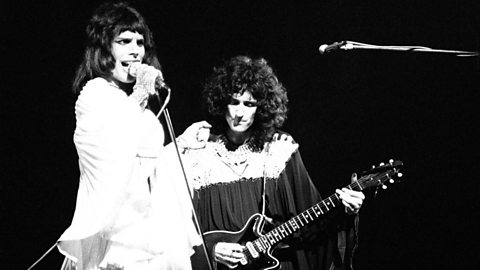
Freddie Mercury is the lead vocalist here and he sings by himself in verses 1 and 2.
The backing vocals enter in close harmony in Bridge 1 and enter into dialogue with Mercury. They also sing ‘aahh’ when Mercury takes over. The multi-layering of tracks creates the distinctive Queen sound.
In Bridge 2, ‘Storm the marathon,’ and in the final verse, the backing singers sing together with the vocalist with some of the harmony lines sitting above Mercury in pitch. Again, this is typical of Queen’s sound. There is great impact towards the end as Mercury is left to sing the final ‘I’ll take you to the seven seas of Rhye’ alone before the band re-enters.
Remember
In your exam you will be tested on the studio version of the song.
Question and answer
Which instrument features in the solo instrumental section?
The electric guitar is the solo instument.
Instrumental features
The Seven Seas of Rhye includes some important instrumental features.
The opening piano riff is Music based on arpeggios - where the notes of a chord are played in quick succession. and played in octaves. The semiquavers give the song a distinctive introduction.
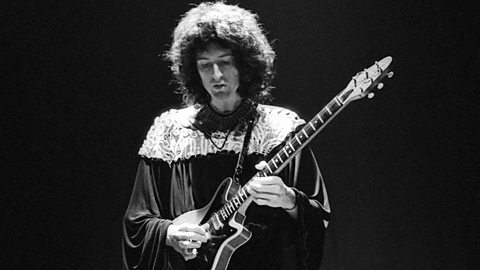
The solo guitar is virtuosic and as well as being high in the guitar, it uses techniques such as slides and pitch bends. The end of the solo features a delay effect. Palm-muting can also be heard in Bridge 1. This is when the side of the strumming hand is used to mute the notes being played. Vibrato, a wobble effect, can be heard in bar 6 of the introduction. Finally, power chords can be heard in the introduction. These are loud and distorted and give the music real energy and excitement.
A stylophone is used to play along with “Beside the Seaside” at the end of the song. This is a miniature analogue electronic keyboard which is played with a stylus.
In pictures: Queen's Seven Seas of Rhye
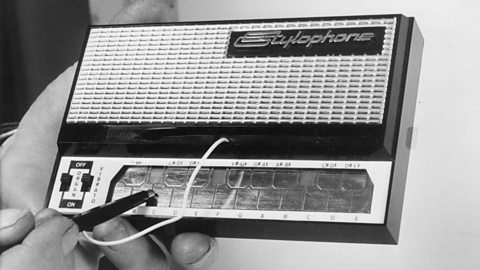
Image caption, A stylophone can be heard at the end of the song, playing “Beside the Seaside.”

1 of 5
Other musical features
| Feature | Description |
|---|---|
| Harmony | Most of the harmony is diatonic, with some occasional chromaticism. The arpeggiated piano introductions make the harmonies clear. In bridge 1, the first four chords ascend by step: D, Em, F#m, G major. The flattened 7th chord (C major) occurs when we hear ‘sister’ and ‘mister’. A tonic pedal is used in the final instrumental. |
| Melody | Verses 1 and 2 open with an arpeggiated piano riff. The phrase ‘the seven seas of Rhye’ is used as a melodic hook or refrain. Blue notes are sung in bridge 1 – the third and seventh degrees of the scale are flattened here. The guitar solo contains leaps and many scalic passages. |
| Texture | Most of the song is in a melody and accompaniment texture with some exceptions - the opening piano riff is in octaves in a unison texture, the backing singers sing in close harmony in a homophonic texture and at the end of the verses the band stops to allow the solo line ‘seven seas of Rhye’ to be heard above the reverb of the instruments. |
| Tempo and metre | The song is fast and lively. It is 4/4 but occasionally changes to 2/4, eg - at the end of the first verse before the hook. |
| Technology | We can hear overdubbing in the vocals and the multiple guitars. The lead vocal part is double-tracked in verse 3. Reverb and stereo panning are added to the vocal lines. The electric guitars use some light distortion. A delay effect is heard at the end of the solo, then feedback from the electric guitar. |
Question and Answer
What is a stylophone?
A stylophone is a miniature analogue electronic keyboard which is played with a stylus.
Seven Seas of Rhye quiz
More on Popular music
Find out more by working through a topic