Key points
- resistance is measured in ohms (Ω)
- resistors control current and protect components in electronic circuits.
- the coloured bands on a resistor is a colour coding system used to identify resistor values and tolerance levels (5% and 10%).
- the total resistance of resistors connected in series is calculated using the formula (\(\text R_\text t =\text R_1 + \text R_2\ldots+\text R_\text n\) )
What is resistance?
Resistance:
- is a measure of how much a component reduces the flow of electric current in a circuit
- It is measured in ohms (Ω)
- the higher the resistance, the less current flows through the circuit
- resistors are used to control the current and protect other components from damage. For example, they can be used to limit the current to an LED to prevent it from burning out
How to read a resistor's colour coding system
Resistors are too small to have their values printed on them, so a colour coding system is used. Each resistor has four coloured bands that represent its value and tolerance (how close the resistor's true resistance is to its labeled value). Here’s how to read them:
- First band: represents the first digit
- Second band: represents the second digit
- Third band: multiplier (the number of zeros to add)
- Fourth band: tolerance (accuracy of the resistor)
- Red: 2
- Violet: 7
- Yellow: Multiplier of 10,000 (\(10^4\))
- Gold: Tolerance of ±5%
This resistor has a value of 270,000 ohms (or 270 kΩ) with a tolerance of ±5%
How to calculate resistance in series
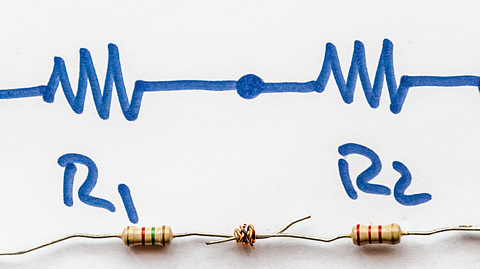
When resistors are connected in components connected end-to-end in a single loop, current flows through each component in turn, their resistances add up. The total resistance (\(\text R_\text t\)) is the sum of all individual resistances (\(\text R_1,\text R_2,\text R_3,\text R_4,\text R_5\) etc): \(\text R_\text t=\text R_1+\text R_2+\text R_\text 3+\text R_4+\text R_5\)…etc
For example, if you have three resistors in series with values of 1kΩ, 2kΩ, and 3kΩ, the total resistance would be: \(\text R_\text t = \text{1kΩ + 2kΩ + 3kΩ = 6kΩ}\)
Test yourself
More on Electronic control systems
Find out more by working through a topic
- count6 of 8
- count8 of 8