Fun fact!
How many times did JK Rowling rewrite the opening chapter of Harry Potter and the Philosopher’s Stone before it was published?
15 times!
Even best selling authors have to go back to their work and proofread and edit it before it is ready to be published.
Introduction to proofreading
Proofreading is an important stage in the writing process.
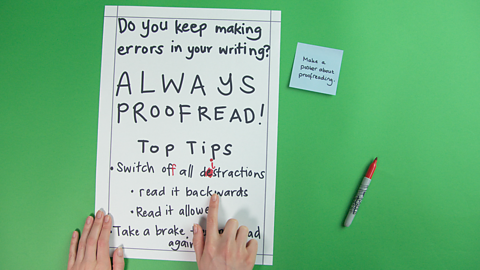
Proofreading means checking your work for errors in punctuation, spelling or grammar.
It is sometimes tricky to see errors in your own writing so proofreading can feel difficult.
How to proofread your writing
Find out how to proofread your writing to avoid errors
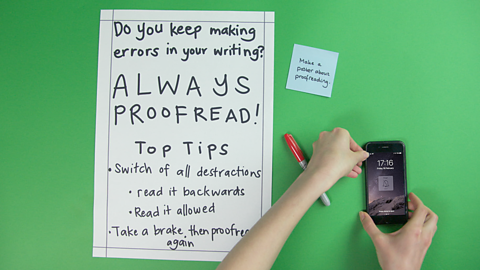
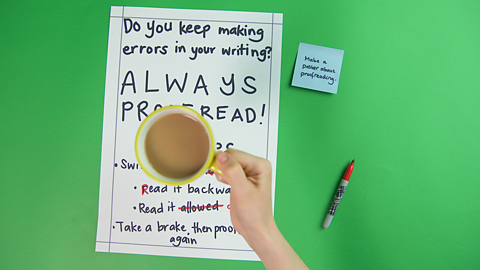
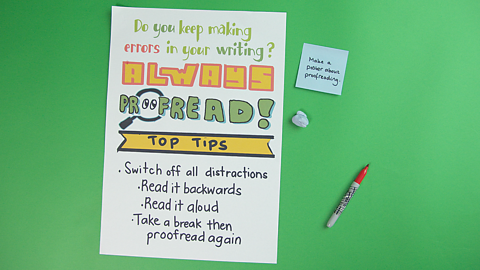
Make a poster about proofreading.
Do you keep making errors in your writing?
ALWAYS PROOFREAD
Top Tips
Switch off all distractions
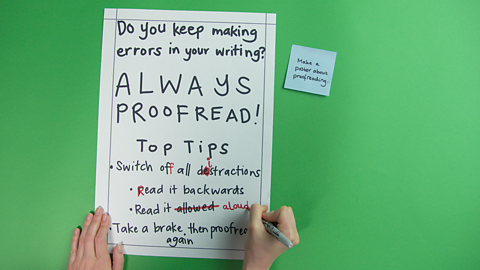
Read it backwards
Read it aloud
Take a break then proofread again
Step-by-step guide to proofreading
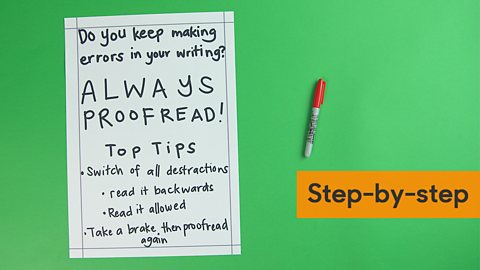
Image caption, Click to see a step-by-step slideshow.
1 of 6
Some proofreading strategies
Proofreading your writing is very important, but it is trickier than it sounds!
When you read your writing, your eye sometimes sees what should have been written, rather than what is actually on the page. This means that you need to find different ways of forcing yourself to spot any errors in your writing.
There are three great methods you can use whenever you are proofreading:
1. Read your writing aloud
The easiest way to proofread is to read your writing aloud. This way, you will often notice when a word or sentence doesn’t sound right.
The most common things to look out for are mistakes with punctuation. You can often 'hear' these if you speak the text out loud.
2. Read your writing backwards
Reading backwards is especially good for spotting spelling errors. Reading your text backwards, word by word, can sometimes help you to notice spellings because it forces you to look at each word in isolation.
3. Proofreading for just one kind of error at a time
Perhaps you already know what kind of mistakes you are likely to make, so begin by looking out for these. Some of the most common mistakes involve getting Words which sound the same but have different spellings and meanings. mixed up.
Or give yourself a proofreading routine: begin with punctuation and capital letters; then sentence structure; then think about spelling.
Remember…Proofreading is often easiest when there is a gap between writing and reading your work. So take a break before starting!
Improving your writing
Sometimes, proofreading might not highlight any errors, but there are always opportunities to make improvements to your work. Some of the ways that writing can be improved are as follows:
- Uplevelling your vocabulary:
Using A word that has the same or a similar meaning to another word. For example: happy, cheerful and merry are all synonyms. and more advanced vocabulary are easy ways to make improvements. For example, instead of describing something as 'nice' or 'good', use a A book, website or app which lists words and their synonyms. and select one of the many synonyms for these words.
- Change up your sentences:
Have a play around with the The arrangement of words and phrases within a sentence..
Instead of starting sentences with a Two or more words containing a noun that can function in a sentence as a subject, object, or prepositional object.:
The lazy dog snoozed on the bed all morning.
You could begin your sentence with the A phrase used at the start of a sentence expressing place, time or manner., eg ‘all morning’ so that your sentence reads:
All morning, the lazy dog snoozed on the bed.
- Expand your sentences:
Try to include a variety of sentence types in your writing (A sentence containing one clause made up of a subject and a verb., A sentence which has at least two main clauses joined together with a conjunction. The two, or more, clauses of the sentence still make sense on their own.compound and A sentence that contains a main (independent) clause and one or more subordinate (dependent) clauses which add extra detail or information to the main clause.). This will also help you to include a wider range of punctuation. Instead of writing ‘I entered the house’ consider what other information you could add to this sentence to convey an idea of what kind of house it is or how you are feeling about being there.
For example:
Hesitantly, I peered around the large oak door before tentatively stepping over the threshold.
This more detailed sentence still tells the reader that the character entered the house but it also tells the reader that it may be a dangerous house and that the character is unsure about going inside.
Test your knowledge
Find the mistakes
Play Bitesize secondary games. game
Have fun playing science, maths, history, geography and language games.

More on Punctuation
Find out more by working through a topic
- count1 of 11
- count2 of 11
- count3 of 11

- count4 of 11