What do you get if you cross a comma with a colon?
A semicolon!
The semicolon is amongst the youngest of the punctuation marks. It was introduced in Venice in 1494. In comparison to the full stop, which was invented in the 3rd Century BC, it is practically a baby.
Introduction to semicolons
A semicolon is a punctuation mark that looks like this ;
When used correctly the semicolon can make writing clearer
The semicolon can help you join closely connected ideas in a sentence
It can also break up a list that contains longer phrases
Video about how to use semicolons
Learn how to use a semicolon correctly to connect ideas or break up a list
SPEAKER ONE: A semicolon looks like a full stop on top of a comma. Like this. But it’s not as final as a full stop …
SPEAKER TWO: And it’s stronger than a comma.
[TYPEWRITER BELL]
SPEAKER ONE: The most common use for a semicolon is to join two independent but related clauses.
SPEAKER TWO: The semicolon replaces a conjunction, like ‘and’ or ‘because’, or ‘but’, or … er … ‘or’.
SPEAKER ONE: You might write, ‘I finished my essay but it was hard work.’
SPEAKER TWO: You can replace the ‘but’ with a semicolon: ‘I finished my essay; it was hard work’.
SPEAKER ONE: You can also use a semicolon when writing a clause with a conjunctive adverb, such as ‘however’ or ‘therefore’.
SPEAKER TWO: ‘I finished my essay last night; therefore I can go to the cinema tonight.’
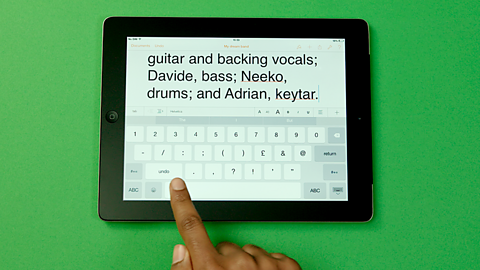
SPEAKER ONE: Another use for a semicolon is to divide the items of a list when there are commas in the items you’re listing.
SPEAKER TWO: ‘There are many ways to write: with a pen, which is cheap; with a pencil, which makes corrections easier; with a computer, which makes your essay neat and tidy.’
SPEAKER ONE: These semicolons make it easier for the reader to keep track of the items you’re listing.
SPEAKER TWO: And lastly, because a semicolon isn’t a full stop, you should never use a capital letter after a semicolon.
SPEAKER ONE: Unless the second clause starts with a proper noun, like a name.
Connecting ideas
The most common way to use a semicolon is to help join closely connected ideas in a sentence. These sections must be independent and complete sentences, but closely linked in some way:
Sandip spent three hours in the library; he couldn’t find the book he wanted.
A semicolon is often used to replace a Connecting words that bring words, ideas or clauses together. They are placed between the words and phrases they are linking (for, and, nor, but, or, yet, so). like 'and' or 'but'. The sentence about Sandip could have been written like this:
Sandip spent three hours in the library but he couldn’t find the book he wanted.
A full stop could often be used instead of a semicolon, but the effect on the reader would change.
- It was the best of times. It was the worst of times.
- It was the best of times; it was the worst of times.
The statement has a different impact with a semicolon because the semicolon closely connects the ideas into one sentence to suggest that the time was good and bad simultaneously. In the first version it sounds more like a contradiction.

Rewrite these sentences using a semicolon instead of a conjunction or full stop:
- Hayley loves sports. Her favourite is basketball.
- Imogen missed the bus so she had to walk to town.
- Rohan had been saving his pocket money. He was hoping to buy a new bike.
- It was a warm, sunny day and we spent the afternoon in the park.
- Hayley loves sports; her favourite is basketball.
- Imogen missed the bus; she had to walk to town.
- Rohan had been saving his pocket money; he was hoping to buy a new bike.
- It was a warm, sunny day; we spent the afternoon in the park.
Semicolons and conjunctive adverbs
A conjunctive adverb connects ideas in a sentence:
- however
- instead
- therefore
- meanwhile
- consequently
- accordingly
- also
If a conjunctive adverb is used to link two sentences, a semicolon must be used before the conjunctive adverb and the conjunctive adverb should be followed by a comma.
"Sandip spent three hours in the library; however, he couldn’t find the book he wanted."
Breaking up a list
Semicolons can also be used when writing a list. In most lists, it’s enough to use commas to separate the items:
When I go to the seaside, I make sure I have my sunglasses, sun cream , sandals and a beach towel.
However, if the list is more complicated semicolons may be needed to make the list clear for the reader:
When I pack for holiday, I make sure I have my passport, tickets and a book for the airport; sunglasses, suncream, sandals and a beach towel for the beach; and foreign currency.
The semicolons are added to signal to the reader which objects are grouped together and make the overall list clearer.
Common mistakes
Think of a semicolon as being like balancing scales. Both sides of the scale must be a A clause which makes sense on its own. or a full sentence on their own.
Don't use a semicolon instead of a comma to join a A clause which does not make sense on its own but functions to add extra information to an independent clause.:
- As the weather gets colder; I like to put more food out for the birds. - is incorrect.
- As the weather gets colder, I like to put more food out for the birds. - is correct.
A comma is needed here, not a semicolon. The first part of the sentence is known as a ‘subordinate clause’ because it is dependent. It does not make sense on its own and needs to be closely linked to the main part of the sentence.
Test your knowledge
Play Bitesize secondary games. game
Have fun playing science, maths, history, geography and language games.

More on Punctuation
Find out more by working through a topic
- count5 of 11
- count6 of 11

- count8 of 11