Why did children join the war effort?
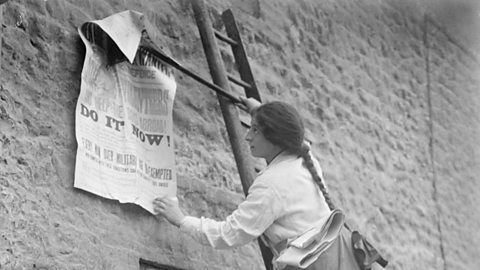
Between 1914 and 1918, everyone was expected to 'do their bit' to help with war work.
Many British children were very keen to lend a hand.
They took on jobs, grew vegetables and raised money.
They wanted to support their fathers and older brothers who were away fighting on the front line and help their families and mother at home.
Watch: How children helped at home
Watch our video to find out more about how children helped with the war effort.
[MUSIC PLAYS]
TOMMY: Since the war began, we’ve all been doing our bit. My name’s Tommy and I live ‘ere.
It’s breakfast time, but not my breakfast.
[CRUNCH]
Some for you, some for me.
[CRUNCH]
Some for you, some for me.
TOMMY’S MOTHER: Tommy! That’s the chicken’s breakfast, not yours!
TOMMY: But mum, I’m hungry.
TOMMY’S MOTHER: Well you’d better start weeding then.
You can get breakfast AFTER you’ve done weeding.
TOMMY: But muuuum!
TOMMY’S MOTHER: Come on Tommy, you’re the man of the house with your dad and brother away.
[MUSIC]
TOMMY: We’ll ‘ave the best veggie patch in town.
IZA: [GIGGLES] Look at you!
TOMMY: I’ve been doing my bit. What about you? Doing something easy no doubt.
IZA: Well I’m knitting scarves for soldiers and knitting’s not easy.
TOMMY: Yes it is.
IZA: Can you do it?
[TOMMY AND IZA SQUABBLE]
TOMMY: That’s Iza. She lives next door. She’s always trying to get one over me.
When I joined the Boy Scouts, she joined the Girl Guides.
The next best thing to being a soldier is a Boy Scout.
IZA: I’ve got my wool. Are you off to practise your signals?
Yes and if I pass that bit, I’ll get to practise drill like a soldier.
I’m learning how to look after wounded soldiers.
TOMMY: That won’t be me. I’ll be the best sharp shooter. Bang bang bang!
TOMMY’S MUM: [GASP] My sausages! I had to queue an age for them. Pick ‘em up before a dog gets ‘em.
IZA AND TOMMY: LAUGHTER
TOMMY’S MUM: You can have the gritty one!
What did 'growing your own' mean?
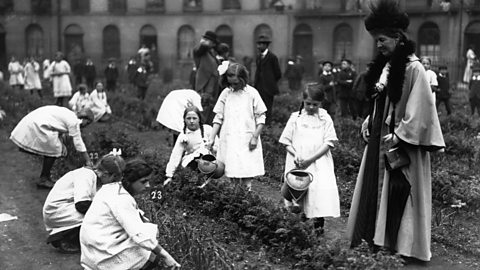
Image caption, ‘Growing your own’ food became very important
There wasn't a lot of food because German U-Boats (submarines) were sinking the ships bringing supplies. Children helped by digging, weeding and looking after vegetable patches.

1 of 3
Fundraising and collecting
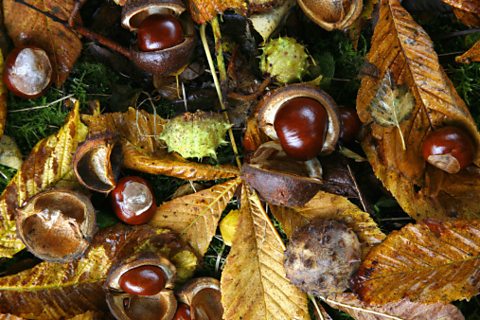
Children collected many useful things, such as blankets, books and even conkers.
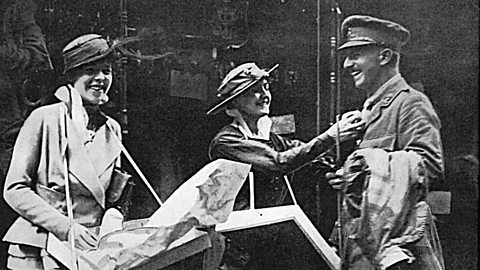
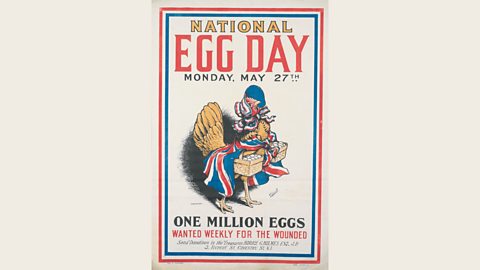
Some things were sent to the soldiers at the front. Others were sold to raise funds for the war effort.
Money raised could be used to build warships or to help wounded soldiers. There was even a Blue Cross fund to help horses hurt in battle.
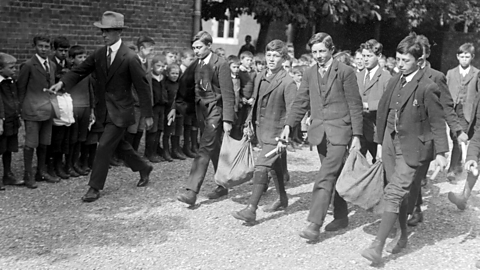
Image caption, Chemicals from conkers were used in making shells and bullets
Posters were put up in schools encouraging pupils to gather conkers. Around 3,000 tonnes were collected by Britain's children in 1917.
1 of 3
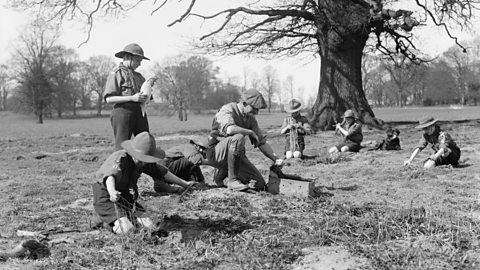
How did Boy Scouts help the war effort?
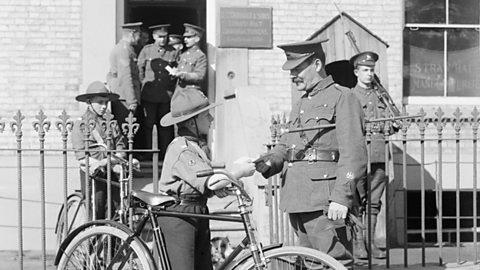
- They carried messages on behalf of the War Office.
- They guarded railway lines, water reservoirs and coastline.
- They watched the skies for attacks and sounded their bugles (a type of brass instrument) to signal when an air raid was over.
- Rifle ranges were opened where boys learnt how to shoot, so they could help to defend Britain if it was invaded.
How did Girl Guides help the war effort?
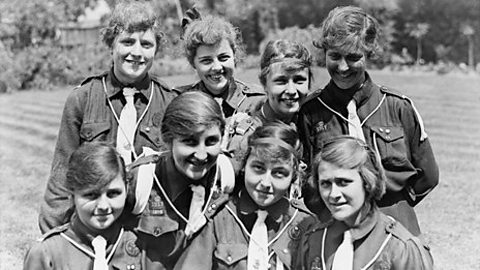
- They knitted socks and scarves to help keep British soldiers warm.
- They learned first aid so they could help with injuries.
- They carried important messages and helped deliver milk.
- Some reports even suggest that Girl Guides acted as messengers for the British Secret Service, MI5.
How did children help their families?
Many children tried hard to 'do their bit' in whatever way they could.
Sometimes this meant looking after younger brothers and sisters, helping with housework or joining long queues for food in the shops.
These small tasks were extremely helpful to the men and women who were struggling with the pressure of life in wartime.
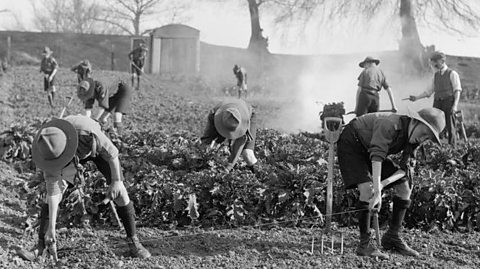 Image source, © IWM Q 30597
Activity 1: Quiz – Children during World War One
Horrible Histories: Raid and Trade game! game
Play Horrible Histories: Raid and Trade KS2 History

More on World War One
Find out more by working through a topic
- count19 of 43
- count20 of 43
- count21 of 43
- count22 of 43