Outside In: Nature Poems
Outside In: Nature Poems, written by Daniel Thompson and illustrated by Julia Murray, is the fourth title in the 2026 Blue Peter Book Club.
Watch the animation below to discover more about the book.
Outside In by Daniel Thompson is a collection of poems that spark a love of nature, bring calm and happiness, and let the outside in.
It's all about the good that comes from listening to nature's hums.
So take a break from being bored inside and see what wonders you can spy.
Bees around a busy hive see nature really come alive.
So go outside in when feeling blue, leave your worries far behind, and maybe read a poem too.
It's a great way to unwind.
Outside In: Nature Poems by Daniel Thompson is a collection of 50 poems that spark a love of nature, bring calm and happiness and let the outside in. With poems about the seasons, senses, wildlife, weather and the joys of mud. It’s all about the good that comes from listening to natures hums.
You can get a sneak peek of the book over on Blue Peter.
What is a rhyming pattern?
You might notice that lots of the poems in Outside In rhyme.
Some poems rhyme, but remember, not all poems have to! Poems that rhyme often have a rhyming pattern.
A rhyming pattern is the way an author organises the sounds at the end of each line in a poem.
Authors and poets use rhyming patterns to link lines together in different ways.
Some poems link lines that are next to each other, while others use a rhyming pattern that is spread across different lines.
They can give poems a sense of flow and make them more fun and engaging to read.
Different forms of poetry
Not all of the poems in Outside In look the same. Poems can be written and presented in different forms. This allows authors to play with the layout, structure and meaning of their poems.
There are different ways authors can do this. For example:
Acrostic poem: This type of poem shares a message using the first letter of each line.
Mesostic poem: This type of poem shares a message using a letter in the middle of each line.
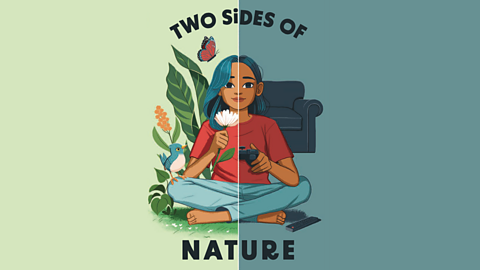
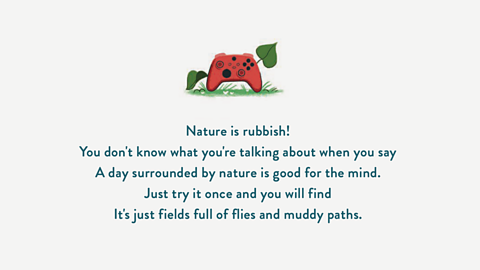
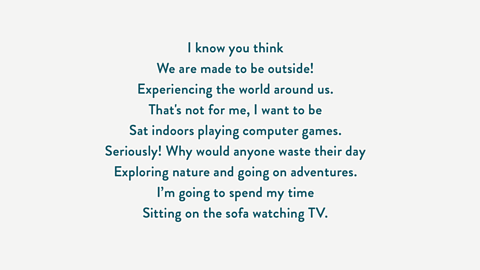
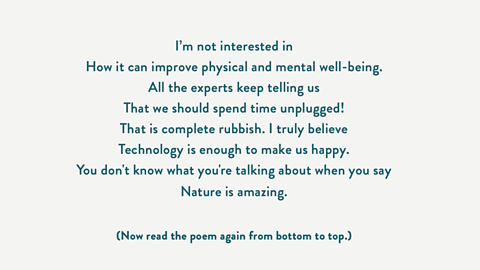
Mirror (or reversible) poem: This type of poem can be read in more than one direction, usually from top to bottom and from bottom to top.
Can you notice how reading the poem Two Sides of Nature in reverse completely changes the meaning of the poem?
1 of 4
What is alliteration?
Poems are a fantastic way to be creative with language!
Alliteration is when two or more words in a sentence start with the same sound.
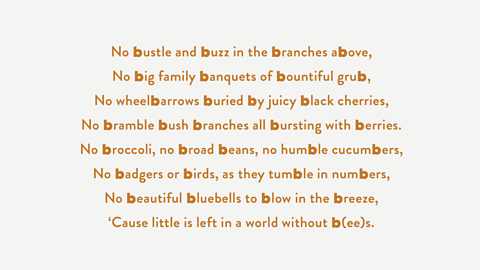
For example, Daniel Thompson uses alliteration in these lines from the poem A World Without Bees:
No bramble bush branches all bursting with berries
or
No beautiful bluebells to blow in the breeze
Alliteration can make poems sound musical, so they are even more fun and memorable to read.
Alliteration is also often used in newspaper headlines and adverts.
Example 1
You can work out the rhyming pattern of a poem by labelling the words that rhyme with each other. This will help you see the pattern of the poem.
For example, if a poem's first and third lines rhyme, you should label those lines 'A'. If the second and fourth lines of the poem rhyme, label those 'B'.
Then you can see that the poem has an 'A B A B' rhyme scheme.
1 of 2
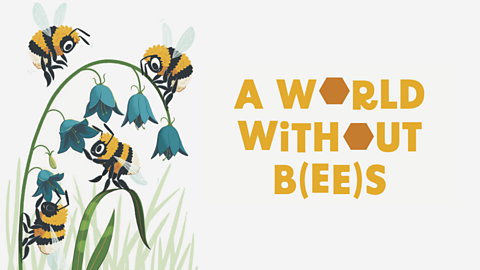
Take a look at A World Without Bees in the slideshow above. (Page 57 of Outside In.)
Does this poem have an ABAB or an AABBCC rhyming pattern?
✓A World Without Bees is written using an AABBCC rhyming pattern, because pairs of rhyming lines are placed next to each other.
Example 2
Remember that poems can be written in lots of different forms.
This is one reason poems are exciting, as authors can structure and present their ideas in a creative way.
1 of 2
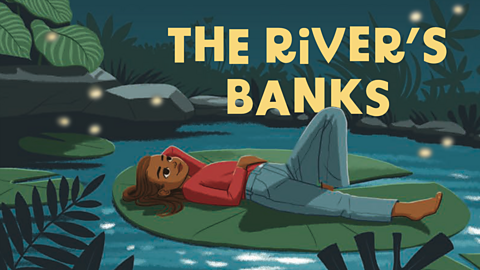
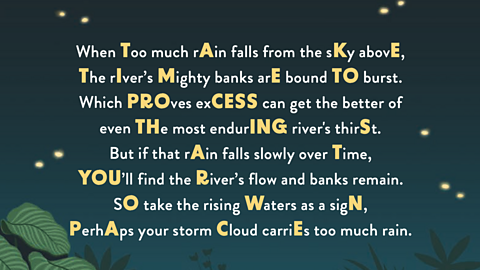
Have a look at The River’s Bank in the slideshow above. (Page 80 of Outside In.)
Have you noticed the bold, yellow capital letters? What secret message do these letters share with the reader?
✓ What do you notice when you read just the yellow capital letters? They spell:
TAKE TIME TO PROCESS THINGS AT YOUR OWN PACE
Blue Peter Book Club
Watch as Joel and the Book Clubbers talk about their favourite parts of Outside In.
Now though, from amazing animals to our latest book club read, which brings nature to life, have a look.
If your days are a bore or if you want something more, take a break from your norm, go out your front door.
Think poetry's not for you? Well, think again.
This book will change how you view the world.
Enjoy the great outdoors, getting muddy in puddles, finding bugs on all fours.
Well then, this month's BP Book Club read might just be the ticket.
To give us the lowdown on these wonderfully wild poems are our book clubbers.
I'm Alfie, Erica, Vihaan, Skyla, Johan, and I'm Irie.
What better place to discuss this book than being out in nature.
So our book clubbers are at a park near Manchester where they're getting involved with a pond health check.
Helping expert Chris take some samples to see how healthy the pond is.
Look, you see it moving?
Oh, I see it, I see it.
This is the tadpole.
There's a big one right there.
In it goes.
So what did you guys think of the book?
It was actually very nice.
Before, I thought poems are not that great, not my type, but when I read it, it made me very, very happy.
I really like the illustration and like the different animals within it.
Do you have a favourite poem in there?
Beautiful flowers.
Beautiful flowers don't come in one shape.
Some fit on a penny, some cover a plate.
Some bloom in the spring, whilst others patiently wait.
Oh beautiful flowers don't come in one shape.
What's yours?
Nature's giant.
And because it talks about trees.
Honey thieves.
What's that one about?
A badger and a bird working together to try and get honey from a beehive.
Has it made you respect nature in a different way, do you think?
Yeah, like, now whenever I go outside, I always think what I could find in nature and what I could do, and like, just spend my time outdoors.
If you go into the woods today, what are you going to find?
Look high, look low, walk extra slow, tune in and take your time.
Samples collected, it's time to see what creatures we found.
Right, Chris, what have we got here?
Find anything cool?
Some different midge, which is a kind of fly.
In here I have a mayfly.
I think we found a damselfly larva fly, which is like a very small dragonfly, it's about this big.
So there's absolutely tons of stuff all in that pond.
Is that like a particularly healthy pond?
It's looking pretty healthy from what we've found so far.
Gotta tell you guys, our adventurer in wildlife and this book has got me excited.
Excited to read a bit more poetry, but for the people watching at home, why do you think they should read it?
I like how it explains things you wouldn't know about nature before you'd read this book.
If someone likes nature, and like they spend a lot of time outside, maybe they should read this book to be calm.
You heard it, what are you waiting for?
Get to the library, read the book, let us know what you think, and you can get yourself a Blue Peter book badge.
Right guys, shall we go find some frogs for the pond?
Yeah, let's do it, come on.
Or other animals too.
I'm not picky.
Can you try to write some short sentences using alliteration? Remember, alliteration is when two or more words in a sentence start with the same sound.
Have a go at writing a short rhyming poem about something in nature that you enjoy.
Both of these will help you earn your Blue Peter Book Club badge, which you can read about here.
Quiz
Now put what you've learnt to the test with this quiz all about poetry, rhyming and alliteration.
More on Blue Peter Book Club
Find out more by working through a topic
- count5 of 19

- count7 of 19
- count8 of 19