The Train of Dark Wonders
The Train of Dark Wonders, written by Alex Bell and illustrated by Beatriz Castro, is the first title in the 2025 Blue Peter Book Club.
Watch the animation below to discover more about the book.
Bess loves her grandfather's collection of curiosities, so she's delighted when she's handed the keys to his Odditorium.
But unless she finds a way to bring in the crowds, she'll have to close its doors for good.
A mysterious train pulls into town bound for the Land of Halloween sweets, sneaking on board, Bess is discovered by Beau, Louis, and Maria the Fire Witch.
Joining their adventure, they search for the rarest sweet of all, the Ghostly Gobstopper.
But, ruled by the fearsome Candymaker, the land is more dangerous than it first appears.
Bess is delighted when she’s handed the keys to her grandfather's Odditorium and his collection of curiosities. But unless she finds a way to draw in the crowds, she’ll have to close its doors for good.
When a mysterious train pulls into town, bound for the Land of Halloween Sweets, Bess sneaks onboard. She joins Beau the puppeteer, Louie the violinist and Maria the fire witch on their adventures.
All is not as it seems, as the land is ruled by the fearsome Candymaker…
You can get a sneak peek of the book over on Blue Peter.
How does the vocabulary make the story exciting?
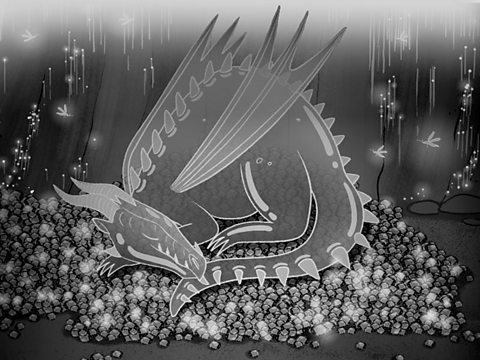
When you jump aboard The Train of Dark Wonders, you find yourself in worlds full of mystery, magic, sweets and adventure!
The author Alex Bell’s writing techniques grab you from the first page and keep you racing through the story. But, what are some of the exciting techniques she uses?
Ambitious, precise vocabulary choices are made throughout The Train of Dark Wonders to create pictures in your head as you read. Instead of using simple, vague words that don't capture the imagination of the reader, Alex Bell has chosen bold and interesting vocabulary to bring the story to life and to make sure you keep reading.
When the children decide to rescue the gummy dragon ‘Flossie’, the author chooses ambitious vocabulary to describe the way Maria feels about the mission:
“Maria seemed a little exasperated by their rescue mission” (page 220)
To give a clearer description of how Maria feels, the author has used the word 'exasperated'. This is an ambitious vocabulary choice, as it goes beyond simple word choices - like 'tired' or 'annoyed' - and makes it clear just how fed-up Maria really is.
What are italics?
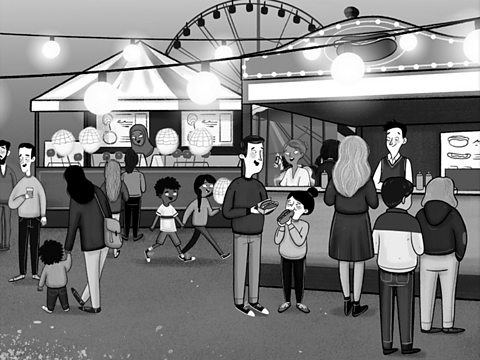
Italics are used throughout The Train of Dark Wonders. Italics are a style of text where the letters lean slightly to the right.
They show that something is being emphasised or thought about. In The Train of Dark Wonders, italics are used to emphasise the importance or urgency of things that happen throughout the story.
For example, the importance of Bess finding Professor Ash at the fair is emphasised by the word ‘somewhere’:
“He had to be there somewhere after all.” (page 62)
When Bess meets Penelope the alien, to make it clear just how bright green Penelope is, the author has written the word ‘bright’ in italics:
“Bess stared in amazement. Penelope’s head really was bright green – the most luminous shade one could imagine.” (page 134)
What are ellipses and how do you use them?
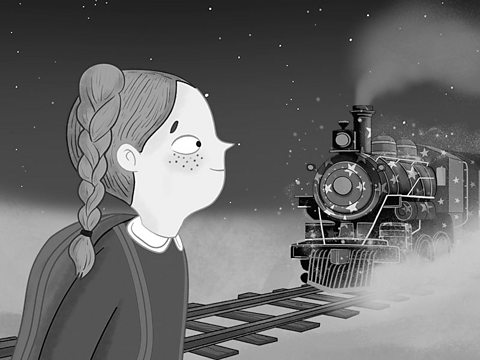
Ellipses are not just as simple as …; they are used by writers to create mystery, hesitation, or an unfinished idea.
Ellipses appear throughout The Train of Dark Wonders to make you, the reader, feel like something mysterious is hiding just around the corner…
At other times, they create a feeling of suspense, that part of the adventure isn’t quite finished yet… This keeps you excited and makes you turn to the next page.
When Bess first climbs aboard the Train of Dark Wonders and it suddenly plummets underground:
“She felt a flash of panic that she’d never see her parents or the Odditorium again…” (page 85)
Here, the ellipses create suspense and mystery by leaving you hanging. As if something exciting or scary is about to happen.
Ellipses can also be used to show hesitation when a character is speaking or thinking.
When Bess buys a ‘hot frog’ at the fair, the author shows her hesitation as she wonders why the food is called a hot ‘frog’ not a hot ‘dog’:
“Is it… Is it actually made from frog then?” (Page 56)
Using ellipses in this way makes Bess’ speech feel more realistic by showing how she stops to think, and even worry, part way through what she is saying.
Example 1
Look at this extract from the book.
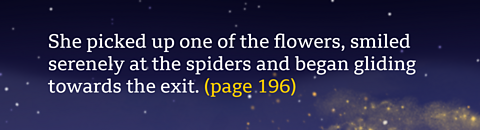
Which word in this sentence is an ambitious vocabulary choice?
✓ 'Serenely' is the ambitious word in this sentence. It’s a more descriptive way of showing that the puppet princess was calm when she looked at the spiders.
Example 2
Let's look at another example.
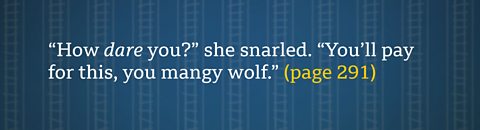
In this sentence, the word 'dare' is written in italics when Queen Pittipat attacks the train. Why is this?
✓ The word 'dare' is written in italics to emphasise how angry Queen Pittipat is!
Example 3
Finally, look at this last section.
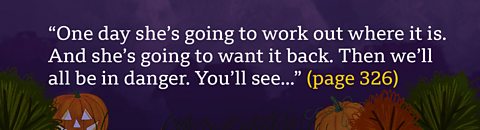
Why have ellipses been used in the ending of The Train of Dark Wonders?
✓ Ellipses are used at the very end of the story to create a feeling of mystery.
The reader will have lots of questions about why Bess is in danger and what will happen next.
Blue Peter Book Club
Watch as Abby and the Book Clubbers talk about their favourite parts of The Train of Dark Wonders.
Inspired by The Train of Dark Wonders…
Smile for the camera! Cheese!
… we're hopping on board our very own Halloween Express, driven by yours truly.
bell rings That's all my skills, that's it.
All aboard.
We're moving! We're off! We're off!
Abby's the train driver.
What do you think of this train of dark wonder?
We love it!
My favourite bit of the book was when Louis licks the gobstopper and turns into a werewolf and runs about the carriage.
Kurt, what's your favourite bit of the book?
It was all the like plot twists and stuff. I found them really exciting.
I love the picture detail in the book. This one when she's playing the violin, when he's playing the violin with the gummy bears all holding it.
And it looks like there's someone else who wants to get a little sneak peek of the book.
Mr Sheep, come on and read the book.
Oh my goodness, the chickens!
(to chickens) I'd recommend this book as your next read.
(to chickens) Welcome to the Peter Book Club. Anyone want to read the book?
Abby, what did you think of the Train of Dark Wonders?
I loved the adventures that they all went on.
I think the train is about as good as this one, or maybe this one's even better.
The bits I didn't like in the book was all the bullying. I think Millie and the Unicorn Club were just horrible to Bess.
Yeah, and, like, all the judgment. They think that everyone should just be like them.
Yeah.
Bess sees some amazing things on the Train of Dark Wonders, but surely the best has to be the Land of Halloween Sweets.
So it's only right we stop there.
Right, we're here.
Inspired by the book, we're heading to our very own Land of Halloween Sweets.
Just like Halloween, this book is absolutely full of tricks and treats.
So, can you tell me about some of the tricks and treats that are in the book?
There's the ghostly gobstopper, which makes you control if you're a werewolf or not. It's pretty cool actually, like, just pop it in your mouth. You're a werewolf!
That's really cool, it's like magic!
There's this like crocodile swamp tea. It doesn't sound too great.
The minty mummy.
Oh, that looks like what you've got in front of you as well.
Oh no, oh no!
So we've got lots of treats from the book, but one of them is actually a trick.
Are we up for this?
Yeah!
OK, let's give it a little go.
This is so good. Do you want to try?
Hmm, that's good.
I think that’s fine.
I think this is good. It's not a trick.
Well, we've not found the trick just yet.
Who's your favourite character in the book?
Maria, because she's a fire witch and she can make all these cool things, animals, with fire.
Oh, that's so cool. Who's your least favourite character?
Probably Billy and the Unicorn Club. They don’t really get on with anyone apart from themselves.
So, they're not very kind to everybody.
Yeah.
We don't like the Unicorn Club. Boo!
Let's pour some tea. Oh, yum, yum.
Oh. Urgh!
It's a bit salty!
Isn’t it salty?!
That's disgusting!
I think this might be the trick. Definitely. No, I'll have a little bit of a biscuit to mask it.
If you fancy reading this book, head to your local library, read it, tell us what you think, and you could earn yourself one of these, a Blue Peter book badge!
Well, more swampy tea anyone?
I'll pass.
Yeah, it's a bit of a pass, I think.
If you've read the book, can you write about what you enjoyed the most? Think about the story, the characters and settings.
Can you make a flyer to encourage people to visit the Odditorium and describe some of the things that they can see?
Both of these will help you earn your Blue Peter Book Club badge, which you can read about here.
Quiz
Now put what you've learnt to the test with this quiz all about ambitious vocabulary, italics and ellipses.
More on Blue Peter Book Club
Find out more by working through a topic
- count7 of 18
- count8 of 18

- count9 of 18
- count10 of 18