Key points
- Macbeth is a play by William Shakespeare that tells the story of a Scottish nobleman called Macbeth.
- Macduff, the Thane of Fife, is Macbeth’s enemy.
- Macbeth is told by the Witches that he should “beware Macduff” which leads him to murder Macduff’s family.
- The two men meet face to face on the battlefield and Macduff kills Macbeth.
Did you know?
It is typical for many characters to die in a tragedy.
Macduff is one of the few characters in Macbeth to survive.
Plot summary
Macduff’s personality
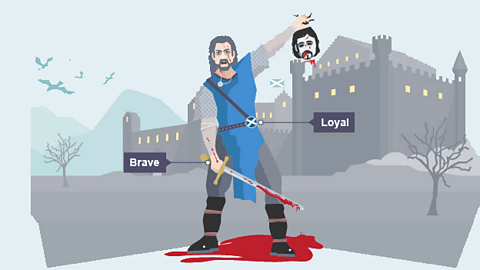
Loyal
Macduff finds Duncan’s body, and once he suspects Macbeth of murdering the king he risks everything to raise an army against him.
Devastated
Macduff is devastated following the murder of his family, and seeks revenge against Macbeth.
Brave
Macduff leaves Scotland to help raise an army against Macbeth, knowing that Macbeth is violent and capable of murdering a king. Macduff To cut off someone's head. Macbeth and presents his head to the new king Malcolm.
Relationships
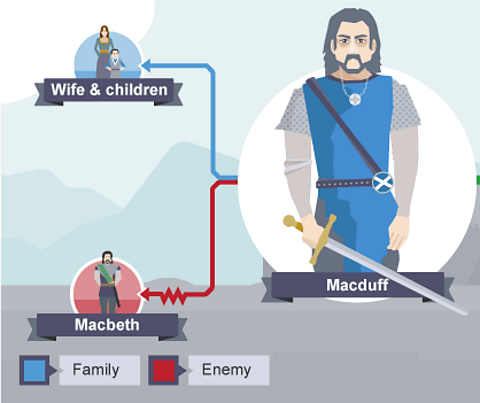
Family
Macduff puts his loyalty to his king and country before his family. He leaves his family and joins Malcolm in England. His wife, Lady Macduff, is angry and upset that he has left them behind. When Macbeth’s men arrive to murder his family, Macduff’s son is loyal to his father when one of the men calls Macduff a traitor.
Macbeth
The Witches warn Macbeth to “beware Macduff, beware the Thane of Fife”. This prediction and the news of Macduff’s departure lead Macbeth to order the murder of Macduff’s wife and children, which in turn drives Macduff to take revenge and kill Macbeth.
The Witches also inform Macbeth that “none of woman born shall harm Macbeth”. By this they mean Macduff, who was born by A method of delivering a baby by making a surgical cut into the abdomen and uterus..
Malcolm
Macduff shows his loyalty to Duncan’s son, Malcolm. He leaves Scotland to support him and joins the English army in the plan to remove Macbeth from the throne. At the end of the play, he presents Macbeth’s head to Malcolm and hails him as king.
Why does Macduff leave his family in Scotland?
Macduff travels to England to support Malcolm, Duncan’s son, out of loyalty to his king and his country.
Changes in character
In contrast to Macbeth, Macduff remains a loyal and honourable character. He discovers King Duncan’s body and becomes suspicious of Macbeth. He refuses to attend Macbeth’s A ceremony during which a person formally becomes king or queen..
When he arrives in England, Malcolm tests Macduff’s honour by pretending that he would be a bad king. Macduff is upset by the suggestion that Malcolm is an When someone goes against what is considered to be socially and morally acceptable. man, but remains loyal to him. This test proves that Macduff is a good man and shows his loyalty to Scotland. The news of his family’s murder also shows his emotional side, as he is devastated by the news of their deaths.
At the end of the play, he avenges his family’s murder by killing Macbeth. He shows himself to be a brave solider.
Activity - Order it
What do these key quotations mean?
Bleed, bleed, poor country!
Macduff
Act 4, scene 3
Macduff uses personification here to powerfully show that Scotland is suffering under Macbeth’s rule. Personification means to give human qualities to something non-human.
All my pretty ones? Did you say all?
Macduff
Act 4, scene 3
Macduff is devastated by the news that Macbeth has murdered his family. His emotional response intensifies the audience’s horror at Macbeth’s actions. Macbeth has committed a terrible sin - he has ordered the deaths of innocent children.
Macduff was from his mother’s womb
Untimely ripp’d …
Macduff
Act 5, scene 8
Macduff tells Macbeth that he was born by caesarean section. Macbeth realises that the Witches have tricked him, and Macduff can kill him.
Listen to a scene
Listen to this audio recording of Macduff and Macbeth facing each other in Act 5, scene 8 towards the end of the play.
Macduff: Turn, hell-hound, turn.
Macbeth: Of all men else I have avoided thee,
But get thee back, my soul is too much charged
With blood of thine already.
Macduff: I have no words,
My voice is in my sword, thou bloodier villain
Than terms can give thee out.
[They fight]
Macbeth: Thou losest labour.
As easy mayst thou the intrenchant air
With thy keen sword impress as make me bleed.
Let fall thy blade on vulnerable crests;
I bear a charmèd life which must not yield
To one of woman born.
Macduff: Despair thy charm,
And let the angel whom thou still hast served
Tell thee, Macduff was from his mother’s womb
Untimely ripped.
Macbeth: Accursed be that tongue that tells me so,
For it hath cowed my better part of man;
And be these juggling fiends no more believed
That palter with us in a double sense,
That keep the word of promise to our ear
And break it to our hope. I’ll not fight with thee.
Macduff: Then yield thee coward,
And live to be the show and gaze o’ th’ time.
We’ll have thee, as our rarer monsters are,
Painted on a pole, and underwrit,
‘Here may you see the tyrant.’
Macbeth: I will not yield
To kiss the ground before young Malcolm’s feet
And to be baited with the rabble’s curse.
Though Birnam Wood be come to Dunsinane
And thou opposed being of no woman born,
Yet I will try the last. Before my body,
I throw my warlike shield. Lay on, Macduff,
And damned be him that first cries, ‘Hold, enough!’
What does Macduff call Macbeth in this scene?
In this scene Macduff calls Macbeth:
A A demon in the form of a dog.
A Someone who uses power in a cruel way and oppresses people.
These names show how Macbeth is viewed by the other characters. He is unpopular and no longer seen as a brave solider.
Test your knowledge
Solve the Story!
An exciting new series from the Other Side of the Story, designed to help young people strengthen their media literacy skills.

More on Macbeth
Find out more by working through a topic
- count1 of 6
- count2 of 6
- count3 of 6
- count4 of 6