Key points
Macbeth is a play by William Shakespeare that tells the story of a Scottish nobleman called Macbeth.
Themes are the main ideas that appear repeatedly in a play. Some of the important themes in Macbeth are:
- Fate - the idea that life’s journey is already mapped out, and that this journey cannot be changed.
- Appearance and reality - the way that people can pretend to be something that they’re not, and how we sometimes fail to see situations as they really are.
- Ambition - the desire and determination to achieve something.
Did you know?
Shakespeare often uses similar themes across his plays. For example:
- The theme of fate is important in Romeo and Juliet.
- The play Richard III deals with an ambitious king.
Fate
Fate is the idea that our life’s journey is already mapped out ahead of us, and that this journey cannot be changed.
Watch this video about fate in Macbeth:
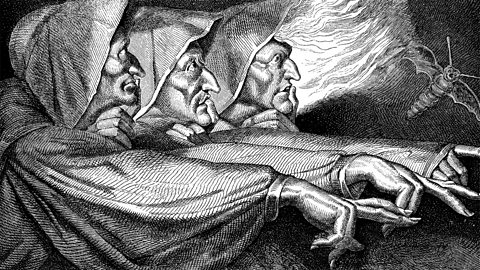
Narrator: Fate: whether it’s an explanation for something big happening, or an excuse for our own success or failure, fate is a popular idea. It’s the idea that our life’s journey is already mapped out ahead of us. It’s certainly popular with Macbeth. Especially when some witches tell him that it’s his fate… to be king!
Does Macbeth have any choice? Or is it all down to fate? It’s not just the audience trying to figure this out. Macbeth is too. He’s happy to accept his fate to be king, but isn’t cheering fate on when Banquo’s kids get the thumbs up to be kings.
Macbeth thinks he can cheat fate. His fate cheating tactics aren’t subtle. None of Macbeth’s tactics are. Violence isn’t the only way to get to the top. What about flower arranging? I mean, I don’t know how fate works. Ah. That’s how.
Macbeth’s own attitude towards fate changes, depending on whether the Witches’ predictions are for or against him. He thinks he is justified in murdering King Duncan because the Witches have said he is fated to become king.
On the other hand, Macbeth tries to cheat fate by killing Banquo and trying to kill his son, Fleance. The Witches predict that Banquo’s children will be future kings of Scotland. Macbeth feels cheated. He has no children himself and begins to feel that his time as king will be pointless if the crown goes to Banquo’s family when he dies.
What is Macbeth’s response to the prediction that Banquo’s sons are fated to be kings?
Macbeth tries to cheat fate by arranging to have Banquo and his son murdered. Banquo is killed, but his son Fleance escapes. This means that Fleance or his future sons could become kings.
Appearance and reality
Shakespeare was fascinated by the way that people can pretend to be something that they’re not, and how we sometimes fail to see situations as they really are. This is known as appearance and reality.
In this play, Macbeth and Lady Macbeth must pretend to be good people so that they can get away with murder.
Watch this video about appearance and reality in Macbeth:
Narrator: Appearance and reality. Shakespeare was fascinated in the difference between how things appear and what’s really going on. In this play we see Macbeth and his wife pretend to be loyal subjects of Duncan… so they can get away with his murder.
The Witches appear to promise Macbeth great things. In reality, they’re telling him he’s doomed.
Macbeth sees some odd things, which may be just his imagination. Imagination or not, that’s still scary. For example, on his way to kill Duncan, Macbeth sees a dagger floating before him. He’s not sure himself if what’s happening is really happening.
But for all the strange things Macbeth sees, reality catches up with him, hidden within an attack he dismissed as silly witch talk!
What appeared to be nonsense was actually inescapable reality. Macbeth still might have the last laugh. Look. He’s got a bad dose of the squirrels. That’s worse than the measles.
What object appears to Macbeth before he murders Duncan?
Macbeth thinks he can see a floating dagger. He thinks the dagger is pointing the way to Duncan’s bedroom. The audience are not sure if this vision is real or a part of Macbeth’s imagination.
What other examples of appearance and reality do we see in Macbeth?
- Many of the A title of nobility in Scotland. must pretend to be loyal to Macbeth in order to survive.
- The Witches make promises which are often only half-truths. They appear to be predicting Macbeth a powerful future, but in reality they are tricking him.
- There are ghosts and visions which may or may not come from Macbeth’s imagination, such as the appearance of Banquo’s ghost, which nobody else can see.
- During her sleepwalking scene, Lady Macbeth thinks she can see blood on her hands.
Ambition
Ambition is the desire and determination to achieve something.
Although ambition can be a positive thing, Macbeth’s ambition begins to control him and leads to his downfall.
Lady Macbeth knows that she can use his ambition to manipulate him. At first, Macbeth is unsure if they should murder King Duncan. However, his ambition allows him to be persuaded.
After he becomes king, Macbeth is convinced that he needs to continue to kill in order to keep his power. Although he has achieved his ambition to become king, he is troubled and haunted by his actions.
Watch this video about ambition in Macbeth:
Narrator: It’s good to get ahead. That’s not what I meant. Ambition. That’s what I meant. To want to be the best and reach the top.
We’re told, if we work hard, we can turn our dreams into reality. Macbeth however, with a push from Lady Macbeth, takes the short cut to the top.
Macbeth admits he’s ambitious. He compares his ambition to a race-horse. Which is interesting isn’t it? Because who’s really in charge? The jockey? Or the horse? Does ambition …carry us away?
Lady Macbeth is worried that Macbeth is too kind to murder Duncan. She asks spirits to take away her femininity so that she can perform the evil task.
But to stay on top, Macbeth keeps on killing… and is ultimately destroyed by his own ambition.
What animal does Macbeth use to represent his ambition?
Macbeth uses a horse to represent his ambition. He compares his ambition to a horse that jumps over an obstacle. However, he also says the horse may misjudge the jump and fall. This shows the audience that Macbeth sees both the power and dangers of ambition.
Did you know?
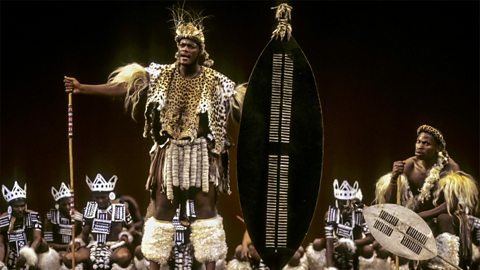
The themes in Macbeth have made the play relevant and popular across the world. There is a popular A group of people from South Africa who were a powerful military force in the 1800s. version of Macbeth from South Africa, which is called Umabatha: The Zulu Macbeth. In this version of the play, an Having a strong wish to be successful or powerful. Zulu warrior kills his leader.
Activity - Order it
Test your knowledge
Solve the Story!
An exciting new series from the Other Side of the Story, designed to help young people strengthen their media literacy skills.

More on Macbeth
Find out more by working through a topic
- count3 of 6
- count4 of 6
- count5 of 6
- count6 of 6