Problem 1 - Counting Cubes
Problem 1 is all about visualising 3-D shapes and counting cubes.
Maths teacher Chris Smith and pupils from Grange Academy are here to explain.
The Maths Week Scotland Daily Challenges have been set by the Scottish Mathematical Council.
CHRIS: This problem is all about visualising 3D shapes and counting cubes.
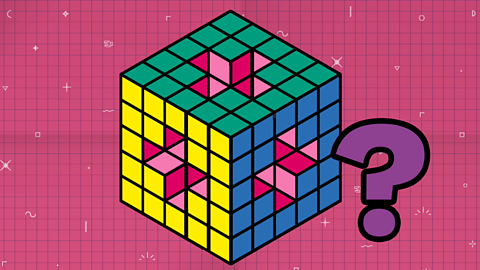
The diagram shows a large cube that has cross shaped holes punched through each face.
How many individual cubes would be needed to construct it?
So I want you to imagine, if you can, a cube which is five by five by five.
Right so a big cube made up of smaller cubes: five cubes by five cubes by five cubes.
PUPILS:
Try building the up yourself using some building blocks.
It might help to think about the whole cube in sections or in layers.
Another way would be to look at the cross shapes and figure out how many blocks have been removed.
Good luck!
So here's the challenge:
The diagram shows a large cube that has had cross-shaped holes punched through each face.
How many individual cubes would be needed to construct it?
Need a hint?
- Try building the cube yourself using building blocks.
- It might help to think of the whole cube in sections or layers.
- You could look at the cross shapes and work out how many cubes have been removed.
Solution
Worked out the answer? Here's how you can do it.
This challenge was all about visualising 3D shapes and counting cubes.
Let’s start by looking at the large cube.
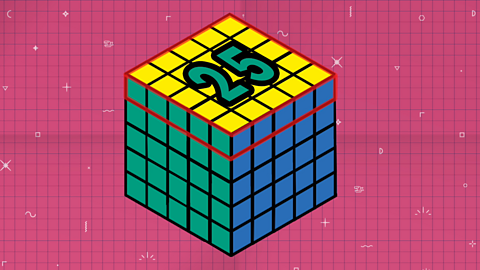
One way to think of it is as five square layers. Each measures five cubes by five cubes.
So it is made up of twenty five cubes.
The top layer has that cross shaped hole, which takes away five cubes.
Twenty five take away five leaves twenty cubes in this layer.
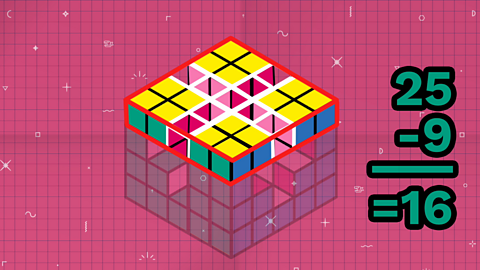
In the second layer, the hole punched through the top meets the holes punched round the sides by the top of the cross shape.
Instead of five cubes being removed, there are another one, two, three, four.
Nine taken out in total.
Twenty five take away nine leaves sixteen cubes in this layer.
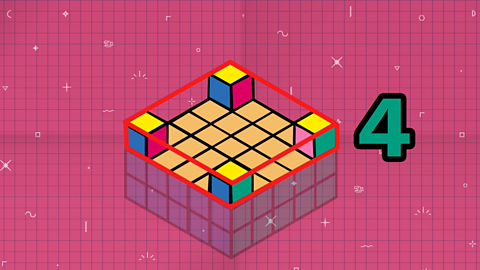
The middle layer is where the cross shaped holes are widest.
Another three cubes have been removed from each corner.
That leaves just four cubes in the middle layer.
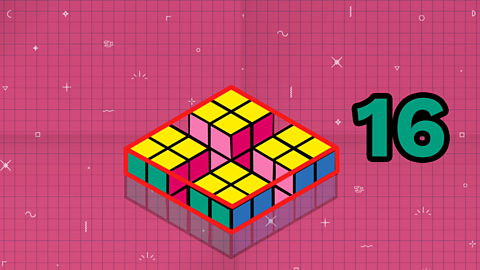
The fourth layer is the same as the second, so it has sixteen cubes.
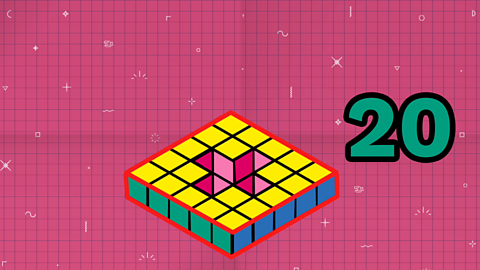
And the bottom layer is the same as the top so it has twenty cubes.
So the total number of individual cubes is twenty plus sixteen plus four plus sixteen plus twenty which equals seventy six.
How did you get on? Did you work it out?
This challenge was all about visualising 3D shapes and counting cubes.
Let’s start by looking at the large cube. One way to think of it is as five square layers.
Each measures 5 cubes x 5 cubes so it is made up of 25 individual cubes.
Now let's look at each layer in the cube.
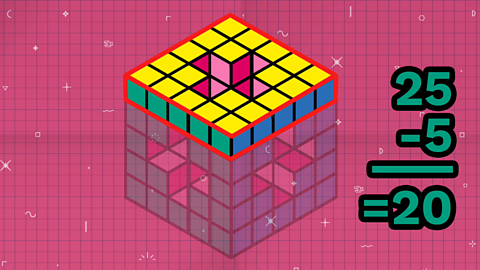
Image caption, Top layer
The top layer has that cross shaped hole which takes away 5 cubes. 25 take away 5 leaves 20 cubes in this layer.
1 of 5
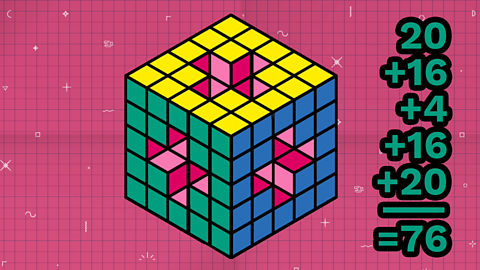
So the total number of individual cubes is:
20 + 16 + 4 + 16 + 20 = 76
The cube is made up of 76 individual cubes.
Maths Week Scotland 2022. list
Try out all the daily challenges from Maths Week Scotland 2022.
Maths Week Scotland 2021. list
Want more maths challenges? Here are all the problems from 2021.

More on Problem solving
Find out more by working through a topic
- count9 of 21
- count10 of 21
- count11 of 21

- count12 of 21