Key points
To multiply and divide Integers are numbers with no fraction or decimal part. They can be positive, negative or zero. 42, 8, and 10000 are examples of integers. by numbers between 0 and 1, you need to be confident with multiplying and dividing by The second power of 10 for example is 100. Powers of 10 are 10, 100, 1000 and so on. and with short multiplication and division.
Multiplying by a number greater than 1 gives a greater answer than the original number. But when multiplying by a number greater than 0 and less than 1, the answer is smaller than the original number.
Dividing by a number greater than 1 gives a smaller answer than the original number. But when dividing by a number greater than 0 and less than 1, the answer is greater than the original number.
Multiplying and dividing whole numbers by numbers greater than 0 and less than 1 can be broken into a whole number calculation followed by multiplying or dividing by a power of 10, for example 10, 100 or 1000 and so on. This makes the calculation simpler to do.
Multiplying whole numbers by numbers between 0 and 1
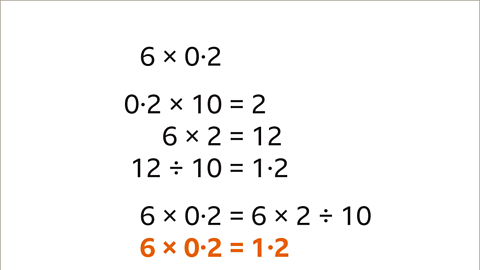
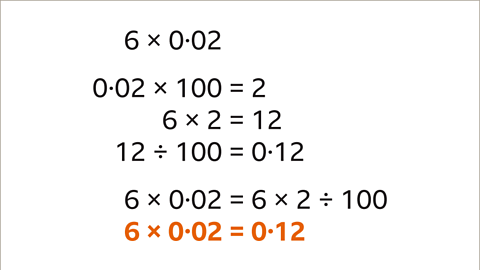
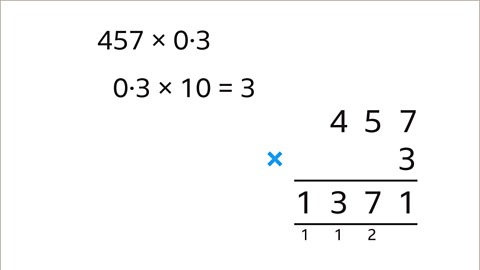
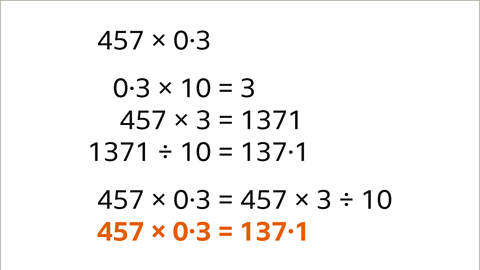
To multiply a whole number by a number between 0 and 1:
- Multiply the decimal by a power of 10 to get a whole number. This makes the calculation simpler.
- Multiply the whole numbers.
- Divide by the power of 10
Examples
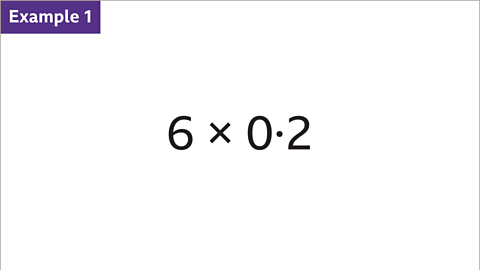
Image caption, Understand how to work out 6 × 0∙2
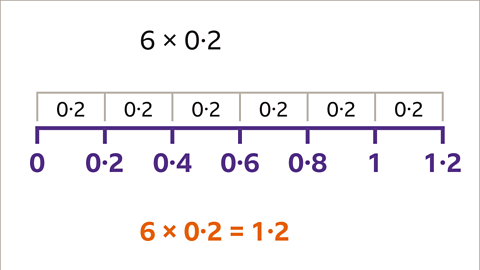
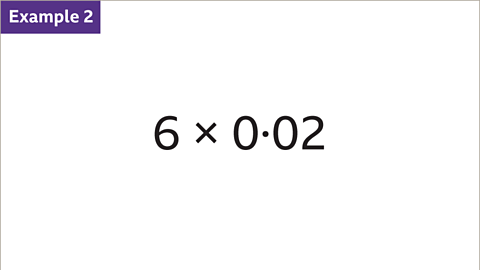
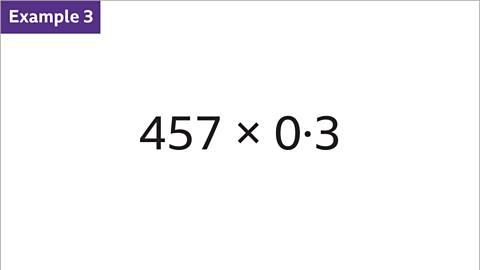
1 of 8
Dividing whole numbers by numbers between 0 and 1
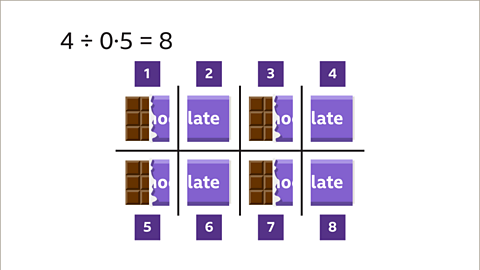
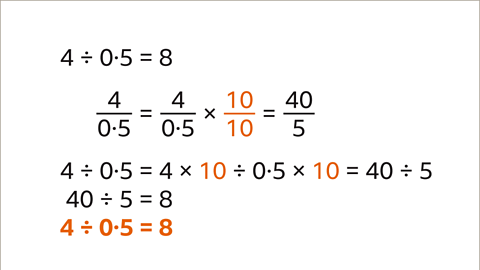
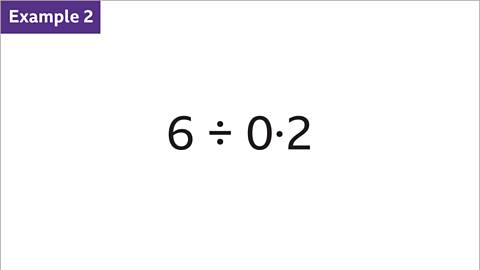
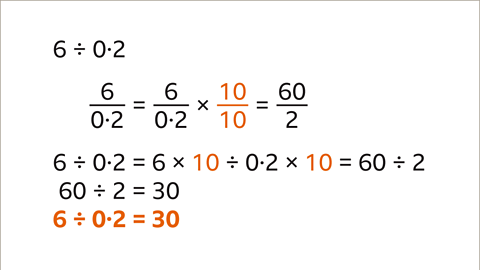
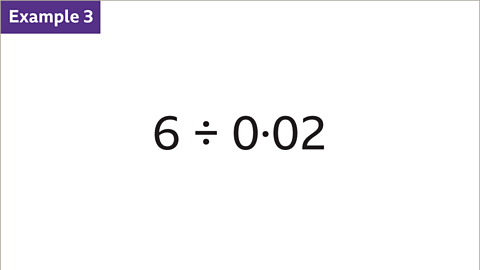
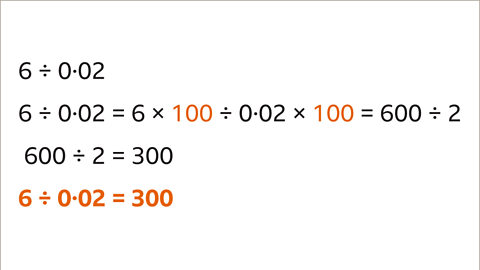
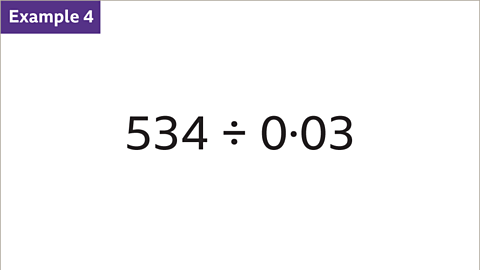
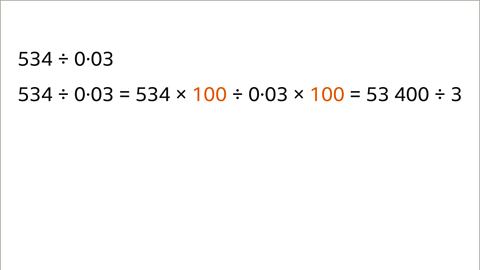
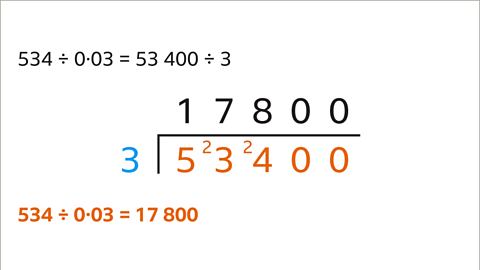
To divide by a number greater than 0 and less than 1:
- Multiply both the Number written at the top of a fraction. The numerator is the number of parts used. Eg, for 1⁄3, the numerator is 1 and Number written on the bottom of a fraction. The denominator is the number of equal parts. Eg, for 1⁄3, the denominator is 3 by the same power of 10 to get whole numbers; this creates an equivalent expression which is easier to calculate.
- Divide the whole numbers.
Examples
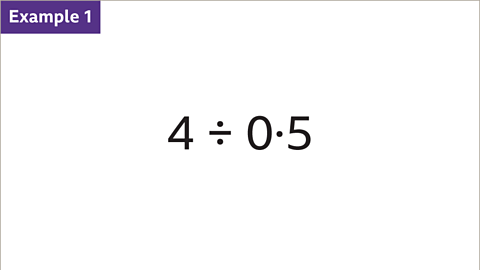
Image caption, Understand how to work out 4 ÷ 0∙5
1 of 10
Question
Which of these calculations give an answer greater than 84?
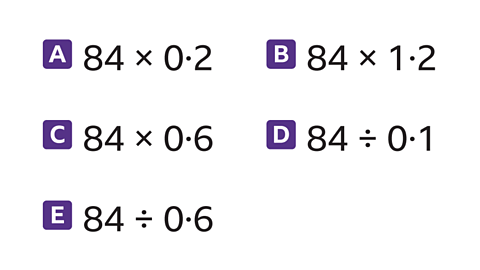
Answers B, D and E are correct and give an answer greater than 84
Remember that multiplying by a number greater than 1 gives a greater answer than the original number and dividing by a number between 0 and 1 gives a greater answer than the original number.
These calculations all give an answer greater than 84:
84 × 1∙2 = 100∙8
84 ÷ 0∙1 = 840
84 ÷ 0∙6 = 140
Practise multiplication & division of integers
Quiz
Practise multiplication and division of integers by numbers between 0 and 1 in this quiz.
Real-world maths

Calculating a measure such as speed, density or pressure may involve division and multiplication by values between 0 and 1
This method can be useful to scientists, motor mechanics and product engineers.
Revise for your exams with BBC Bitesize
Get ready for the GCSEs with quizzes, past papers, flashcards, podcasts and more resources!

More on Operations - Calculations
Find out more by working through a topic
- count10 of 10
- count1 of 10
- count2 of 10