Key points
The order of operations is a collection of rules that gives the correct sequence of steps for doing a calculation.
BIDMAS is an acronym used to tell you the correct order to complete a calculation when there are different A rule for combining numbers. For example, addition, subtraction, multiplication and division are all operations.. It stands for Brackets, Indices are powers eg, 3 to the power of 2, written 3² , Division, Multiplication, Addition and Subtraction.
Division and multiplication are both given equal priority, as are addition and subtraction.
Video
Watch the video to hear Berry discuss how remembering the correct order of operations is important when being paid in her life as a musician.
Bobby: Hi Berry, nice to meet you.
Berry: Hi, nice to meet you.
Bobby: So, you’re a musician, right?
Berry: Yeah, I’m a bassist in a band called Red Ivory.
Bobby: Exciting, so how long have you been with Red Ivory for?
Berry: We’ve been around for about a year but I’ve been playing bass and guitar for nearly two years.
Bobby: So, does your band go and perform in public?
Berry: Yeah, we gig around all of London.
Bobby: So, if people came to see your gigs, do you get paid for these?
Berry: Yeah, we get paid by how many people attend our shows and how much the tickets cost.
Bobby: So you've got money coming in but I presume you’ve also got expenses. So, how do you work out how much each member gets paid?
Berry: So, obviously, you have to subtract costs of damaged equipment, like a broken guitar string, and you also have to pay for the transportation of our equipment to and from the gigs. But after that, we can divide it equally between the four members.
Bobby: Ah! So to me, mathematically, that sounds like an ‘order of operations’. To get your pay per member, you need to multiply the ticket price by the number of tickets sold, and then subtract your expenses from that total. All before dividing by the number of band members. Since multiplication and division come before addition and subtraction in the order of operations, subtracting expenses would need to be inside the brackets.
Bobby: Does that play a part in other parts of your band or maybe even the future?
Berry: Well, we do want to release as much music that we can into the world and so, we have to save up for recording and then we have to save up for mastering those recordings, and then we can release it onto platforms.
Bobby: It sounds like you use maths quite regularly in your life as a musician.
Berry: Yeah, we do, definitely.
Using BIDMAS to carry out calculations
Remember BIDMAS is the agreed order of operations in Maths:
Brackets
Indices are How many times to use the number in a multiplication. For example, 3² is 3 to the power of 2 or 3 squared., eg 3² or 4³
Division - start on the left and work them out in the order that you find them
Multiplication - start on the left and work them out in the order that you find them
Addition
Subtraction
When only addition and subtraction are left in the calculation, work them out in the order you find them - starting from the left of the calculation and working towards the right.
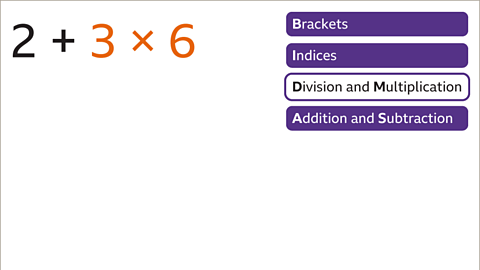
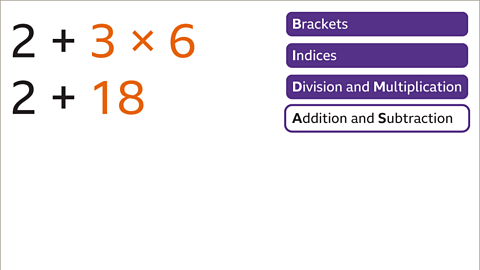
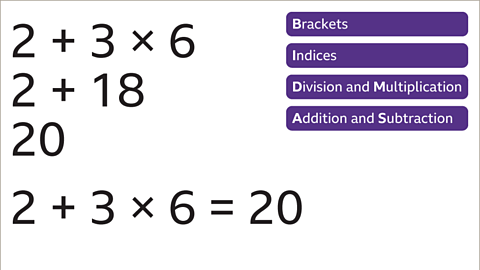
Example: calculate 2 + 3 x 6
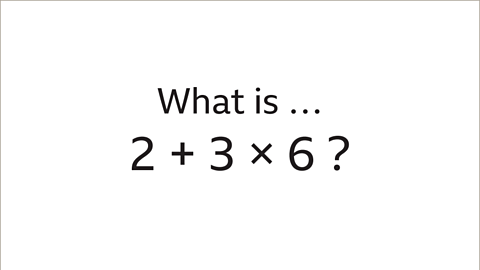
Image caption, Use the correct order of operations to do this calculation: 1. Brackets, 2. Indices, 3. Division and Multiplication, 4. Addition and Subtraction.
1 of 4
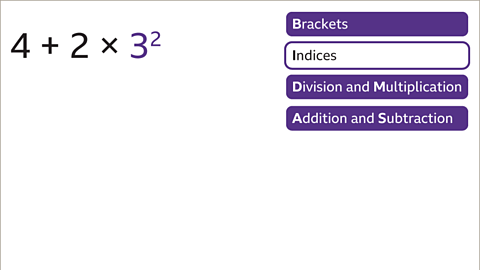
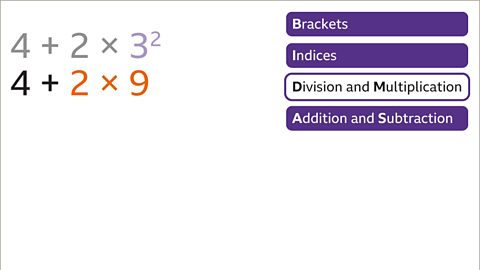
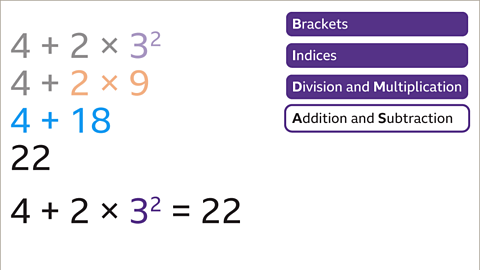
Example: calculate 4 + 2 x 3²
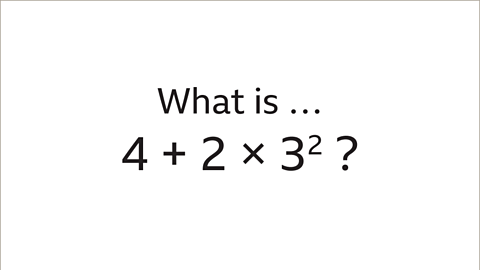
Image caption, Calculate 4 + 2 × 3² using the correct order of operations.
1 of 4
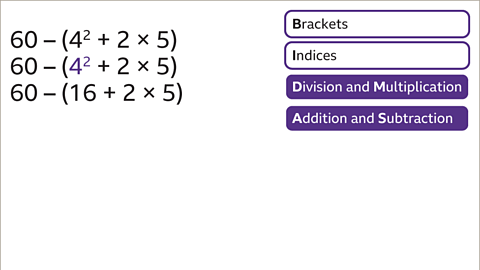
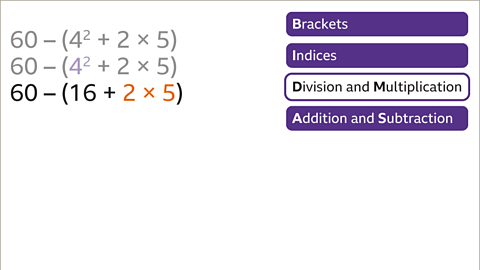
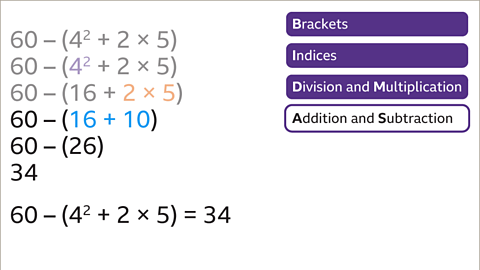
Example: calculate 60 – (4² + 2 x 5)
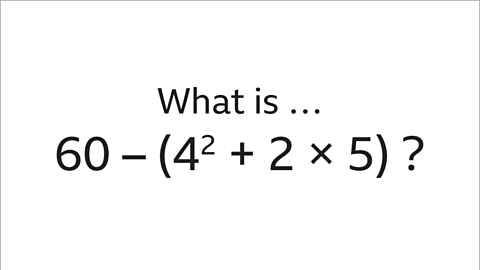
Image caption, Calculate 60 – (4² + 2 x 5) using the correct order of operations.
1 of 4
Question
Use BIDMAS to work out \( \frac{30 + 10 × 2}{6 × 4 + 1} \)
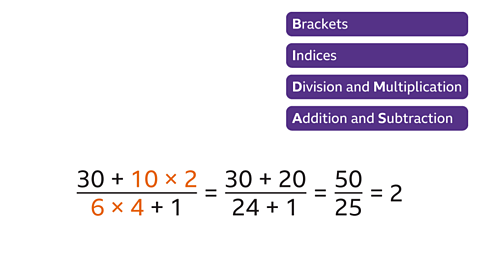
Use the correct order of operations to work out the numerator (the number written at the top of a fraction) and denominator (the number written on the bottom of a fraction), then do the division.
It is as if there are invisible brackets round the numerator and round the denominator.
Practise BIDMAS
Activity: practise order of operations using BIDMAS
Put the operations into the correct order in this activity.
Order of operations quiz
Now try this order of operations quiz. You may want to use a pen and paper to help you work out the answers.
Real-world maths

Anyone doing a calculation in any profession uses the order of operations using BIDMAS. It is all about everyone everywhere getting the same answer so we have consistency.
Calculators and computers all use this agreed order.
Revise for your exams with BBC Bitesize
Get ready for the GCSEs with quizzes, past papers, flashcards, podcasts and more resources!

More on Operations - Calculations
Find out more by working through a topic
- count2 of 10
- count3 of 10
- count4 of 10
- count5 of 10