Key points
Much Ado About Nothing is a comedy by William Shakespeare about couples who fall in love.
The play is set in Messina, Italy, and tells the story of Beatrice and Benedick.
At the start of the play, Don John arrives in Messina with his half-brother, Don Pedro.
Don John’s jealousy of his brother leads him to betray Don Pedro and his friend Claudio by ruining the wedding of Claudio and Hero.
Did you know?
In Shakespeare’s time, women were often punished harshly if they were unfaithful to their husbands. Don John uses this to his advantage to ruin Claudio and Hero’s wedding, knowing that an unfaithful woman would be shamed.
Plot summary
Don John’s key moments
Click through the slideshow to see Don John’s key moments
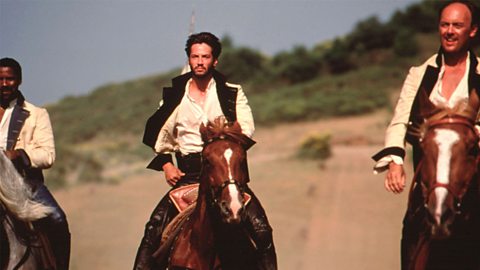
Image caption, Don John arrives in Messina with his half-brother, Don Pedro, Benedick, Claudio and other soldiers.
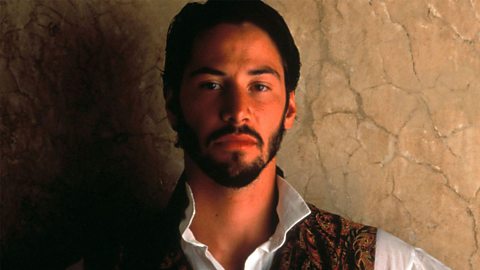
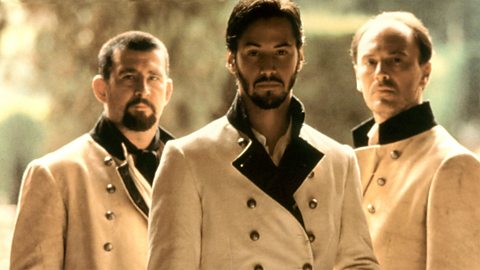
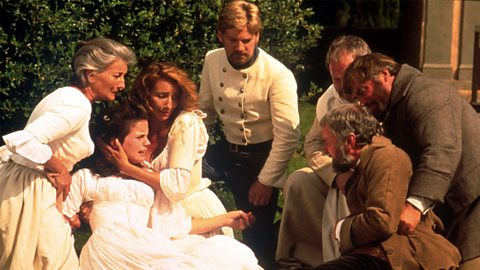
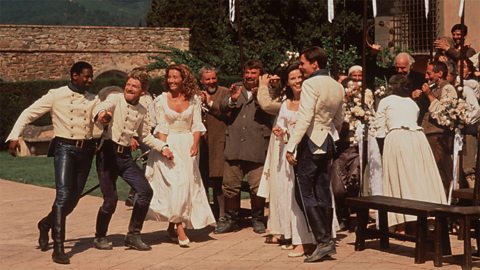
1 of 5
Character traits
Jealous
Don John hates Claudio because everything seems to be going right for him. He is also jealous because Claudio and Don Pedro have a close friendship. He calls Claudio a “young start-up” who has taken Don John’s glory from him.
Anti-social
The other characters in the play find his company uncomfortable. Don John describes himself as being “not of many words”. He finds it difficult and unpleasant to follow the rules of society.
Dishonest
Don John lies about Don Pedro wanting to marry Hero. He later lies about Hero being unfaithful to Claudio before their wedding. He compares himself to other men who like to compliment and flatter others. Don John prefers to be a “plain-dealing villain”. He takes pleasure in the outcomes of his lies.
Listening activity
In Act 1, scene 3, Don John talks to Borachio about how he cannot change his unpleasant personality. Listen to the clip and then answer the question below.
Don John: I cannot hide what I am: I must be sad
when I have cause, and smile at no man's jests: eat
when I have stomach and wait for no man's leisure: sleep
when I am drowsy, and tend on no man's business: laugh
when I am merry, and claw no man in his humour.
Conrade: Yea, but you must not make the full show of this
till you may do it without controlment. You have of
late stood out against your brother, and he hath
ta'en you newly into his grace, where it is
impossible you should take true root but by the
fair weather that you make yourself: it is needful
that you frame the season for your own harvest.
Don John: I had rather be a canker in a hedge,
than a rose in his grace, and it better fits my blood to be
disdained of all, than to fashion a carriage to rob
love from any. In this (though I cannot be said to
be a flattering honest man) it must not be denied
but I am a plain-dealing villain. I am trusted with
a muzzle and enfranchised with a clog, therefore I have decreed not
to sing in my cage. If I had my mouth, I would bite: if I had my
liberty, I would do my liking. In the meantime let me be that I am
and seek not to alter me.
What does Don John mean when he says “I had rather be a canker in a hedge than a rose in his grace”?
Don John uses a metaphor to say that he would rather appear to others as a diseased plant - a canker - than a beautiful rose. This shows both his villainous nature and his unwillingness to meet the expectations of society.
Relationships
Claudio
Claudio is Don John’s enemy. Don John dislikes Claudio and is jealous of his happiness and his closeness to Don Pedro. This leads Don John to plan to ruin the wedding between Claudio and Hero.
Don Pedro
Don Pedro is Don John’s half-brother. They share the same father but Don John’s mother was not married when he was born so he is A child born to parents who are not lawfully married..
Why don’t Don John and Don Pedro get along?
Don John is illegitimate, which means that he doesn’t have as many rights as Don Pedro and he cannot inherit his father’s land. Don Pedro will always rule over Don John as the legitimate prince, which makes Don John feel jealous and bitter towards his half-brother.
Borachio and Conrade
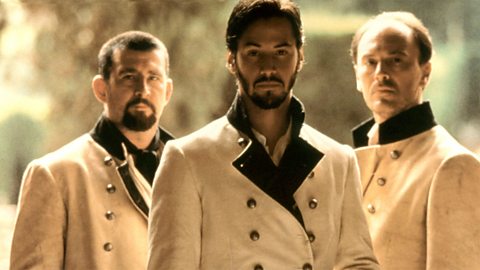
Borachio and Conrade are Don John’s friends and loyal helpers. Together, they plot to betray Don Pedro and to ruin Claudio’s happiness. They are blindly loyal to Don John but also lead to his downfall at the end of the play.
Dogberry and the watchmen overhear Borachio boasting about ruining Hero’s reputation. This leads to Don John’s arrest at the end of the play.
Video - How would you present Borachio’s plan?
Watch the video below to see how a director might present Borachio’s plan.
Presenter: Hello and welcome to The Big Scene, we’re at rehearsals for Much Ado About Nothing. Now, this director has shown some real form in this play so far, but now she faces a real challenge.
It’s Act 2, scene 2, and Borachio tells Don John of his plan to disguise Margaret as Hero to convince Claudio that she’s been unfaithful to him. Sneaky.
It’s got a little bit of everything this one, double crossing, mistaken identity and a little bit role play thrown in for good measure. It’s like Saturday night round at my house, and let me tell you, if the plan’s not clear you just end up with a roomful of confused people staring at you blankly, and you do not want that. She’s gotta get this scene bang on.
Here we go. Props, nice tactics, good formation.
Borachio: Hear me, call Margaret, Hero. Hear Margaret ,call me, Claudio.
Oh, I’m sorry, is this Claudio or is it just my macchiato?
Presenter: What a mess, and boy, does it show! Baffled, bewildered, busting for a wee.
Okay, here we go again, and as I said when I proposed to my fifth wife, if at first you don’t succeed, try something else.
Better delivery this time, this should get the plan across nicely
Oh dear, my six year old can draw better than that, and she is rubbish at art. Sorry Jennifer, but it’s true. What a wasted opportunity.
The pressure is really on now for the director, she’s got a mountain to climb to sort this mess out, and if she doesn’t, her head will be on the chopping block. Okay, it’s not that serious, but you get the point.
Oh, great move, it’s slick, it’s impressive, you can see who is who and exactly where they’re meant to be. The crowd will be right behind them for the rest of the play if they… oh no, the director’s just remembered she’s setting this back in Shakespearean times, and I’m hearing rumours that laptops weren’t invented back then. Her team are quite rightly furious.
Terrible display of communication by the director there, dreadful in fact. The worst display of…
Director: Excuse me?
Presenter: Yes.
Director: What’s that you were saying?
Presenter: Just… I thought you’d been robbed. Unlucky.
Director: Idiot.
Presenter: I didn’t know laptops hadn’t been invented then either. I really didn’t.
Changes in character
Don John does not change much throughout the play. What does change is how the other characters see him.
In the beginning Don John is openly hostile. His friend Conrade advises him to try to hide his feelings. He takes the advice and appears to be helpful to Claudio and Don Pedro, when in reality he is plotting to ruin their happiness.
Don John delights in ruining the wedding and watching Claudio publicly destroy Hero’s reputation. At this point, Claudio and Don Pedro still believe Don John’s lies.
By the end of the play, all the other characters see the reality of Don John’s character and lies when he is arrested for his actions.
Activity - Order it
What do these key quotations mean?
…it must not be denied but I am a plain-dealing villain.
Don John
Act 1, scene 3
In this scene, Don John and Conrade are alone together on stage. This allows Don John to openly state what he is really like to the audience.
…if I can cross him any way, I bless myself every way.
Don John
Act 1, scene 3
Don John is talking about Don Pedro, saying that he would like to betray, or “cross”, him any way he can. Doing this will make him happy, or “blessed”. Don John takes pleasure from causing others pain.
How tartly that gentleman looks, I never can see him but I am heart-burned an hour after.
Beatrice
Act 2, scene 1
Beatrice says that Don John appears to look bitter. Although she doesn’t see him often, when she does he gives her “heart-burn”. This shows how other characters react to Don John and what they think of him. His anti-social personality makes others feel uncomfortable
…go but with me tonight, you shall see her chamber window entered, even the night before her wedding-day.
Don John
Act 3, scene 2
Don John tells Claudio that he has proof Hero is unfaithful. When Claudio does go to Hero’s chamber window, he is actually looking at Margaret kissing another man, but he believes it is Hero.
Test your knowledge
Solve the Story!
An exciting new series from the Other Side of the Story, designed to help young people strengthen their media literacy skills.

More on Much Ado About Nothing
Find out more by working through a topic