Key points
Much Ado About Nothing is a comedy by William Shakespeare about couples falling in love.
The play is set in Messina, Italy, and tells the story of Beatrice and Benedick.
At the start of the play, Beatrice and Benedick argue and insult each other.
By the end of the play, they realise that they love each other and get married.
Did you know?
In Shakespeare’s time, there was an expectation that women would get married. Beatrice says that she is opposed to marriage several times in the play, which was unusual for the time, but then she does get married in the end.
Plot summary
Beatrice’s key moments
Click through the slideshow to see Beatrice’s key moments
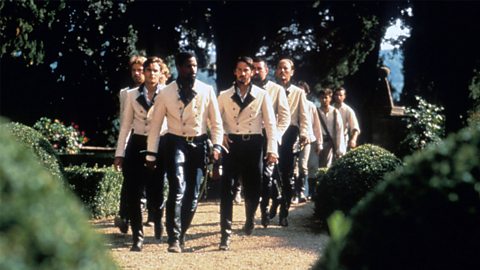
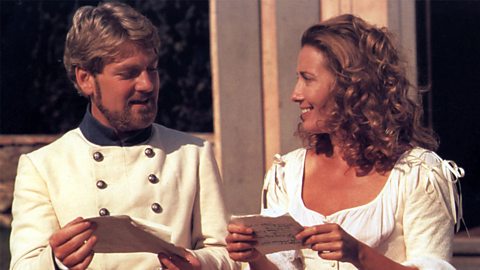
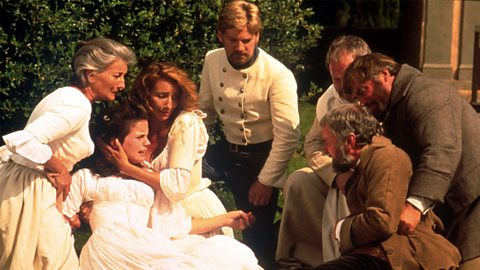
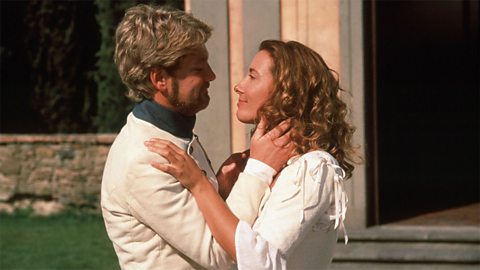
Image caption, Don Pedro and his fellow soldiers, Benedick, Claudio and Don John, arrive in Messina. Beatrice and Benedick argue and insult each other.
1 of 5
Character traits
Witty
Beatrice likes to play with words and argues with Benedick, insulting him with her sharp wit.
Independent
At the start of the play, Beatrice argues that she does not need a husband, even when Leonato tries to persuade her to marry.
Fiercely loyal
Beatrice is one of the few characters who stands up for her cousin Hero. She wishes that she were a man so that she could do more to defend Hero when she is shamed at her wedding.
Video - Rehearsing the masked ball
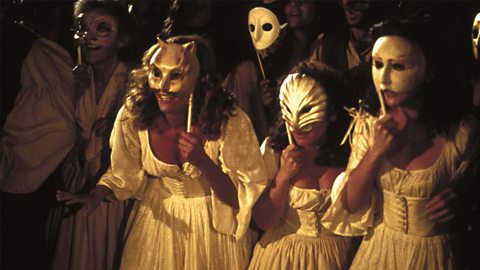
Watch this video to see how a director might stage the masked ball scene. In this scene, Benedick and Beatrice both wear masks and pretend not to know who the other is. They dance together and continue to insult each other.
Narrator: Previously on Much Ado About Nothing, Beatrice and Benedick had been at each other’s throats. And now we find them together at the masked ball. Does Beatrice know it’s Benedick? Is she playing games with him or deadly serious? All important decisions for the director. Which way he chooses to go will affect how the audience view her and the relationship through the rest of the play.
Benedick: I pray you, what is he?
Beatrice: I’m sure you know him well enough. Why, he is the Prince’s jester. A very dull fool.
Chloe: Oh my god. Totes embarrassing babes. Beatrice went up to Benedick and starts slagging him off right to his face, what a muppet! He was well devoed!
Then, some right weirdo bloke comes over, Derek Tor I think his name was, anyways, he was obvs well jell because he starts speaking to Beatrice, and then, well…
Beatrice: Only his gift is in devising impossible slanders. None but libertines delight in him.
Chloe: Derek Tor must have told her it was Benedick, ‘cause she was right messing around with him (laughs), it was proper LOLs-- I nearly peed my pants. No, really I did. Then, right, that Derek Tor bloke only comes back over and tells Bea something else, he was proper stirring it, she started acting like a right stroppy cow.
Benedick: When I know the gentleman, I’ll tell him what you say.
Beatrice: Do, do. He’ll but break a comparison on me, which, her adventure not mocked or not laughed at, strikes him into melancholy.
Chloe: I don’t know if Benedick knew it was Beatrice or not, babes, but either way, she was being totes out of order. And to think, I used to tell people she was alright, but I’ve gone right off her now. I know Benedick’s a bit of a loser, but he has feelings. And he’s well fit. Then Derek Tor starts chatting again, so, honestly, I had to say something.
I seen you chatting rubbish all night, stop getting involved, get out my face.
Director: Er, this is Much Ado About Nothing.
Chloe: It might be nothing to you, but you’re hurting people’s feelings babes, and you’re ruining the party.
Director: I think you’re confused, I’m the director.
Chloe: I know who you are Derek, now give it up.
Hiya!
How does Beatrice hurt Benedick?
Beatrice hurts Benedick with her sharp wit and clever use of words to insult him. At the masked ball she calls him a “dull fool”.
Relationships
Benedick
At the start of the play Beatrice and Benedick don’t like each other. Whenever they meet they engage in a “merry war”, arguing and insulting each other. As the play goes on, they are both tricked into thinking one is in love with the other by their friends. They then realise that they do love each other.
Hero
Beatrice and Hero are cousins. They are close, like sisters, and support each other throughout the play. Hero helps to trick Beatrice into falling in love with Benedick. Beatrice is one of the only characters to believe Hero when she is shamed by Claudio at their wedding.
Claudio
After Hero is shamed at her wedding, Beatrice asks Benedick to kill Claudio for what he has done to Hero. Although Claudio is not Beatrice’s enemy, she is fiercely loyal to her cousin and wants to defend her honour.
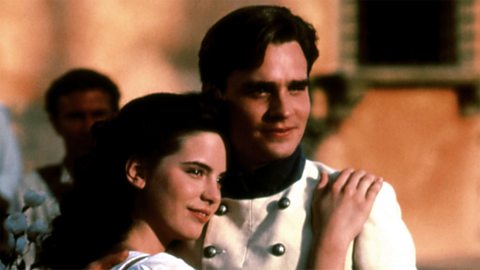
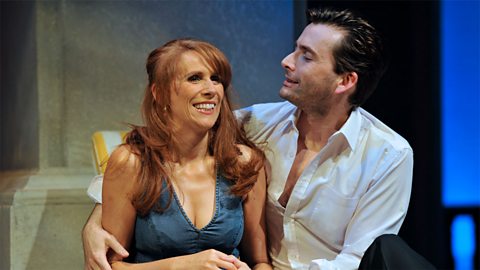
This image is taken from a 1993 film adaptation of Much Ado About Nothing. What does it show the audience about the relationship between Beatrice and Benedick?
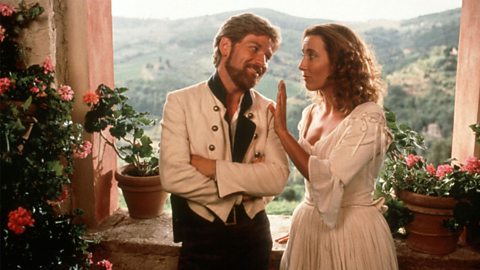
This image shows the two sides of their relationship: comedy and arguing. Benedick is smiling with his arms crossed while he looks at Beatrice. This shows his humorous response to Beatrice’s sharp wit and hints at the loving relationship they have by the end of the play. Beatrice has her hand up to Benedick with a stern look, reflecting her feelings of annoyance towards Benedick at the start of the play.
Changes in character
At the start of the play, from their very first scene together, Beatrice appears to dislike Benedick. She realises that she loves with him when she is tricked into thinking he loves her.
She is witty and opinionated throughout. At the beginning of the play she argues against marriage but after she is tricked by her friends she talks passionately about being loved by Benedick.
Beatrice has an independent streak which was quite an unusual way for women to behave in Shakespeare’s time. She refuses to marry, is cheeky to her uncle and wishes she was a man to challenge Claudio. At the end of the play she agrees to marry Benedick but continues to use her wit to make fun of him.
Activity - Order it
What do these key quotations mean?
I had rather hear my dog bark at a crow than a man swear he loves me
Beatrice
Act 1, scene 1
Beatrice is declaring her independence and does not feel like she needs a man in her life. She uses exaggeration to make her point.
I know you of old
Beatrice
Act 1, scene 1
Beatrice says this to herself at the end of an argument with Benedick. It suggests that she has known him a long time and hints that they might have had a romantic relationship in the past.
He is the prince's jester, a very dull fool
Beatrice
Act 2, scene 1
What literary device does Beatrice use here to describe Benedick?
Beatrice uses a metaphor to describe Benedick. A metaphor is a literary device that compares something to something else by saying it is that thing, even though it isn’t. Benedick is not actually a jester. Beatrice says this to him at the masked ball, which allows her to be more playful and honest whilst hidden behind her mask. She insults Benedick to his face and hurts his feelings.
Benedick love on; I will To return or respond to someone's feelings of love and affection. thee
Beatrice
Act 3, scene 2
Beatrice has overheard Hero and her gentlewoman, Ursula, saying Benedick is in love with Beatrice. Her friends’ trick works, and Beatrice believes them. She says that she will return his love.
Listen to a scene
Listen to the audio clip taken from Act 1, scene 1, in which Beatrice and Benedick argue, and then answer the question below.
Beatrice: I wonder that you will still be talking, Signior Benedick, nobody marks you.
Benedick: What, my dear Lady Disdain! Are you yet living?
Beatrice: Is it possible Disdain should die, while she hath such meet food to feed it, as Signior Benedick? Courtesy itself must convert to Disdain, if you come in her presence.
Benedick: Then is courtesy a turn-coat: but it is certain I am loved of all ladies, only you excepted: and I would I could find in my heart that I had not a hard heart, for truly I love none.
Beatrice: A dear happiness to women, they would else have been troubled with a pernicious suitor. I thank God and my cold blood, I am of your humour for that: I had rather hear my dog bark at a crow than a man swear he loves me.
Benedick: God keep your ladyship still in that mind, so some gentleman or other shall scape a predestinate (fatal) scratched face.
Beatrice: Scratching could not make it worse, an 'twere such a face as yours were.
Benedick: Well, you are a rare parrot-teacher.
Beatrice: A bird of my tongue is better than a beast of yours.
Benedick: I would my horse had the speed of your tongue, and so good a continuer but keep your way a God's name. I have done.
Beatrice: You always end with a jade's trick: I know you of old.
What does Benedick mean when he calls Beatrice a “rare parrot teacher”?
Benedick is suggesting Beatrice talks too much. Her clever use of words means that she copies Benedick, like a parrot, but turns his words into insults to use against him.
Test your knowledge
Play Bitesize secondary games. game
Have fun playing science, maths, history, geography and language games.

More on Much Ado About Nothing
Find out more by working through a topic