Key points
Richard III is a play by English playwright William Shakespeare.
Richard III is a history play, which means it is based on real people and events from history, but fictional elements have been added.
At the start of the play, Richard is the Duke of Gloucester. He then betrays his family and commits crimes until he’s crowned the king of England.
Richard III’s reign of A way of governing or ruling that is oppressive and cruel to the people. is finally ended when he is killed in battle by Richmond, who then becomes King Henry VII.
Video - Casting Richard
Watch the video below to see how a director might cast the part of Richard.
Presenter: Richard the III really existed, but wasn’t quite as gross as Shakespeare insisted. He’s a villain planning killing on his bother the King but how would you show his evil cunning? This is “Casting Richard!”
Actor 1: I, that am curtailed of this fair proportion, cheated of feature by dissembling nature, deformed, unfinished.
Presenter: Wow, a classic evil Richard with a classic Richard look, and in Shakespeare’s day, a lot of people did believe that the worse you looked, the nastier you were.
Casting director: Mmm, yeah you really do give me the creeps. So what do you do in your spare time?
Actor 1: Oh I do a lot of volunteer work for charity, help old people with their shopping, find homes for rescue dogs that sort of thing. And I also do parkour.
Argh! Mmm!
But I'm not very good at it.
Presenter: Now this is interesting. This guy’s toned down Richard’s physical impairment, perhaps to make it a less significant part of the character. He also looks pretty dapper. Let’s hope he’s rotten on the inside.
Actor 2: I am determined to prove a villain and hate the idle pleasures of these days.
Casting director: Great stuff, so do you have an agent at all?
Actor 2: I did, but I killed him and ate him.
Casting director: No agent. Good.
Presenter: Richard says that he looks so lamely and unfashionable, dogs bark at him as he passes by. I’m not sure this is quite what he meant.
Casting director: No!
Presenter: Wow! This guy’s really gone to town. Richard is hungry for power, so the mad dictator vibe could be perfect.
Actor 3: To set my brother Clarence and the King in deadly hate, the one against the other.
Casting director: Thanks for that. So what made you decide to audition today?
Actor 3: Well since those pesky rebels toppled my government, I’m ashamed to say I’ve been a little bit bored.
Casting director: Right.
Actor 3: God I’d kill for a coffee.
Did you know?
The real Richard III was the last English king to die on the battlefield. Historical evidence also suggests that Richard III was a confident A soldier who rides a horse. and a skilled warrior. Shakespeare’s Richard III is also shown as a great soldier.
Plot summary
Richard’s key moments
Click through the slideshow to see Richard’s key moments
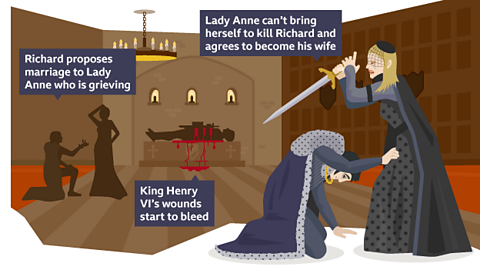
Image caption, Richard persuades Lady Anne to marry him, even though he has killed her husband and father-in-law.
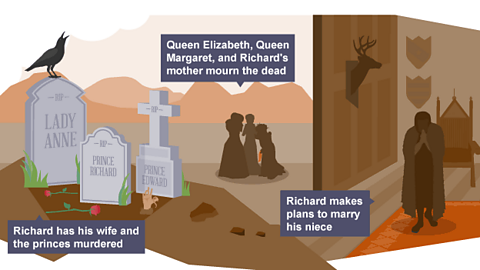
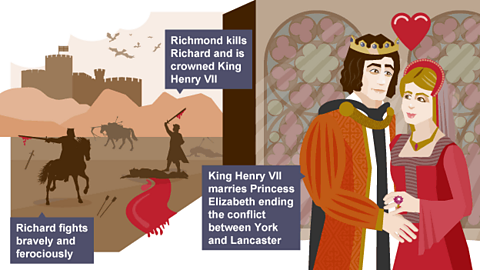
1 of 5
Character traits
Richard is a fascinating character and an entertaining villain. Although he commits terrible deeds, his energy and fearless confidence make him interesting to watch.
Cunning
Richard is intelligent and cunning. He uses language skilfully to manipulate and dominate other characters.
Immoral
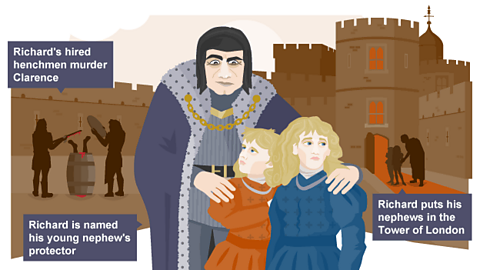
Richard commits many crimes in the play, including the murder of men, women and children. He lies to gain power and turns against his family and friends. He pretends to be a protective and harmless uncle, but secretly plans the imprisonment and murder of his young nephews.
Two-faced
Richard is a skilled actor and pretends to be caring, honest and A person who has strong religious beliefs.. He pretends to be friends with many of the characters at court but is secretly plotting against them. He shares his true nature with the audience, who can see his ruthless and immoral character.
Ambitious
Richard is determined to seize power and become king. He cleverly encourages an atmosphere of mistrust in the royal court. He then plots his way to the throne by murdering those that stand in his way. It is suggested that other characters underestimate Richard because he has a disability.
Did you know?
In 2012 the remains of the real Richard III were found underneath a car park in Leicester, England. The skeleton proved that the real Richard had a condition called scoliosis, which led to his spine being twisted with his right shoulder higher than his left shoulder.
Video - Rehearsing Richard being offered the crown
Watch the video below about how a director might stage the scene in which Richard is offered the crown and then answer the question below.
Narrator: Welcome to rehearsals for Richard III. Now we know wicked Richard really wanted be the king, but remember this is the scene where he makes Buckingham do all the hard work while he plays a God-fearing goodie two-shoes. He’s got a small crown, but it’s the big crown he’s after. The question is; how convincing should this performance be? Only the director can decide.
Lord Mayor: See how he stands between two clergymen?
Buckingham: Two props of virtue for a Christian Prince.
Chloe: Er tres amaze, I heard Richard was a right nasty bit of work, but he was praying and everything, and he’s got that bad leg bless him.
Director: Okay yeah, that, that was good, it might be a bit too convincing so…
Chloe: Yeah so that weird bloke comes over, Derek Tor, I think his name was, anyway he said something to Richard and then, well…
Buckingham: Refuse not Mighty Lord, this proffered love.
Sir Richard Catesby: Oh make them joyful. Grant them their lawful suit.
Richard: Alas why would you heap these cares on me? I am unfit for state and majesty…
Director: Yeah that’s good, let’s see how far we can push it. Can you lay it on any thicker?
Chloe: Be-have! I don’t reckon Richard is holy at all, and there they was giving him the top job and he’s acting like he don’t want it when I can tell he did want it even though he didn’t want it. Everyone was lapping it up. What a bunch of muppets. I nearly weedmyself laughing! No really I nearly did babes.
Richard: I cannot nor I will not yield to you.
Chloe: Joke! Joke.
Director: Who is that? Okay never mind. Look it’s good, it’s really good, let’s try seeing if we can add a dash of venom yeah?
Chloe: Then, then, then I don’t know what Derek Tor said to him, but one minute it was proper lols, the next it was well scary.
Richard: Your love deserves my thanks, but my desert un-meritable shuns your high request.
Chloe: Oh my G! Bitchy Richie or what? I knew he was a wrong ‘un. And everyone wanted him to be King. I had to say something.
Oi, Derek Tor–I seen you chatting rubbish; pack it in, and you lot; I know you’re game. Oi! Mayor, don’t trust him. I don’t think ‘e was even prayin.
Director: Yeah, it’s not real.
Chloe: Says you! But there’s plenty of people who do believe.
Director: Ah… let’s, let’s just take a break shall we?
Chloe: Er, what happened to his limp? You faking that an’ all? What is the matter with you people? Disgusting! I’m keeping this. I’m keeping it, you won’t need it where you’re going.
How is Richard trying to manipulate his image?
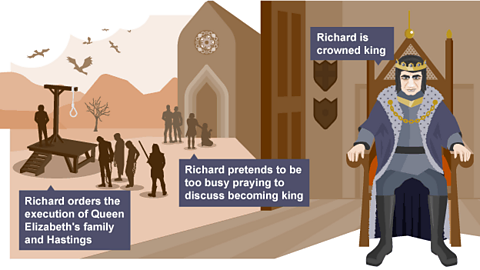
Despite his villainous nature, Richard wants to appear as a modest and pious man. He hopes this will strengthen his popularity with the common people. Buckingham stages a scene and pretends to encourage a reluctant Richard to take the crown. These political games are an attempt to shows he is a moral leader who is worthy of becoming king.
Relationships
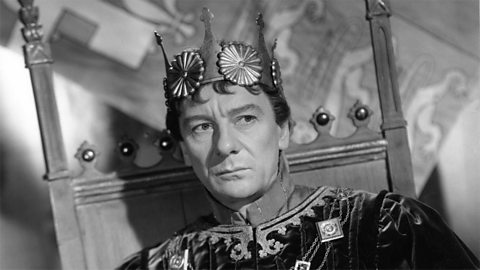
Family
Richard has no loyalty to his family and many of them are fooled by his skilful acting.
Richard’s brother Clarence is unaware of his brother’s true nature. Even as he’s about to be killed on Richard’s orders, he calls out for his brother to help him.
Richard’s brother Edward believes Richard is loyal and makes him Lord Protector of his two young sons. Richard also kills his own wife, tries to marry his niece and has his two nephews murdered.
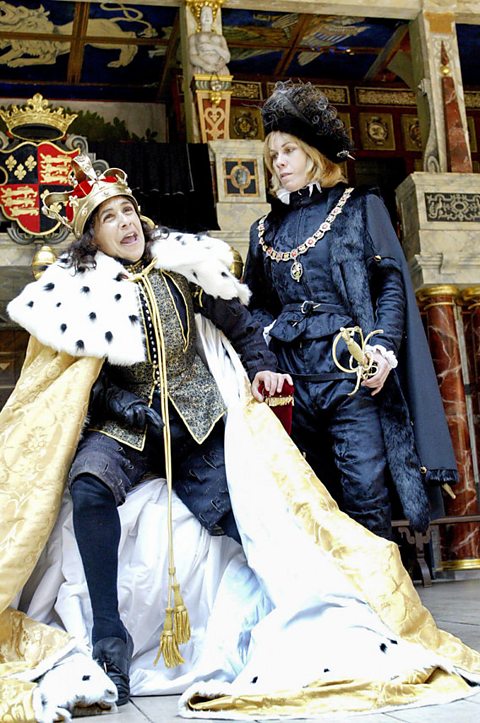
Friends and allies
Some characters, like Hastings, are manipulated by Richard’s charming side and don’t realise how dangerous he is. Hastings believes Richard is not capable of deception and thinks they are friends and allies. Hastings remains loyal to King Edward IV and his sons, so Richard makes false accusations against him and has him executed.
Buckingham is an influential nobleman. At first, he is loyal to Richard and helps him become king, including staging a scene that seems to show Richard as a pious man who is reluctant to become king.
Buckingham later decides to join Richmond against Richard when he doesn’t get his promised reward. He is captured by Richard and executed.
Enemies
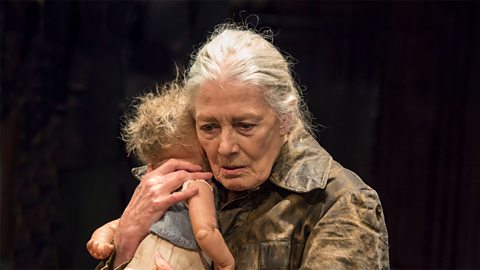
Queen Margaret is the widow of King Henry VI. Her husband has been murdered by Richard and his throne has been taken by Richard’s brother during the Wars of the Roses. She realises that Richard is evil and frequently insults and curses him. She is delighted when her curses come true.
Queen Elizabeth is married to Richard’s brother, King Edward IV. She stands up to Richard and tries to protect her sons. When Richard wants to marry her daughter, she secretly promises her daughter to Richmond instead.
The Earl of Richmond is also Richard’s enemy. Richmond raises an army against Richard, and some of Richard’s supporters even join his side in the battle. He fights Richard at the Battle of Bosworth Field and wins. He marries Queen Elizabeth’s daughter, Princess Elizabeth, and becomes the first Tudor king, Henry VII.
How do Richard’s enemies describe him?
Shakespeare uses lots of animal metaphors to show how intensely Richard’s enemies hate him. A metaphor is when something is described as something else for comparison.
For example, Queen Margaret calls Richard a dog many times. She also calls him a “rooting hog”, “poisonous bunchback’d toad” and a “bottled spider”. Richmond also refers to Richard as a “bloody dog” at the end of the play.
Changes in character

Richard doesn’t change much during the play. At the start of the play he is a villain and at the end of the play he is a villain. He shows no true feelings of guilt or remorse, even when he is visited by the ghosts of all those he had murdered.
At the start of the play, Richard is not likely to become king. He has two older brothers and their heirs standing between him and the crown. After the deaths of his two brothers, he becomes Lord Protector of the young princes. He then manipulates this position of power to gain the crown, killing his nephews in the process.
Towards the end of the play, Richard starts to lose his power. He has less control over events and starts to pity himself. Because he hasn’t shown genuine loyalty to any of his followers, many of them leave him and join his enemies.
His boldness continues to the end. He fights bravely on the battlefield before losing everything, including his life and the crown.
Activity - Order it
What do these key quotations mean?
I am determined to prove a villain
And hate the idle pleasures of these days.
Richard
Act 1, scene 1
Richard enjoys his role as a villain. He’s a man of war and action and is not suited to the “idle pleasures” of court life.
I have her, but I will not keep her long.
Richard
Act 1, scene 2
Richard has flattered Lady Anne with false words and persuaded her to marry him. In this line he shares his dark plans with the audience: he will kill her when she is no longer useful to him. His marriage to Anne is part of his plan to seize power. He later has her killed so he is free to marry his niece.
Bloody thou art, bloody will be thy end;
Shame serves thy life and doth thy death attend.
Duchess of York
Act 4, scene 4
Bloody thou art, bloody will be thy end;
Shame serves thy life and doth thy death attend.
Duchess of York
Act 4, scene 4
Richard’s own mother curses him for his immoral behaviour and predicts his violent death. The repetition and rhyme add power and force to her words. The Duchess predicts that his violent “bloody” deeds will result in his own “bloody” death.
A horse! a horse! my kingdom for a horse!
Richard
Act 5, scene 4
During the battle, Richard loses his horse. His passionate cry and the use of repetition shows his determination to fight. These are his final words before his death.
Test your knowledge
Solve the Story!
An exciting new series from the Other Side of the Story, designed to help young people strengthen their media literacy skills.

More on Richard III
Find out more by working through a topic
- count4 of 5
- count5 of 5
- count1 of 5
- count2 of 5