Overview of influence in Scotland
There are three parts to the Influence section of National 4 Modern Studies:
- media
- pressure groups
- trade unions
Look through this article for a quick guide to these areas, or to revise what you have already learned.
Click on the links to get more detailed information on each section.
Media influence in Scotland
Scotland has an independent media history, with unique newspapers, TV, and radio channels separate from the rest of the UK.
The Scottish media’s primary role is to keep the public informed on local, national, and international issues that impact Scotland.
The role of print media
- Newspapers were once the main source of political news but have declined in influence due to the internet.
- Widely read newspapers include The Scottish Sun, The Daily Record, The Herald, and The Scotsman.
- Scottish newspapers can report with a particular bias or perspective as long as their information is accurate, often leading to varied portrayals of the same story.
- During elections, newspapers may openly endorse certain political parties, though not all readers are influenced by this.
The role of broadcast media
- Broadcast media (television and radio) is legally required to provide fair and balanced reporting.
- Political debates aired on TV, while popular, have shown minimal influence on changing voter opinions.
Internet and social media:
- Increasingly, the internet, especially social media, has become a significant source of political news for many Scots.
- Online platforms provide extensive information access but can contain misinformation due to lack of regulation.
- Social media enables political parties to communicate directly with voters, broadening engagement opportunities.
Find out more detail about how the media influences politics in Scotland
Pressure group influence in Scotland
The role of pressure groups:
- Pressure groups are organisations of people with similar views who aim to influence decision-makers without seeking political power.
- They encourage public participation in democracy outside of election cycles.
Types of pressure groups in Scotland:
- Insider groups have strong government connections and are consulted by officials for advice.
- Outsider groups do not have direct government influence and rely on public campaigns to gain attention.
Methods used by pressure groups:
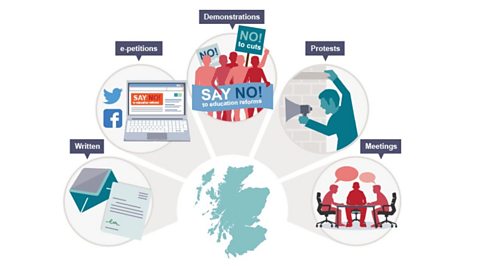
- Demonstrations, marches, and rallies.
- Petitions and direct lobbying of MSPs (Members of the Scottish Parliament).
- Media engagement including interviews, publicity stunts, and letter writing.
- Campaigns including distributing leaflets, canvassing, and raising awareness.
Factors affecting influence:
The size and membership of pressure groups significantly influence their impact, with larger groups often wielding greater power. This advantage stems from their broader public representation, and have the potential to sway election outcomes, increased capacity for long-term campaign efforts, and easier access to funding.
A pressure group’s influence is also shaped by the level of public support for its goals, the importance of the issues it highlights, and the degree of public approval for its methods.
Find out more detail about how pressure groups exert influence in Scotland
Trade union influence in Scotland
Trade unions are worker organisations focused on improving members' pay and working conditions. Members pay a subscription fee to gain benefits, including legal assistance and financial perks like mortgage deals and discounts.
Roles and negotiations of trade unions
- Trade unions play a vital role in advocating for employees, particularly in negotiating key financial aspects like salaries, pensions, and benefits.
- Workplace union representatives, known as shop stewards act as as a go-between working to bridge communication between employees and management to address and resolve workplace concerns effectively.
Union members can:
- Attend workplace meetings to discuss pay and conditions.
- Vote in union ballots to decide on actions or elect representatives.
- Stand as candidates for shop steward positions.
- Participate in industrial actions, such as strikes or work-to-rule actions.
Employers recognition of unions:
- Some employers resist union involvement, viewing it as a potential disruption to business.
- Others acknowledge the value of good worker-management relations and support union roles.
| Trade union rights | Trade union responsibilities |
|---|---|
| Organising industrial actions to protect workers' rights | Not pressuring anyone into joining |
| Holding secret ballots to decide on union actions | Consulting members on workplace changes |
| Collecting membership subscriptions | Ensuring all union activities are lawful and peaceful |
Larger unions with many members can be more influential because:
- They represent a larger segment of the population and may sway votes and elections.
- With more members, unions have more funds for campaigns and potential legal action.
Public support hinges on:
- the union's campaign relevance
- the union’s actions
- how the public is impacted (e.g., disruption from strikes).
Find out more detail about how trade unions exert influence in Scotland
More on Democracy in Scotland
Find out more by working through a topic
- count16 of 19

- count17 of 19
- count18 of 19

- count19 of 19