Key points about word order
German word order is very important because it gives a clear structure to a sentence.
In A complete sentence which can stand on its own. It has a subject and a verb and in German, the verb usually comes in the second position. , the verb is always the second idea.
When a phrase is added to the start of a sentence - for example a time or place phrase, the verb must move to the second position. This is called Switching the subject of the sentence with the verb so that the subject comes after the verb. .
If there is a second verb in the sentence, it goes at the end.
Verb as the second idea
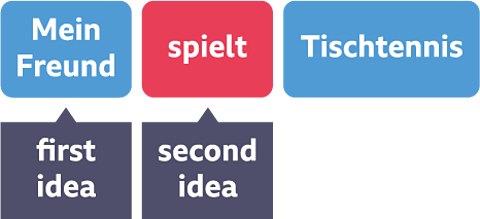
In a German sentence, the position of the verb is very important. It has to be the second idea in a sentence:
- Check your connection, refresh the page and try again.I learn German.
Here, ichthe subject is the first idea of the sentence and lernethe verb is the second idea.
The second idea isn’t always the second word:
- Check your connection, refresh the page and try again.
In this example, meine Schwester (the subject) is two words but it makes one idea. It is the first idea in the sentence. The verb is hört, so it is the second idea in the sentence.
When a phrase is added to the beginning of a sentence, the verb must still be the second idea.
- Check your connection, refresh the page and try again. – I live in England.
If a phrase is placed before it, the The person or thing doing the action, described by the verb. and the verb swap places. This is called inversion and it keeps the verb as the second idea.
For example:
Check your connection, refresh the page and try again. - In winter I live in England.
Check your connection, refresh the page and try again. - Before school, Dan plays football.
Video - How to build sentences in German
Word order: How to build sentences in German
In German the order you say and write things is important. For example, the verb is always the second idea in the sentence. Not necessarily the second word but the second idea.
Ich esse Pizza - I eat pizza.
Ich is the first idea and esse is the second idea.
But if you put oft - ‘often’ - first, the word order changes like this:
Oft is the first idea and because the verb has to be the second idea you flip the verb and the subject round to esse ich, so it would literally be Often eat I pizza.
Sometimes the first idea is not just one word but a phrase like jeden Tag - ‘every day’.
Jeden Tag esse ich Pizza - Every day I eat pizza.
Now, there are some situations where parts of verbs get booted to the end of the sentence.
For example in the perfect tense, the past participle goes to the end of the sentence.
Ich habe eine Pizza mit meinen Freunden gegessen - I have eaten a pizza with my friends.
And when you use modal verbs like ich will - ‘I want to’ - the infinitive goes to the end of the sentence.
Ich will Pizza essen - I want to eat pizza.
So with the verb as the second idea and some verbs booted to the end of the sentence you should start to get your words in the right order.
Two verb rule
In German, when using modal verbs - the perfect tense or the future and conditional tense, there are two verbs in the sentence. When a main clause has two verbs, the word order follows a specific pattern:
The first verb, which is the main The process of changing a verb to show who is doing the action. verb, goes in position two
The second verb, which is an The part of the verb found in the dictionary. It is the basic form of a verb without a subject, and the equivalent of English ‘to….’verbs. The infinitive usually ends in -en, -n, -ern, -eln in German (eg spielen – to play). or A verb form which is used to talk about the past, like ‘played’ or ‘eaten’ in English. In German these verbs often start with ‘ge’and come at the end of the sentence., goes to the very end of the sentence.
Check your connection, refresh the page and try again. - I will watch a film.
Check your connection, refresh the page and try again. - Tomorrow she wants to travel to Munich.
Check your connection, refresh the page and try again. - We went to the cinema.
Quiz
Practise what you've learned about word order with this quiz.
More on Adjectives and adverbs
Find out more by working through a topic
- count4 of 5
- count5 of 5

- count1 of 5
- count2 of 5