How do surfaces reflect light?
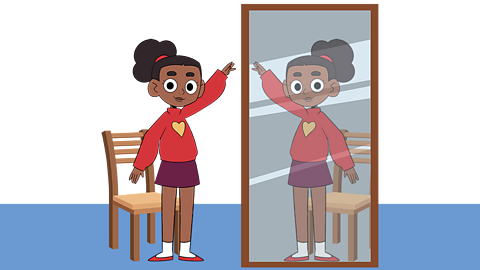
Reflection is when light energy bounces off of an object. When light is reflected, it changes direction.
All surfaces reflect light.
Smooth, shiny surfaces reflect light at the same angle as it came from, whereas uneven surfaces scatter the light in different directions and dull surfaces absorb most of the light energy, and only reflect a little.
Watch: What is reflection?
Fran: I am looking at my reflection.
When light from an object is reflected by a surface, it changes direction - it bounces off the surface.
So, if we shine this light onto this mirror, then we can see that the light reflects straight out.
Now, light travels in straight lines, so if I change this light so it now hits the mirror at an angle, then the light bounces away at that same angle.
And that means we can change the direction of light.
So let's see what one of my researchers is investigating.
Child: I'm going to see if I can move light using just this mirror.
The light is changing direction when I move the mirror.
That must be because the angle the light is hitting the mirror is changing as I move the mirror.
I wonder what would happen if I shine the light on other surfaces?
Mmm… that one's not so good - but I think I have an idea! Ta da!
Fran: It's not just mirrors that reflect light.
Lots of surfaces can reflect light, even just a little bit.
Shiny, smooth surfaces, like this metal teapot, they reflect light really well.
You can see it there on the table.
Rougher materials, like this crumpled foil, they don't reflect light as well.
And then dull surfaces, like this block of wood, don't reflect my light at all.
So, remember the next time you need to check your reflection, a smooth shiny surface will work best.
Watch: How light travels
Learn how light travels and what reflection is.
Welcome to the Grand Light Stream Derby.
Any moment now…
Yes!
We're off!
The light waves are instantly streaming away at an incredible speed!
The amazing thing is that they will carry on going forever.
Unless they bump into something.
But there's certainly plenty for them to bump into here.
And here comes the first obstacle.
It's a mirror!
Shouldn't be a problem.
A mirror is very reflective, that means of course that the light, just bounces straight off it and there they go!
What a bounce!
They've all just bounced straight off!No problems there, but they're coming up to the next obstacle it's a black wall!
Definitely a black wall!
The colour black is not very reflective.
I think this is going to be more tricky!
Oh and there it goes!
A lot of them have been absorbed!
They're gone!
Some have bounced off and kept going, but there are not so many left now!
But of course they're not slowing down and they're not stopping.
That's just not what light does.
It looks like they're approaching something else.
And they've gone!
Unbelievable!
They have gone into that eye and I think…that's it…they're not coming back.
Fascinating facts
Light coloured surfacesreflect more light than dark coloured surfaces.
Smooth surfaces, like mirrors and polished metal, are good reflectors.
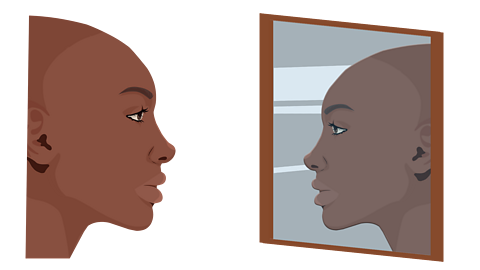
When you stand in front of a mirror, your body reflectslight patterns to the mirror, which bounce back to your eyes.
Reflection is crucial for us to see, our brain converts the light that enters our eyes into an image of what we can see.
Sound waves can also be reflected, like light.
People have used various polished objects as mirrors for many thousands of years. The German scientist Justus von Liebig created the first modern glass mirror in 1835.
We call the study of lightoptics.
Mirrors only reflect light back at us, the image itself is reversed.
How reflection works
When light from an object is reflected by a surface, it changes direction.
Light bounces off the surface at the same angle as it hits it.
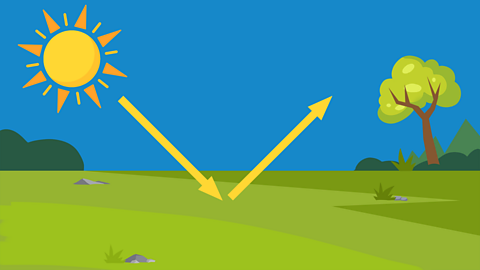
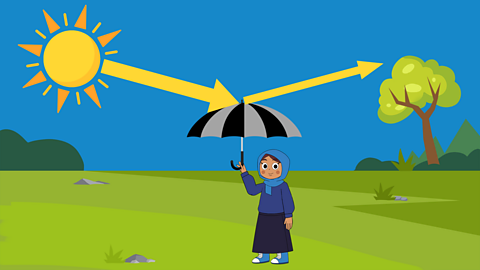
Smooth, shiny surfaces such as mirrors and polished metals reflect light well. Dull and dark surfaces, such as dark fabrics, absorb light so they do not reflect it well.
Watch: How light is reflected into our eyes
Find out how reflected light enters our eyes so that we can see.
Here’s what you want to know about reflected light.
When you look at something you can see it because light rays are reflected into your eye. The iris controls how much light enters the pupil.
The light rays are bent and focused by the lens onto the retina at the back of your eye. But at this stage, the image is upside down.
When the light sensitive cells in the retina are hit by the light, they send messages to our brain which then turns the images the right way up.
And that’s how we see.
Did you know?
Did you know that people have used the principles of reflection to create clever gadgets.
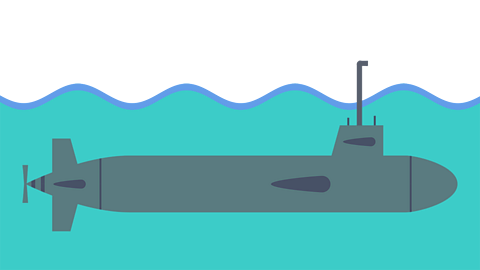
In WW1 people used the mirrors in periscopes to see over the top of the trenches.
Submarines still use periscopes to see what it above them.
Important words
Important words you need to know about reflection.
Absorb - To take in or suck up.
Dull - It is not bright or shiny, or doesn't have very much colour.
Light - Beams that can be seen by the human eye, it travels in straight lines and will keep going until it is blocked by a solid object.
Optics - The study of light.
Reflection - When light from a light source is bounced back off of an object.
Reflectors - Objects that reflect light, like mirrors.
Activities
Activity 1 – Order the stages of reflection
Activity 2 – Quiz
New game! Horrible Science: Stinky Space. game
Join Pipette on her epic mission and learn some revolting facts about space along the way.

More on Light
Find out more by working through a topic
- count3 of 3
- count1 of 3