You can’t always use a calculator or a pen and paper to work out a sum.
Sometimes you have to work it out in your head.
Sometimes it’s even faster.
There is only one rule when it comes to mental maths, if it works for you, then do it.
But here are some suggestions to get you going.
It’s easier to add together whole groups of ten, so we can put this six to one side, and that gives us 50.
Don’t throw that six away though, we are going to need it later.
Now we are left with 20 plus 50 which gives us 70. Now let’s bring that six back and we have our total.
You can use whole groups of ten to make subtraction simpler as well.
If we change this eight to a ten by counting on two, we make it easier to subtract.
Just remember to hold on to that two. So 46 take away ten equals 36. Now add on our final two to give us our answer of 38.
Also with subtraction you can count on from the lowest number to the highest to find your answer.
So with 30 minus 27 you can count on from 27 to 30 to give you the answer of three.
Very impressive, Albert.
Rounding numbers
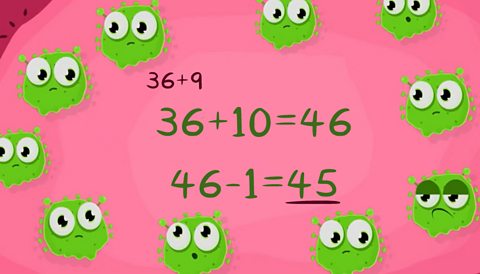
Rounding numbers to the nearest 1, 10 or 100 can help with lots of mental maths problems.
- To add 9 to another number, add 10 and then subtract 1: 36 + 9 = 36 + 10 - 1 = 45
- To add 18 to another number, add 20 and then subtract 2: 48 + 18 = 48 + 20 - 2 = 66
- To add 97 to another number, add 100 and then subtract 3: 439 + 97 = 439 + 100 - 3 = 536
- To add 0.9 to another number, add 1 and then subtract 0.1: 3.7 + 0.9 = 3.7 + 1 - 0.1 = 4.6
Breaking down numbers
Breaking down numbers can help you add or subtract in your head. For example: find the difference between 38 and 63.
- Count on from 38 to 40 and keep that 2 in your head.
- Now count on from 40 to 60, which is 20.
- Finally count from 60 to 63 which is 3.
- Add them together: 2 + 20 + 3 = 25
More on Number and number processes
Find out more by working through a topic
- count10 of 25

- count11 of 25
- count12 of 25

- count13 of 25