Aww do you wish you had more balloons?
You know, you have four balloons there. If you multiply that by ten you’d have 40.
Because to multiply anything by ten, you just move the number one place to the left and put a zero in the gap.
Or to multiply four by 100, you move the four two places to the left, add the zeros to the ones and tens columns, and that’d give you 400.
Of course, division is just the opposite. To divide by ten we take away a zero.
And to divide 400 by 100 move all digits two places to the right.
You know what’s interesting, though? If you multiply any number by one, it stays the same.
And if you multiply any number by zero, you get zero.
Useful, right?
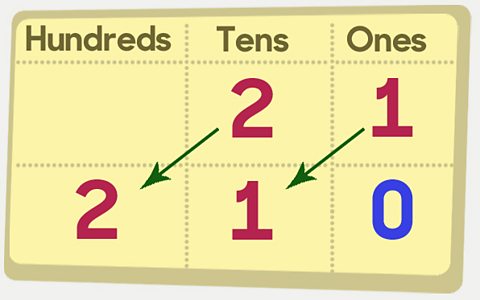
Multiplying by 1, 10, or 100
- When you multiply by 1 the answer stays the same. 21 × 1 = 21
- When you multiply by 10, move all the digits one place to the left, putting a zero in the empty space. 21 × 10 = 210
- When you multiply by 100, move all the digits two places to the left, putting a zero in the empty spaces. 21 × 100 = 2100
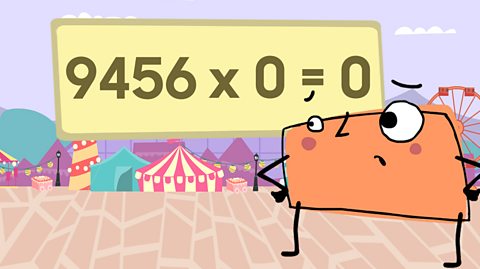
Any number multiplied by 0 is 0
- 5 × 0 = 0
- 100 × 0 = 0
- 9456 × 0 = 0
- What is 1,000,000 × 0?
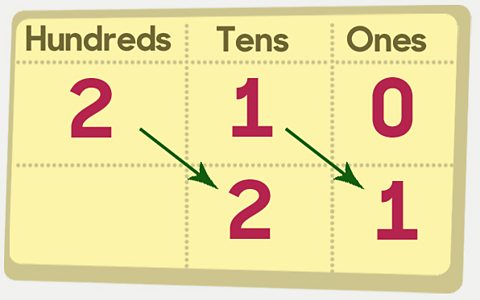
Dividing by 1, 10 or 100
- When you divide by 1 the answer stays the same. 21 ÷ 1 = 21
- When you divide by 10, move all the digits one place to the right. 210 ÷ 10 = 21
- When you divide by 100, move all the digits two places to the right. 2100 ÷ 100 = 21
More on Number and number processes
Find out more by working through a topic
- count11 of 25

- count12 of 25

- count13 of 25

- count14 of 25