What are the key points about the reflection and refraction of waves?
Wavefronts.
Reflection wavefront diagrams.
Refraction wavefront diagrams.
How are wavefronts observed in a ripple tank?
A ripple tank can be used to investigate the The number of waves produced each second. The unit of frequency is hertz (Hz)., The length of a single wave, measured from one wave peak to the next. and the speed of water waves.
A ripple tank is a transparent shallow tray of water with a light shining down through it onto a white card below.
The light allows you to see the motion of the ripples created on the water's surface more easily.
Ripples can be made by hand but to generate regular ripples it is better to use a motor.
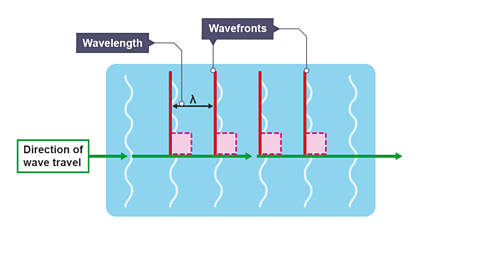
Wavefronts
When drawing wave diagrams, it is easier to draw wavefronts rather than The topmost part of a wave. and The bottommost point of a wave..
Each wavefront is drawn at right angles to the wave direction.
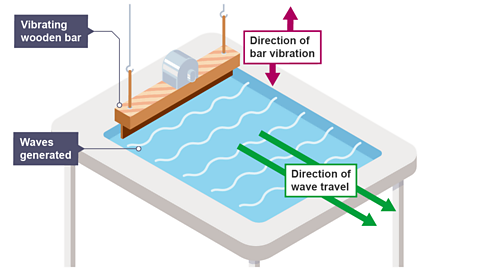
Image caption, 1. A wooden bar vibrating up and down creates waves on the surface of the water.
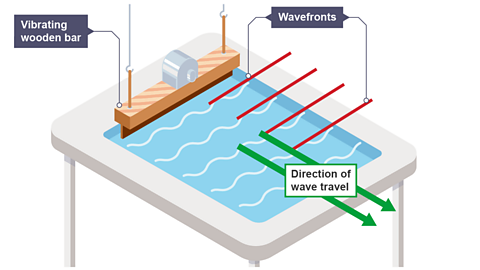
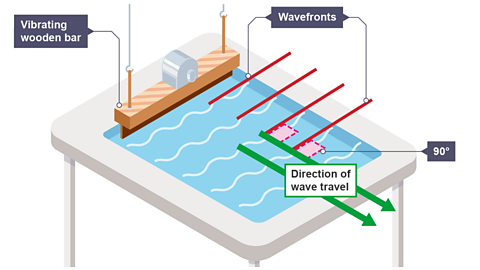
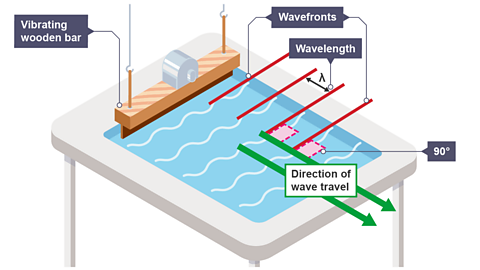
1 of 5
How are waves reflected?
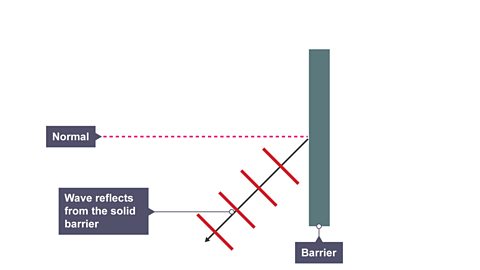
Waves - including water waves, sound and light - can be reflected at the boundary between two different materials.
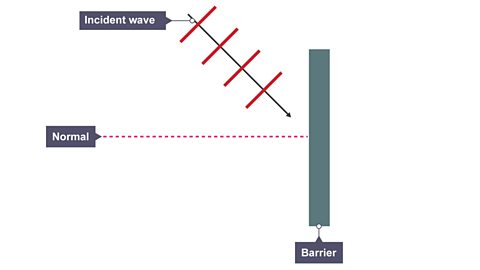
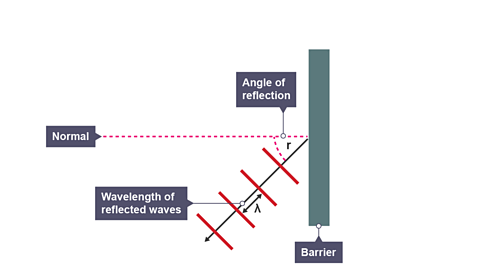
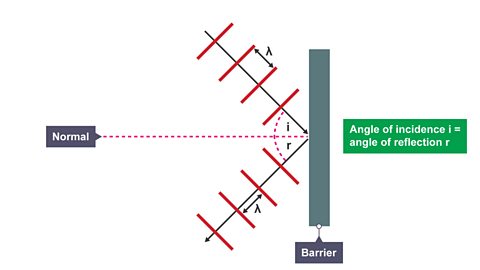
Image caption, 1. Incident wave before hitting the barrier.
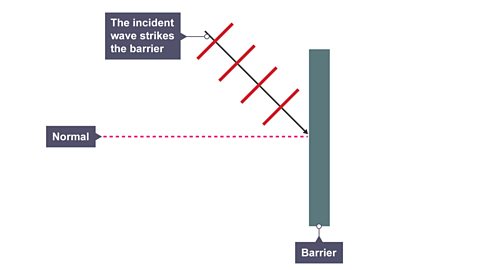
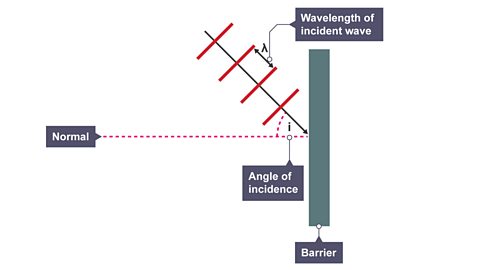
1 of 6
Key points
When waves are reflected:
- angle of incidence i = angle of reflection r
- wavelength remains unchanged
- frequency remains unchanged
How are waves refracted?
Refraction is the change in direction of a wave as it travels from one medium to another.
For instance, when light travels from air to glass or water waves travel from deep to shallow water.
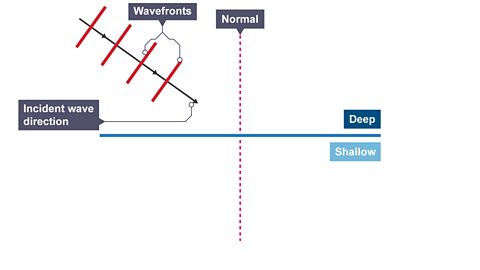
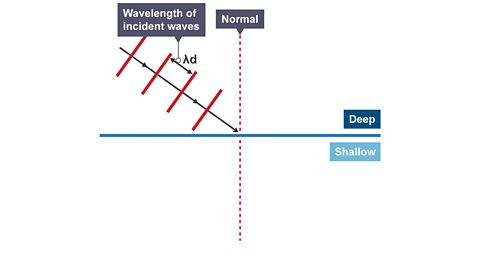
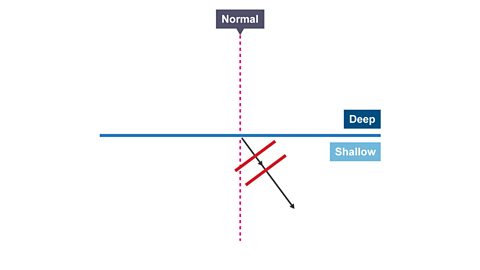
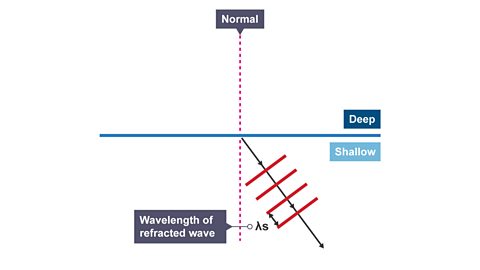
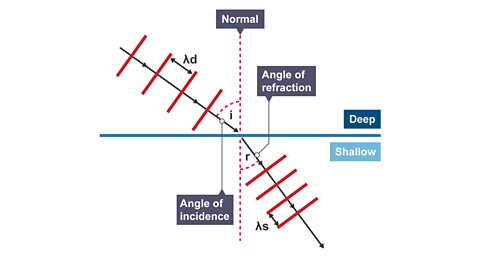
Image caption, 1. A water wave approaches a boundary between deep and shallow water. The normal is an imaginary line perpendicular to the boundary. Notice the normal extends across - on both sides of the boundary)
1 of 5
As the waves slow down the waves change direction towards the normal.
The The number of waves produced each second. The unit of frequency is hertz (Hz). of the waves does not change because the source of the waves continues to vibrate at the same frequency.
Since v = f λ
If the speed, v, decreases and the frequency, f, remains unchanged, then the The length of a single wave, measured from one wave peak to the next., λ, must also decrease.
\(\lambda\)shallow is shorter than \(\lambda\)deep
Key point
FAST is a useful way of remembering the speed and direction changes of waves during refraction:
- If waves get Faster, they bend Away from the normal
- If waves get Slower, they bend Towards the normal
| Letter | Meaning |
|---|---|
| F | Faster |
| A | Away |
| S | Slower |
| T | Towards |
What happens to the speed and wavelength when waves are refracted?
If waves are incident along the normal when passing from one medium to another, their speed and The length of a single wave, measured from one wave peak to the next. change but their direction does not change.
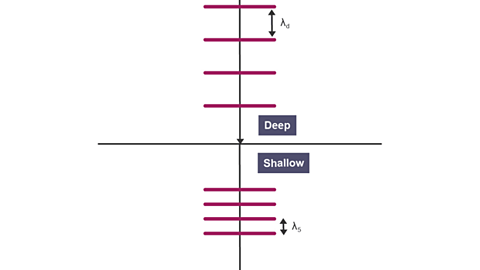
Image caption, Speed and wavelength
Waves incident along the normal and passing from deep to shallow water...
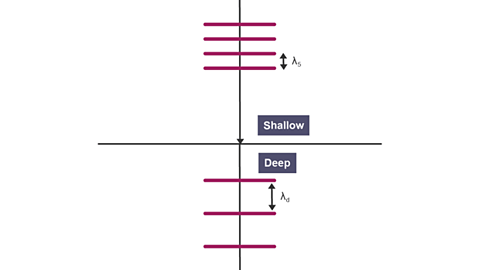
1 of 2
The diagram below shows the refraction of waves passing from air to water (the equivalent of from deep to shallow).
As the waves travel from air to water, they slow down – water is denser than air.
They refract towards the normal and wavelength decreases.
The frequency of the waves remains unchanged.
| Property | Reflection | Refraction: deep to shallow | Refraction: shallow to deep |
|---|---|---|---|
| Speed v | Unchanged | Decreases (Slower) | Increases (Faster) |
| Direction | i = r | Towards the normal | Away from the normal |
| Frequency f | Unchanged | Unchanged | Unchanged |
| Wavelength λ | Unchanged | Decreases | Increases |
How much do you know about the reflection and refraction of waves?
More on Unit 2: Waves
Find out more by working through a topic
- count4 of 5
- count5 of 5
- count1 of 5
- count2 of 5