Time to the nearest minute

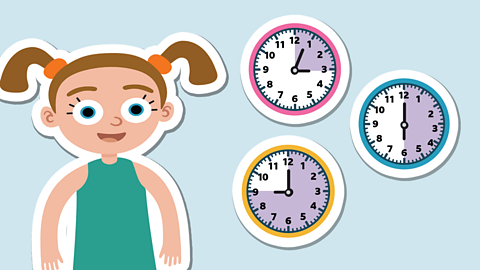
When you look at an analogue clock, you see 12 numbers.
There is a long minute hand and a short hour hand.
Depending where they point, you can work out what the time is.
Activity: Time to the nearest minute
Learn more about telling the time to the nearest minute with this interactive activity and then put your knowledge to the test with a quiz.
How to tell the time to the nearest minute
You can use clocks to tell the time to the nearest minute.
To do that, you have to look closely at where the minute hand (the long hand) is pointing.
You also need to remember how many minutes 'past' or 'to' each of the numbers on the clock shows. You can count in fives to help do this.
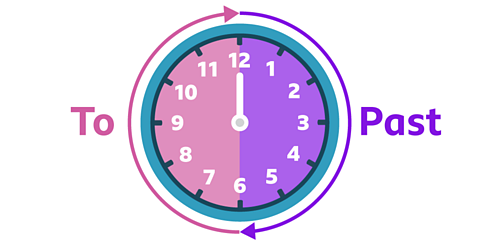
You then need to have a look at the number of small marks that the minute hand has passed.
On the clock below, the minute hand is pointing to two minutes past the 2 hour marker.
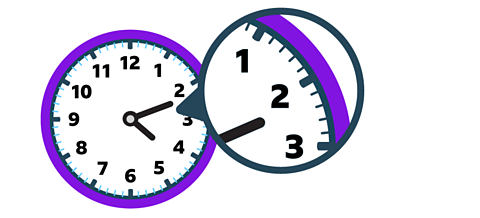
Each number on the clock represents 5 minutes. So this clock shows the minute hand has reached '12 minutes past' the hour.
Therefore, the time on this clock is '12 minutes past 4'.
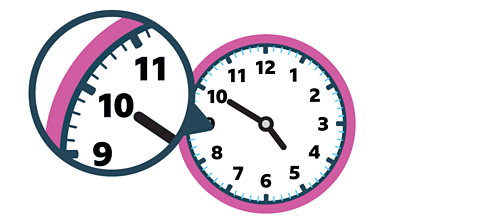
On the next clock, you can see the time is '10 minutes to 5 o'clock'.
Example 1
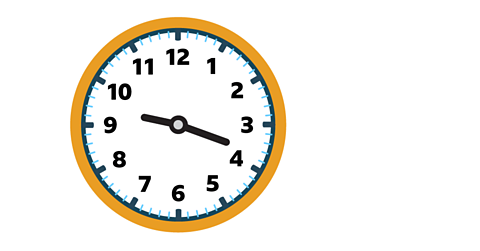
We know the hour is 9, but what is the nearest minute?
✓ To work this out, you need to look closely at where the minute hand is.
You can see that it's gone three more minutes past the 3 hour marker.
So, it's showing us '18 minutes past 9'.

Example 2
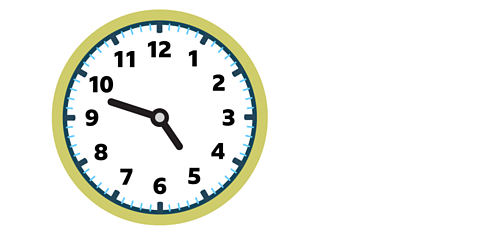
If you look at the minute hand on this clock, it's 12 minutes to.
But, what is the hour?
✓ To work this out, you need to look closely at where the hour hand is.
You can see the hour hand is past the 4, but not yet at the 5.
You know the next hour is going to be 5.
So, it's showing us '12 minutes to 5'.

Example 3
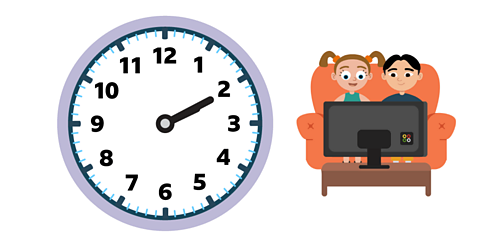
A TV show starts at 10 past 2. The show lasts for 25 minutes.
What time will it end?
✓ The hour is 2 and the minutes are 10.
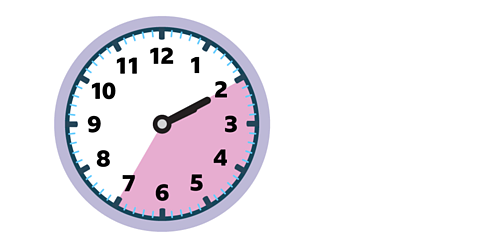
You know the clock numbers show every 5 minutes.
So you can count the minutes in 5s around the clock.
5, 10, 15, 20, 25 minutes, which takes you up to 35 minutes past 2.
Or '25 to 3 o'clock'.
More on Time
Find out more by working through a topic
- count2 of 6
- count3 of 6
- count4 of 6
- count5 of 6