More and more people are questioning the ways human beings use animals, and some are actively turning away from using animal products in their daily lives. Religious and non-religious people hold varying views about the status of animals, and of animal rights.
Explore the issues
Watch Shola as she explores religious and non-religious teachings about the treatment of animals.
We use animals in all kinds of ways: for food, work, sports and entertainment. But does it matter how we treat animals?
Hindus and Sikhs believe that the life of God lives in all things and that animals should be treated kindly. And in Hinduism, some animals like monkeys, cows and elephants get special respect. Most Buddhists, Hindus and Sikhs try to follow the principle of ahimsa, which means non-violence or doing no harm. So you'll usually find that no meat is allowed in their temples, only vegetarian food.
Judaism, Christianity and Islam all teach that animals are precious because they were made by God. The Bible has a long list of laws about which animals can and can't be eaten and most Jews still follow these rules.
The Qur'an allows Muslims to eat meat. But again, there are rules about which animals can and can't be eaten. Islam and Judaism both have rules about how animals should be killed for food, partly to reduce their suffering but some people feel the rules need to be updated to reduce the animal's pain.
But do we need to use animals for food at all? Maybe we should think about the effect our love for burgers is having on the planet. Large areas of the world's forests have been cleared to make room for cattle, causing wider problems like climate change.
And in this country, there are factory farms which keep thousands of cattle, pigs or chickens in cramped conditions inside massive industrial sheds. So, more and more people are cutting down on meat or becoming vegetarian or vegan for ethical as well as religious reasons.
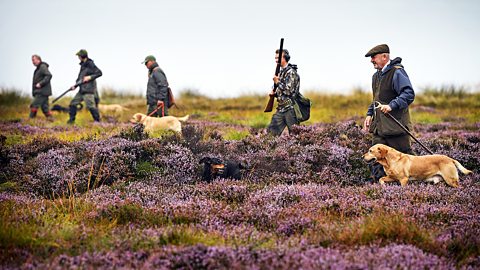
But we also use animals for entertainment and animal rights campaigners want most of it stopped: bird shooting, greyhound racing, horse racing, circus animals, even zoos. One very tricky area is the use of animals in scientific research. New drugs and medical treatments are often tested on animals to make sure that they're safe for humans. But it's argued that scientists could use cells grown in a laboratory or donated human organs instead.
So what do you think? Do animals matter? Are they one of the earth's resources for us to use or do they have rights that we should be thinking about?
Animal rights
Animal rights refers to the idea that animals should be entitled to live lives that are free from abuse by humans. In the UK, there are laws designed to protect animals from cruelty. For instance, it is a crime to neglect or mistreat an animal, including when an animal is being transported or slaughtered. It is also illegal to stage fights between animals for entertainment, or to test cosmetics on animals. Some forms of hunting are also illegal and people can be fined or face imprisonment if they cause unnecessary suffering to animals.
While most people believe it is acceptable to use animals for food and clothing, increasing numbers of people are turning to vegetarian or vegan ways of living. This may be due to the belief that animals deserve rights, the most basic being the right to life. Some people choose to follow a vegetarian or vegan diet out of concerns about the impact of meat and animal products on the environment, especially those produced by factory farming methods. As well as food and clothing, some people question the use of animals for entertainment and in experimental testing for cosmetics, household products, or medicines.
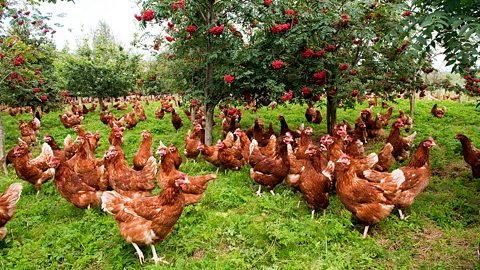
Evolution or creation?
Many religions view humans as superior to animals. For example, Jews and Christians believe that when the world was created, God told humans to rule over it, and therefore they can treat animals however they like. Non-religious people, such as Humanists, point out that the Theory of Evolution presents a big challenge to the idea that animals were put on the earth by God for us to use. How could animals have been made for us to use if we actually evolved from them?
Also, scientists are discovering that many animals are much more intelligent than we thought, and have greater abilities to communicate. They feel pain, pleasure and even some emotions in similar ways to us. Science shows us how closely related we are, in terms of our DNA, to many other species. This leads some people to conclude that animals should have rights, and that it is wrong to treat them in ways that cause them to suffer, even if human beings benefit from it.
Words of wisdom
What do religions and non-religious literature and texts teach about our treatment of animals? Click the picture below to find out.
Reincarnation
Buddhists, Sikhs and Hindus believe that everything is connected through the cycle of birth and rebirth. Therefore, the idea of ruling over the animals is not a belief shared by these religions. Many of these believers live a vegan or vegetarian lifestyle. However, some would argue that they value human life as higher than animal life because being reincarnated in human form is thought of as being better than being born as an animal.
Animals as food
In some religions there are strict rules about the use of animals. For instance, in Judaism and Islam, animals must be slaughtered for food in very specific ways by specially trained religious people who will say blessings over them. Also, it is forbidden to eat certain animals, like pigs. In Islam killing animals is only allowed in order to provide food. Hunting for pleasure is not allowed. Muslims may keep animals as pets, although generally keeping dogs is not allowed unless for a practical reason, for example guarding livestock. Many Christians, Jews and Muslims believe that caring for animals is a very important part of being a good caretaker for God’s earth and some campaign for better treatment of animals, and even adopting vegan or vegetarian lifestyles.
Animals and animal rights in pictures
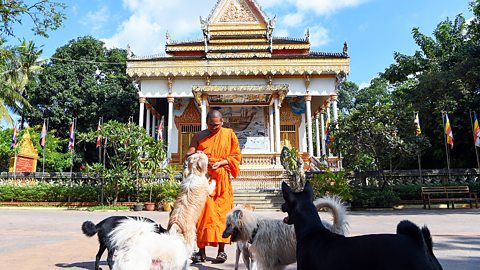
Image caption, Buddhism – A monk caring for dogs
A Buddhist monk, Hul Houth Hab, from Cambodia, adopts and cares for dogs abandoned by their owners. This reflects the Buddhist belief of showing loving kindness and compassion, as well as the belief in the interconnectedness of all different forms of life. Why do some people believe those with a religious faith have a duty to care for animals?
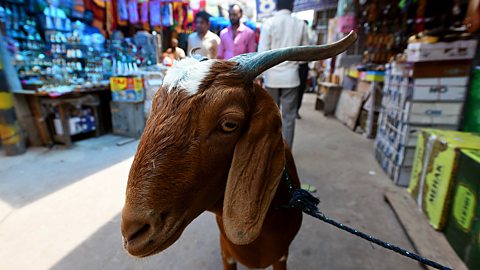


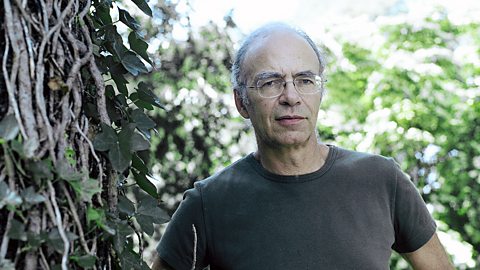
1 of 7
Careers advice and tips from BBC Bitesize
Future careers, further studies and the world of work - we're here to help with advice from experts and from young people who've found their path.

More on Morals, ethics and philosophy
Find out more by working through a topic
- count1 of 8
- count3 of 8