What are pulleys, levers and gears?
A pulley is a type of wheel that has an inner groove.
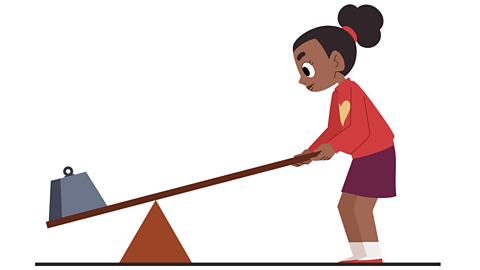
A lever is a simple mechanism that uses a bar to pivot around a fixed point called a fulcrum.
A gear is a special wheel that has parts called teeth around its outer edge (its circumference).
Pulleys, levers and gears allow a larger force to act upon a load than is supplied by the effort. Therefore, it is easier to move large or heavy objects.
The longer the pulley, lever or gear is, the further the effort acts from the pivot, and the greater the force on the load will be.
Watch: Gears and pulleys
Join Sam in his workshop to learn how gears and pulleys work.
Have you ever seen a flag being raised, or wondered how a mechanical clock works? Let’s take a look at some of the simple mechanisms that they use.
Pulleys and gears.
When a flag is raised, it will often be lifted using a pulley mechanism.
A pulley is a wheel on a fixed axle. The wheels normally have a groove in them, to guide a rope or cable through.
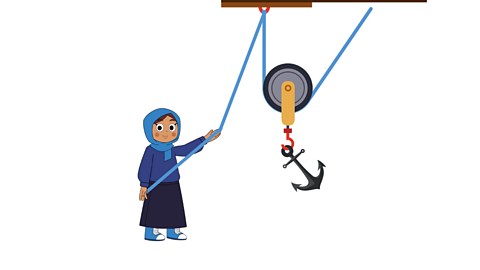
One end of the rope is attached to a load that needs to be lifted. Then the other end of the rope is looped through the groove on the pulley wheel.
When you pull the opposite end of the rope, the pulley mechanism changes the direction of the force applied, which lifts a load like this.
The more pulley wheels you add to the mechanism, the less force is required to move the load. Pulleys are used to help lift many things. Lifts, window blinds and cranes often use pulley systems. Let’s change gear to look at gears.
Gears are also wheels attached to a fixed axle, but rather than a groove, they have little teeth that can slot together with other gear wheels. When one gear wheel turns, the other turns too, in the opposite direction.
If the gear wheels are different sizes, they can be used to change the rotating speed and the turning force of the other gear wheel.
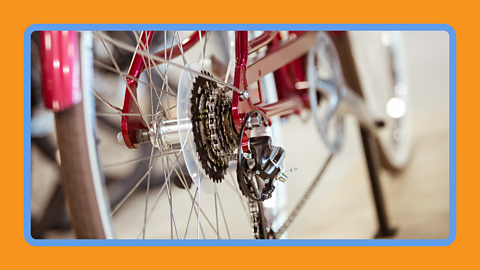
For example, if we have a larger gear wheel attached to a smaller gear wheel like this, when we turn the larger gear wheel, the smaller gear wheel rotates more quickly. This is how bicycles work.
They use a chain to connect the gears. When you turn the pedals, the force turns the larger gear. This then turns the smaller gear, which rotates much more quickly on the back wheel, making the bicycle move forward.
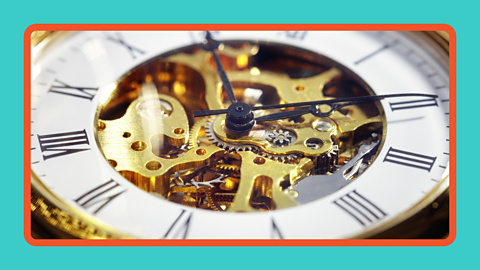
Some bicycles also have gear systems that allow you to change the size of the gear wheel, making it easier to pedal uphill.Gears are also used in clocks, watches and engines.
So, there we are, gears and pulleys.
Mechanisms that use wheels and circular motion to make things move.
Fascinating facts
Gears were mentioned by the ancient Greece philosopher and scientist Aristotle around 300 BC.
Gears were originally wooden (and prone to breaking) and used for watermills and windmills.
Gears are found in items we use every day, such as bicycles, clocks, and cars.
Pulleys were used by ancient Egyptians to help build the pyramids.
Pulleys were likely used in construction cranes to lift heavy loads from one place to another.
Levers have been used for many thousands of years. Evidence has been found of levers dating back to around 5000 BC.
What are pulleys?
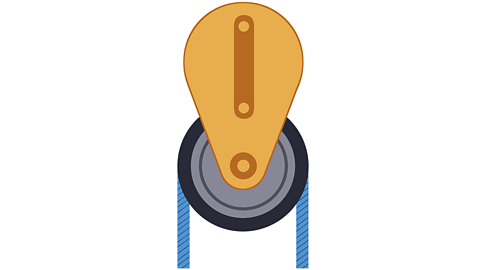
A pulley is a type of wheel that has an inner groove on its edge.
When a rope, cable or belt runs along the groove, objects can be moved and lifted with far less effort.
It’s easier when two people share the lifting of heavy objects and pulleys work in the same way.
When you pull the rope, the pulley helps you lift heavy objects more easily because it spreads out the effort needed between the pulley and your hands.
Think about when you want to lift a heavy load, like a bucket of water. If you just try to lift it directly, it can be quite heavy. But if you use a pulley, you can change the direction of your pull. Instead of lifting the bucket straight up, you can pull down on the rope, making it easier to lift the bucket.
Pulleys are found in lifts, cranes, car engines and garage doors.
Types of pulleys
Fixed pulleys and moveable pulleys are two of the most common types of pulleys.
Fixed pulleys
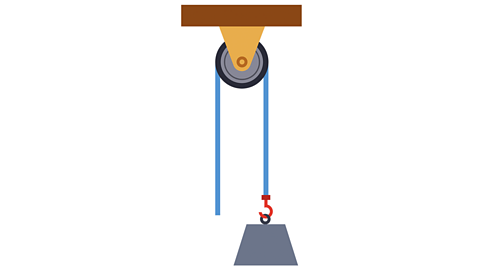
Fixed pulleys are attached to a single point, like a ceiling or a tower.
When the rope is pulled down, the load moves up, making it easier to lift heavy objects.
Imagine trying to lift a heavy backpack. If you could use a pulley, you could lift that backpack much more easily!
Moveable pulleys
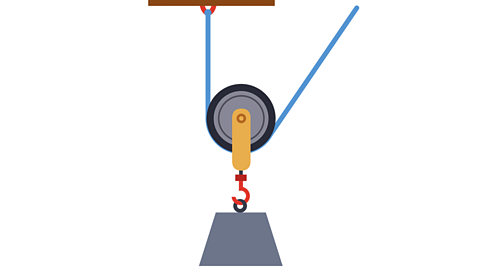
In moveable pulleys, one end of the rope is fixed, and the pulley itself is free to move.
When the free end of the rope is pulled, the load travels up, and only half the force is required.
These types of pulleys can be found in cranes and lifts.
What are levers?
A lever is a simple mechanism that has a rigid bar or beam that pivots or rotates around a fixed point called a fulcrum.
A lever has three important parts:
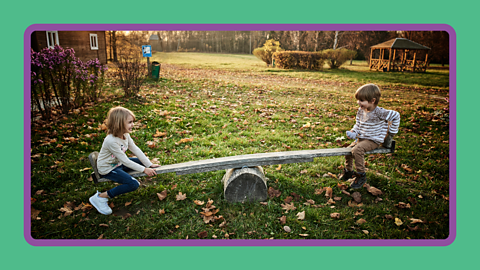
- Load – The load is the object that is being moved. It could be a large rock, a filled bucket, or even a friend sitting on a seesaw.
- Fulcrum – This is the spot where the lever sits. It allows the lever to move up and down, side to side, in a curve, or around and around.
- Effort – This is the power that we use to make the lever work. When we push or pull to move things we use our muscles to make the lever do its job.
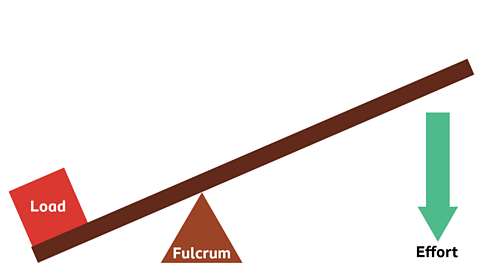
Levers can make work easier by changing the direction or strength of a force.
When effort is used to push down on one end of the lever, the load on the other end goes up.
This makes it easier to lift heavy objects because you can use the lever to help with the hard work.
Some examples of everyday levers are scissors, bottle openers and cooking tongs.
What are gears?
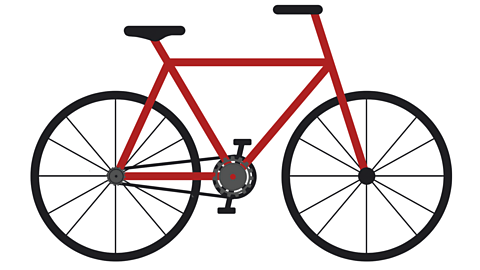
A gear is a special wheel that has parts called teeth around its outer edge.
These teeth interlock with the teeth of another gear, belt or chain.
When two or more gears are connected, they transfer motion and power from one gear to another.
Gears can be found in machinery including bicycles, cars and clocks.
Explaining gears
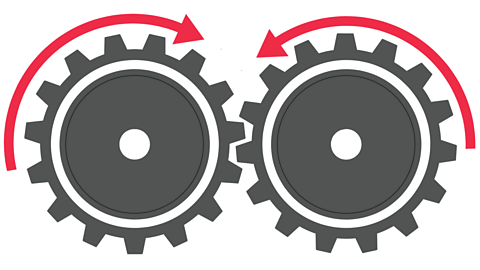
Direction of rotation
Gears can change the direction of rotation. When gears are interlocked, they turn in opposite directions.
Gear speed
When a smaller gearinterlocks with a larger gear, the larger one turns more slowly than the smaller one which turns quickly.
When a larger gear turns a smaller gear, it increases the speed of the smaller gear.
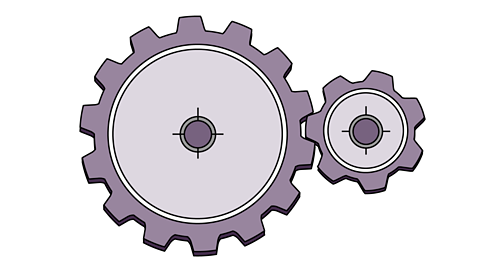
Gear power
When a smaller gear turns a larger gear, the larger gear turns at a slower rate than the smaller gear but it is more powerful.
This combination of gears lets a bicycle convert fast pedalling into a slower but more powerful rotation of a wheel. This can help you with climbing a steep hill.
Gear ratio
ln the example right, the larger gear is twice as big as the smaller gear, with twice as many teeth.
The smaller gear will rotate twice for every one rotation of the larger gear. We call this a gear ratio of 2:1.
Slideshow: Pulleys, levers and gears
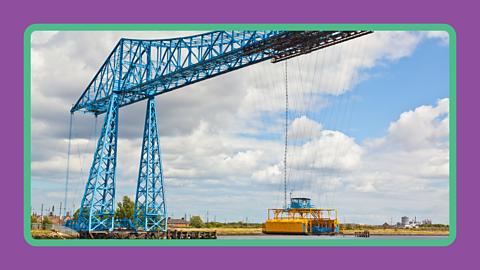
Image caption, Pulleys
A pulley is a type of wheel that has an inner groove on its edge. When a rope, cable or belt runs along the groove, objects can be moved and lifted with far less effort. The Middlesbrough Transporter Bridge uses a series of pulleys to carry heavy loads across the River Tees.
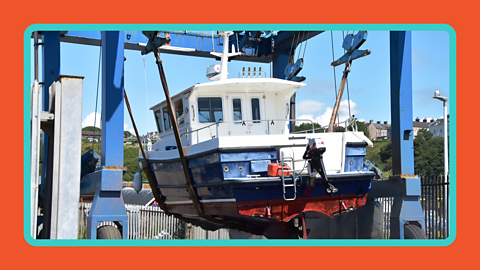

1 of 6
Did you know?
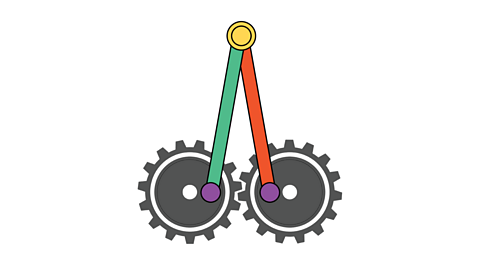
Levers or gears can be joined together to form linkages.
A linkage is a mechanism which is made by connecting levers or gears together through joints known as pivot points.
Linkages can be found in lots of things we use everyday, like cars and machinery.
Important words
Fixed pulleys – A pulley that is attached to a fixed point, like a ceiling or a tower.
Fulcrum – The place where a lever turns or is supported.
Gears – A mechanical part with teeth that interlock with another gear or belt. Gears transfer motion and power while changing speed or direction in a mechanical system.
Interlock – To connect or engage two or more parts in a way that they fit together securely, stopping separation or movement.
Levers – A simple mechanism that helps us move things more easily. A lever has three important parts: the fulcrum, the load, and the effort.
Linkages – A mechanism which is made by connecting levers or gears together through joints known as pivot points.
Mechanism – A set of moving parts that work together to make something happen.
Moveable pulleys – A pulley where one end of the rope is fixed, and the pulley itself is free to move.
Pulleys – A simple machine consisting of a grooved wheel on an axle. A pulley guides a rope, belt, or cable.
Wheel – A circular object that rotates around a central axis.
Activities
Activity 1 – Take the quiz
Activity 2 – Label the pulleys, levers and gears

New game! Horrible Science: Stinky Space. game
Join Pipette on her epic mission and learn some revolting facts about space along the way.

More on Forces
Find out more by working through a topic
- count1 of 3

- count2 of 3