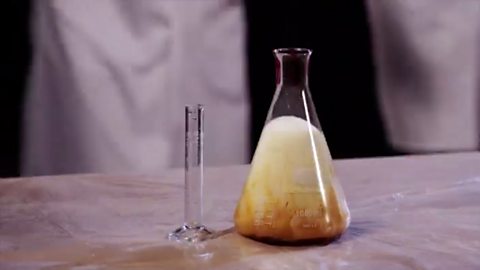
Analysing data
The results obtained from an experiment need to be analysed to understand the findings.
Using the data collected, we can identify relationships between the independent and dependent variables and explain their meaning.
Graphs
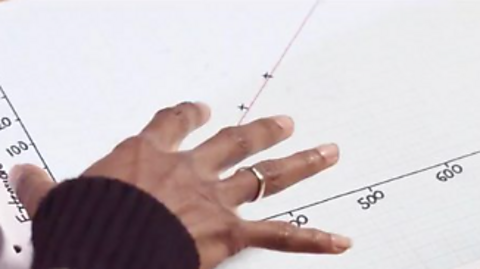
Graphs are drawn to show experimental data obtained during scientific experiments.
It is important to consider the following when drawing a graph:
- The x-axis should be labelled (with the independent variable) and include appropriate units.
- The y-axis should be labelled (with the dependent variable) and include appropriate units.
- A suitable scale should be used that is even and results in the graph taking up at least half of the page.
- The plots should be accurately plotted.
- The plots should be joined with the appropriate straight line, curve or line of best fit.
Identifying Patterns and Trends: Look for relationships between variables and check if the results support the hypothesis.
Checking for Anomalies: Identify any outliers (plots not lying on line of best fit) and assess their cause
Example
Practical 1.4: Investigating the effect of temperature on the action of an enzyme
As temperature increases from 0°C to 40°C, the time taken for starch digestion decreases.
As the temperature increases above 40°C, the time taken for starch digestion increases.
Make deductions from given observations
It is sometimes necessary to record observations during a scientific experiment.
These could include noting any changes during an experiment, recording results in a table or making a drawing.
Example
Practical 1.1 - Make a temporary slide and use a light microscope to examine, draw and identify the structures of a typical plant and animal cell and produce labelled biological drawings
A good biological drawing should be:
- drawn in pencil. Lines should be firm and continuous with no gaps (not sketchy).
- large with the same proportions as the observed cell.
- labelled using separate ruled lines. These should be spread out with a bullet point on one end and a clearly written label on the other.
- given a title that includes its magnification or size.
Watch: Practical skills - Analysing
Test your knowledge
More on Practical skills
Find out more by working through a topic
- count4 of 4
- count1 of 4

- count2 of 4