How can individual human rights be balanced with those of society?
Limits on human rights
An individual's human rights are balanced by their responsibility to consider other people’s human rights and to obey the law.
In some cases, it is necessary to limit the human rights of some individuals to protect others in society. Below are some examples of balancing the rights of the individual with those of society.
| Human right | Rights of society |
|---|---|
| Right to freedom of expression | Prisoners often have their correspondences and communications read or listened to by prison authorities - this is balanced by a need to protect society at large. |
| Right to freedom of movement | Convicted criminals in prison have limits on their right to freedom of movement - this is balanced against the need to protect the public from people who have chosen not to obey society's laws or infringed on others' human rights. |
| Right to peaceful assembly | An individual's right to protest and march is sometimes removed - balanced against the need to provide security and safety for the public. |
| Right to privacy | CCTV cameras are viewed by some as a violation of our right to privacy but others feel they are a necessary limit on human rights balanced against the public's need to be protected from crime. |
What are absolute rights?
There are some human rights that it is not acceptable to limit. Some must be upheld in all circumstances! These are called absolute rights.
Is it ever okay to torture someone or hurt them badly?
The absolute right not to be tortured or treated in a way that is cruel or humiliating can never be limited or taken away from the individual. Cruelty is never acceptable and can never be permitted.
Individual responsibilities
Everyone has human rights. To ensure that each person can enjoy them, it's essential that individuals are aware of their responsibility to protect the human rights of others.
If a person violates someone else’s human rights, they may face charges, fines or prison.
Northern Ireland Human Rights Commission (NIHRC)
The Human Rights Commission in Northern Ireland is known as the Northern Ireland Human Rights Commission (NIHRC). It was established to promote and protect human rights in Northern Ireland, addressing both legacy issues from the past and current human rights concerns.
The NIHRC was established in 1999 under the Northern Ireland Act 1998 as part of the peace process and the implementation of the . The Commission is tasked with:
- promoting and protecting human rights
- ensuring individuals' rights are respected
- providing advice and recommendations on human rights issues
The Northern Ireland Human Rights Commission is a vital institution in promoting and protecting human rights in Northern Ireland. Its work is essential in addressing both historical and contemporary human rights issues and ensuring that the rights and freedoms of individuals are safeguarded in the region.
Watch: What are the protections provided by the UDHR and the UNCRC?
The importance of the UDHR and the UNCRC in protecting human rights
Narrator:
What is the Universal Declaration of Human Rights? Or UDHR.
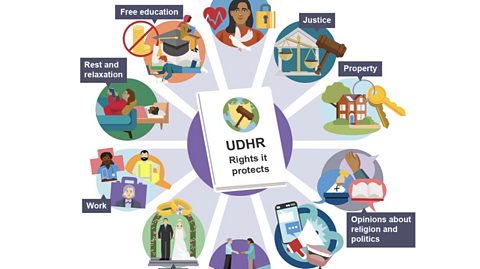
The Universal Declaration of Human Rights outlines the basic rights and fundamental freedoms of all people, regardless of things like where they are born, their gender, their race, their sexual orientation or religious faith.
It is a milestone document that was signed in 1948 and adopted by the United Nations.
It contains 30 articles and is divided into 4 parts.
Protection rights, participation rights, survival rights and development rights.
An example of a protection right is Article 3, which says every person has the right to life, liberty and security.
An example of our participation right is Article 21, which guarantees the right to participate in government, ensuring people feel engaged in the political process.
An example of a survival right is Article 25.1, which ensures access to basic necessities like food and medical care.
An example of a development right is Article 26, which is the right to education, promoting personal growth and development of society.
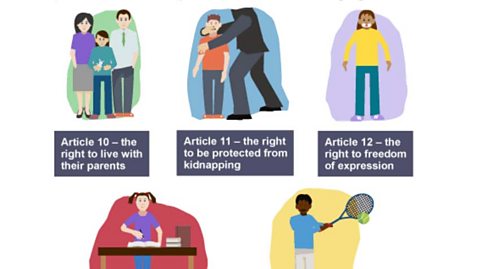
In the 1980s, it was felt another agreement was needed on the rights of children.
The United Nations Convention on the Rights of the Child or UNCRC was adopted in 1989 and specifically protects children's rights.It recognises their vulnerability, protecting them from things like conscription as child soldiers, child labour and sexual exploitation.Article 38 ensures children are not used in armed conflict, while Article 28 protects their right to education, which prevents children from working in jobs and says they have a right to be in school.
Article 34 safeguards children from sexual exploitation and Article 19 ensures protection from all forms of abuse.
Both these agreements are monitored by the United Nations.
If countries violate these rights, the UN can take actions like sanctions or, in extreme cases, international military action.
A key challenge in human rights is balancing individual rights with societal needs. For example, the right to privacy versus public security.
Governments should monitor private communications to prevent crime and ensure public security. But excessive surveillance violates privacy.
During COVID-19 lockdowns and vaccine mandates raise questions about individual freedoms versus public health.
Similarly, religious freedom versus anti-discrimination laws ensure that personal beliefs do not violate the rights of others.
More on Rights and responsibilities
Find out more by working through a topic
- count1 of 4