Key points
- Black and Asian A person who campaigns to bring change. confronted racism in different ways: by protesting, using the legal system, strengthening their communities, and celebrating their history and culture
- The murder of the Black teenager Stephen Lawrence and the struggle for justice in this case was a key turning point in how racism is understood and legally defined.
- The aims and ideas of the Black Power movement have continued into the Black Lives Matter movement.
Racism
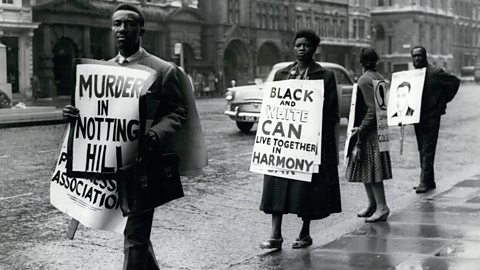
Racial discrimination was made illegal through the Race Relations Acts of 1965 and 1968. However, these laws did not bring racist practices, racial violence and hostility to an end. The growth in immigration and the presence of Black and Asian people in Britain continued to be talked about as if it were a problem.
In 1968, a Conservative Party MP, Enoch Powell, gave a speech that came to be known as the ‘Rivers of Blood’ speech. In it he claimed that too many Black and Asian people had settled in Britain and that they could never fully be integrated into British society. He argued that their presence would lead to racial violence. The speech used very inflammatory, offensive racist language.
Many political figures were outraged by Powell’s speech. The next day Powell was dismissed from the A group of Members of Parliament (MPs) from the opposition political party, or parties, who are not in power. They challenge and question the government’s policies. . However, Powell also gained a huge following and support for his ideas. His speech led to an increase in racial violence, hostility, and abuse.
Black Power and activism in Britain
By the late 1960s a Black Power movement developed in Britain - as it had in the United States. In this movement, A person who campaigns to bring change. focused on strengthening their communities by helping them develop awareness and pride in their Black identity. They also thought people should be able to defend themselves, if attacked violently. Black Power organisations were A person or group that doesn’t accept the way things are and supports great social change. in their anti-racism and organised to demand equality and justice.
The most influential Black power activist organisation was the British Black Panthers - they were led by Althea Jones-Lecointe after 1968. She came to Britain from Trinidad to study at University College London. She spoke out boldly against racism around the world and racial injustice suffered by the Black community in Britain.
The Black Panthers believed the authorities that were supposed to protect and support people, were often the ones who discriminated against them. The Black Panthers worked against racism in the following ways:
- Led campaigns and marches against police brutality
- Exposed racism and discrimination in employment, education, and housing.
- Produced newsletters and a newspaper
Race Today was a publication which was printed from 1969 - 1988. In 1972 it became less neutral and more radical. It was edited by Darcus Howe from 1973 and included work by Farrukh Dhondy, Mala Senand and Jean Ambrose, these activist-writers became known as the Race Today Collective. These journalists used the publication as a tool to campaign against racism and showcase Black art, culture, and history. Race Today was also committed to solidarity with all people who were fighting against exploitation, When a country takes control of another territory or land even if there are already others living there. and racism.
The Black Power movement saw Black and Asian communities work together in solidarity to fight against racism in Britain.
How did Asian communities work to fight against racism in Britain?
One example of anti-racism activism from the Asian community were the Asian Youth Movements (AYMs). They were formed in the 1970s and were made up of second-generation South Asians - meaning at least one of their parents immigrated to Britain from the southern part of Asia. Members of the AYMs campaigned against racism in Britain and incidents of racial violence.
Many protests were sparked by racially motivated murder.
- In 1976, Gurdip Singh Chaggerwas killed in a racist attack. The Southall Youth Movement organised a protest to demand justice for his murder.
- In 1978, Altab Ali, a Bangladeshi man, was murdered in a racially motivated attack in Whitechapel. Protest marches were organised. The local community in East London became more determined to stand up to racist intimidation and violence.
The Mangrove Nine
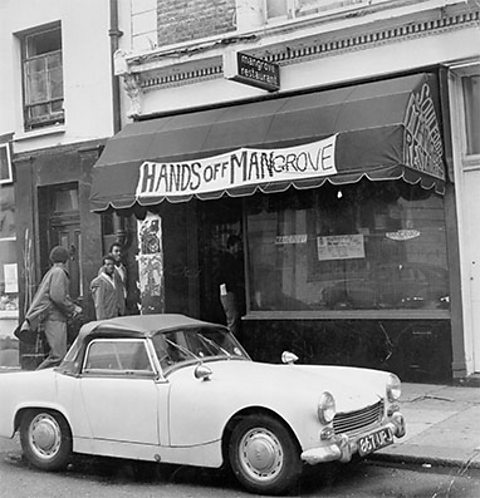
The Mangrove restaurant in Notting Hill opened in 1968 and became a hub for the Black community.
- It was a meeting place for A person who campaigns to bring change., artists and intellectuals who contributed to its vibrancy.
- It was targeted by a group of police officers who raided the restaurant 12 times between 1969 and 1970.
- None of the raids led to any evidence of criminal or illegal activity being found.
Frank Critchlow, the restaurant's owner, wrote to the A board set up to consider complaints under the 1965 Race Relations Act. Members of the board worked to assess and resolve individual cases of discrimination. in protest against the unlawful discrimination he faced from the police and authorities as a Black British citizen. The Mangrove restaurant customers and community were fed up with the being harassed and discriminated against. They set up the Action Committee for the Defence of Mangrove.
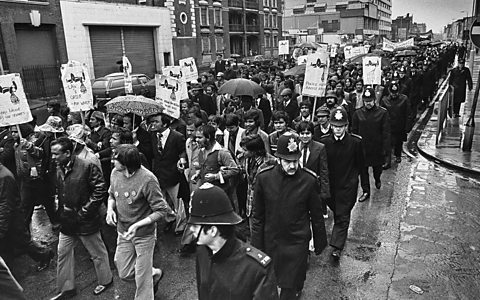
On 9 August, 1970, 150 people marched to the local police station in protest. Home Office documents reported that the police deliberately used heavy-handed tactics against the protesters to target and undermine the Black Power movement.
The police arrested several people including Frank Critchlow, Darcus Howe, and Althea Jones-LeCointe. Even though a magistrate judge had already ruled that they were not guilty, nine activists were put on trial at the Old Bailey. Howe and Jones-Lecointe successfully defended themselves by showing that their treatment was a continuation of a long history of When a country takes control of another territory or land even if there are already others living there. and racism. The Mangrove Nine were found not guilty of the charge of inciting a riot. In the judge’s closing statement, he stated that there was evidence that the police involved in the case held racist beliefs.
The New Cross fire - 1981
On 18 January 1981, a suspected racistThe criminal act of setting fire to someone's property, usually a building.attack took place in London. Thirteen young Black people were killed and over 50 were injured in a fire in a house in New Cross, southeast London. People had gathered at the house to celebrate the 16th birthday of Yvonne Ruddock and the 18th birthday of Angela Jackson. Yvonne was killed in the fire.
Several racially motivated attacks had recently happened in the local area - where the A far-right political group formed in the 1960s that believed all non-white immigration should be stopped, and that only white Britons should have British citizenship. They were often involved in violent clashes. was also known to operate. There were no arrests made and the police said it was not a racist attack. There was also a lack of sympathy shown by the government and authorities to this tragedy.
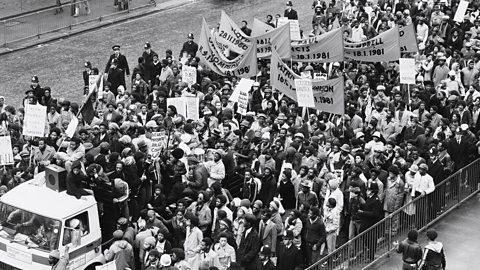
In response to the fire and the events which followed the New Cross Massacre Action Committee was set up. They organised a national demonstration on 2 March that was called The Black People’s Day of Action. “13 dead, and nothing said” became one of the A word or phrase, an event, or a belief that encourages people to unite in support of a cause or idea. of the protesters. Around 20,000 people marched, and it was the largest mass movement for racial justice in Britain at the time.
Racial tension continued to grow between the police and Black community because of how the police handled investigations into racial violence. Many people in the Black community felt the police did little to protect them or arrest those who committed crimes against the Black community.
The murder of Stephen Lawrence -1993
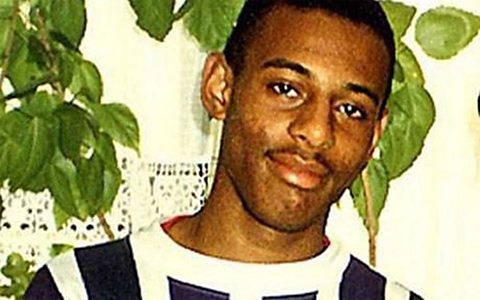
Stephen Lawrence was 18 years old when he was murdered in an unprovoked, racially motivated attack at a bus stop in Eltham, southeast London, in April 1993. He was studying for his A-levels and wished to be an architect.
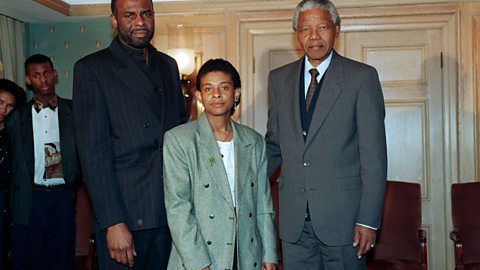
On 4 May 1993, the Lawrence family held a press conference to explain that not enough was being done to catch Stephen’s killers. On 6 May, they also met with The Black South African anti-apartheid activist who served as the first president of South Africa from 1994 to 1999. , who also spoke out about the injustice of Stephen’s murder. Other Black and Asian young men and teenagers had also been killed in racially motivated attacks in South East London and surrounding areas in the years before Stephen’s murder.
The names of five suspects of Stephen’s murder were given to the Metropolitan Police repeatedly. But it was not until two weeks later that the suspects were arrested. Only two of the suspects were charged with murder. However, the charges were dropped by the government’s prosecuting service (CPS) who said there was insufficient evidence to take the pair to court.
After the CPS dropped the murder charges and the police made no more arrests by 1996, Stephen’s parents decided to take out a private prosecution case against three of the suspects. The outcome of this case was that the suspects were found not guilty.
The Lawrence family’s campaign for justice
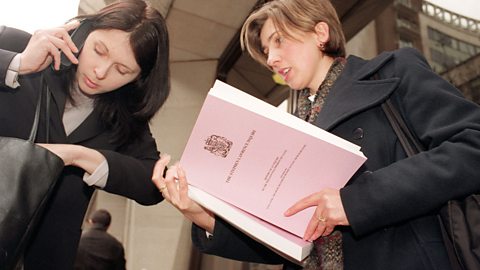
There was growing pressure on the police and government to ensure justice was served in this case. In 1998, a public inquiry into Stephen’s death produced the MacPherson report. The report stated that Stephen’s murder was racially motivated, and that the police’s handling of the case was also driven by incompetence, institutional racism and leadership failures.
One of the Macpherson report’s recommendations led to the introduction of a new law to make legal protections against racism stronger. The Race Relations (Amendment) Act 2000 extended the 1976 Race Relations Act. Under the new law, a duty was placed on public sector organisations like schools, hospitals and the police to advance equality in their organisations.
In 2012, nineteen years after Stephen's murder, the A rule that means someone cannot be put on trial for a crime if they have been previously found not guilty of that crime. rule was changed and new Tests or methods used by scientists to examine evidence to help the police solve crimes. analysis of evidence was used in a case against two of the suspects Gary Dobson and David Norris - who had previously been found not guilty. They were then found guilty and given a life sentence.
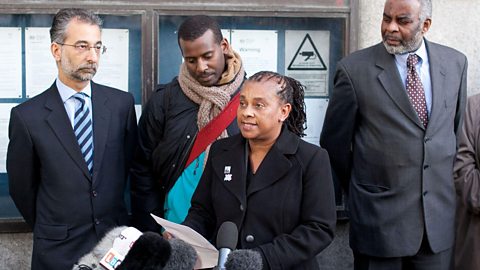
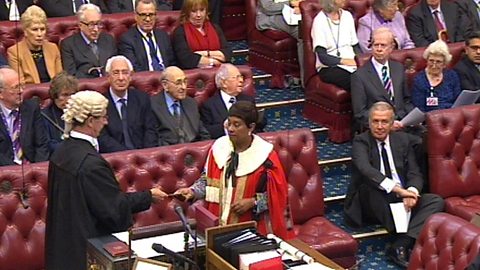
Stephen’s parents were relentless in the pursuit of justice. Stephen’s mother Doreen Lawrence continued to campaign for victims of racist crime. In recognition of her dedication to this work, she was made a The title given to a woman who is appointed as a member of the House of Lords. Members of the House of Lords examine bills, question government action and investigate public policy. in 2013.
The campaign for justice
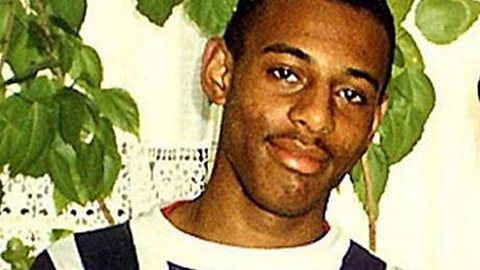
Image caption, 22 April 1993 - Black teenager Stephen Lawrence was 18 years old when he was fatally stabbed by a group of white teenagers at a bus stop in Eltham, south-east London.
1 of 5
The Black Lives Matter movement
Policing has often been at the centre of campaigns for racial justice in the UK. A person who campaigns to bring change. have campaigned against the disproportionate amount of times Black people are Powers that allow the police to stop, search people if they suspect a person is, has been or is about to be involved in unlawful activity, or where they are seeking information about a person’s whereabouts and intentions., are imprisoned, or die in police custody.
The Black Lives Matter movement is a global movement that began in 2013. In the United States of America, George Floyd, a black man, was killed by a white police officer on 25 May 2020. His death sparked protests in many countries across the world, including the UK. Many protesters marched as part of the Black Lives Matter movement - which campaigns for freedom, justice and equality. In May and June 2020, thousands of people across the UK took part in anti-racism protests.
Test your knowledge
Solve the Story!
An exciting new series from the Other Side of the Story, designed to help young people strengthen their media literacy skills.

More on The struggles against racism and for human rights
Find out more by working through a topic