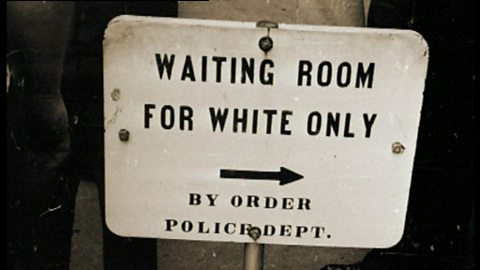
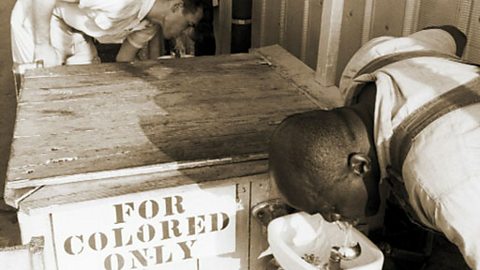
At the start of the 1950s, state laws in the Southern USA systematically denied Black citizens their rights.
Civil Rights groups, such as the NAACP, began campaigns to challenge segregation.
In 1952, the NAACP helped a parent named Oliver Brown to sue the local Board of Education for the right to send his 9 year old daughter, Linda, to a ‘whites only’ school.
In 1954, the US Supreme Court sided with Brown, stating that racial segregation in schools was unconstitutional.
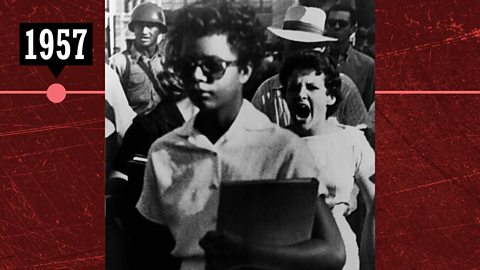
In 1957, black students were enrolled by the NAACP in the whites-only Little Rock High School. On the first morning, 15 year old Elizabeth Eckford arrived to face an angry mob…
TESTIMONY VOICE: “A large crowd moved closer to me, calling me names. My knees started to shake and I wondered if I would make it to school… I saw an old lady. She looked kind but then she spat on me.”
President Eisenhower sent the army to restore order, and patrol the school.
Activists kept up the pressure for change…
The year long bus boycott in Montgomery, Alabama; ‘sit-ins’ at white-only diners and cinemas; black and white activists riding interstate buses in the ‘Freedom Rides’…
All showed the growing social and economic power of the movement.
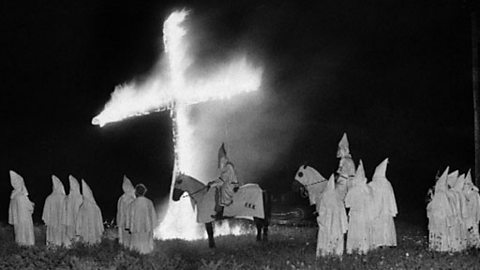
In 1963 in Birmingham, Alabama - a hub of Ku Klux Klan activity - Martin Luther King led a series of peaceful marches of up to 30,000 people.
Police responded by attacking marchers with fire hoses, clubs, and dogs. Hundreds of attending schoolchildren were arrested – and media coverage meant that the whole nation - and the world - was watching.
Public pressure led to President Kennedy intervening - he directly ordered Birmingham’s city government to end all segregation.
The 1964 Civil Rights Act followed soon after - making all forms of discrimination illegal.
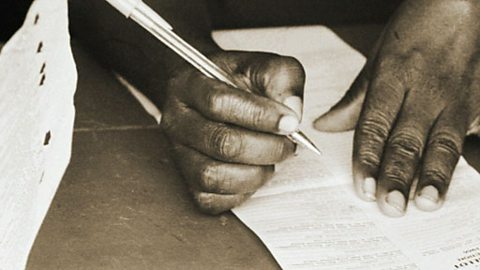
But Black citizens in the South were still barred from registering to vote. As Martin Luther King said, the movement had won “dignity without strength”.
He organised mass marches from the town of Selma, Alabama. They were met with violence by the local police - who beat one protestor to death as the marchers tried to cross a bridge.
The public anger at these scenes again led to a government response. The 1965 Voting Rights Act guaranteed federal oversight of voter registration in all Southern states.
Black citizens were now free to choose their own representatives - and US politics was changed forever.
Description
This film explores some of the key protests and challenges of the civil rights movement in 1950s and 60s America. Through school protests and bus boycotts, black Americans challenged the segregation policies of the southern states of the US.
Now playing video 3 of 16
- 2 of 16
- 10 of 16
- 12 of 16
- 16 of 16