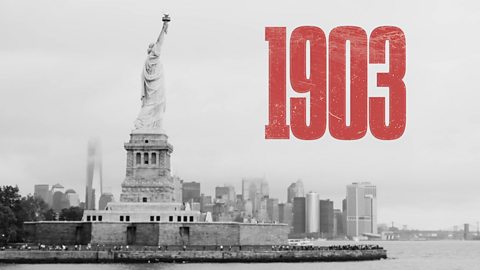
“Give me your tired, your poor, your huddled masses yearning to breathe free…”
When these words were fixed to the plinth of the Statue of Liberty in 1903, the USA was experiencing a huge surge of immigration
Beginning in 1901, people from Southern and Eastern Europe started heading to the US, hoping for freedom and opportunity.
Most of them arrived with no money - and no English.
By 1920, close to 15 million of them had crossed the Atlantic
They often found themselves living in desperate conditions, with housing in the cities becoming more and more crowded. And when a surge in unemployment after World War One led to unrest breaking out across the country, the new arrivals became a focus of suspicion…
Workers blamed them for driving down wages and causing unemployment.
Politicians and business owners feared them for different reasons… Were the boatloads of new arrivals full of secret revolutionaries? In Russia in 1917 a revolution had overthrown the social order. Could this happen in the USA?
Newspaper stories ramped up the tension – creating the ‘Red Scare’…
Before 1900, almost all Europeans who’d settled in the US had been Protestants from Northern Europe. They were known as ‘WASP’s; White, Anglo Saxon Protestants - and the sudden arrival of so many non-Protestants made many of them anxious…
“We true Americans … don’t want our jobs and homes taken away from us by immigrants. There are far too many people coming from southern Europe and many are Catholic or Jewish. They are not good Protestants like us.”
When the slogan ‘America for Americans’ became more and more common, politicians felt the pressure. Governments responded by passing a series of laws restricting immigration. The 1902 Chinese Exclusion Act, 1917 Immigration Act, and the 1921 Emergency Quota Act.
But those who sailed past the Statue of Liberty in the early 20th Century changed the USA forever. A new, more complex racial hierarchy was formed, with WASPS at the top.
But it was also those ‘tired and poor’ immigrants who powered the nation’s economic boom - and became part of its uniquely diverse cultural heritage.
Description
This film explores the reasons why America’s Open Door policy towards immigration changed in the 1920s. It looks at cultural concerns around immigration from southern Europe, and social and economic fears about the effects of unchecked immigration.
Now playing video 1 of 16
- 10 of 16
- 12 of 16
- 16 of 16