Measuring ingredients

Measuring accurately is very important in cooking and baking.
In cooking, if you measure incorrectly, the final dish may taste bad or may not be edible. For example, if you added too much of a spice.
In baking, if you measure incorrectly, the mixture could become too runny or dry.
Video: How to measure different ingredients
Join Suzie, Anna and Solomon to learn how to measure ingredients using different units of measurement.
Suzie: I'm in my kitchen with Anna and Solomon. We're measuring different ingredients. What are we making?
Anna: We're making pancakes.
Suzie: We have self-raising flour, milk, eggs, salt and baking powder.
Solomon: And we'll need to measure our ingredients.
Suzie: Yes, and we've already washed our hands and we are ready to get started.
We can use lots of different pieces of equipment to measure out ingredients. To measure the flour, we'll use these analogue scales. They show the weight of the ingredients using a dial. So, how much flour do we need for our recipe?
Solomon: We need two hundred grams of flour.
Suzie: Before adding the ingredients, first put the container on the scales. Make sure the pointer is at zero. And then you're looking at it face on so you can see it accurately.
Anna, do you want to get the flour and measure it out accurately? Watch the pointer carefully until it reaches two hundred.
Suzie: If you go slightly over, then use your spoon and take a little bit out to make sure that it is at two hundred.
Suzie: Perfect! A gram is a standard unit of measurement. Standard units of measurement are those we use to measure things like mass, length and volume. This cooking recipe tells us exactly how many grams we need.
Anna: You can also use digital scales.
Suzie: Yes that's right. But instead of a dial, digital scales show the weight in numbers on a screen and you can set it to zero by pushing a button.
Now we need to measure two hundred millilitres of milk. What shall we use to do that?
Solomon: This measuring jug.
Suzie: Perfect. Millilitres are a standard unit of measurement used to measure volume. A measuring jug or cup is the best way to measure liquid. Place the jug on a flat surface and make sure that you are looking at it at eye level.
Can you see the two hundred millilitre line? And Anna, do you want to slowly pour the milk? And Solomon will tell you when to stop.
Solomon: That looks good. Two hundred millilitres.
Suzie: Perfect, Anna do you want to pour that into the bowl?
What should we add next?
Anna: One teaspoon of baking powder.
Suzie: What measuring device should we use for that?
Solomon: One of these measuring spoons!
Suzie: That's a good idea. Which one is a teaspoon?
Solomon: This one.
Suzie: Brilliant! Equipment like a teaspoon from a set of measuring spoons has an equivalent measurement in millilitres. You can see on the spoon here that one teaspoon is 5ml. This means that it is a standard unit of measurement.
Take a big scoop and then we use our finger to level it off.
Perfect! What's next?
Anna: Now it says to add a pinch of salt. How can we measure that?
Suzie: Ah! A pinch is not a standard unit of measurement. For a pinch, the measuring tool is your fingers.
Anna: But our fingers are all different shapes and sizes!
Solomon: And some people might pick up less?
Suzie: Exactly! That's why a pinch is a non-standard unit of measurement. We use it mainly for adding flavour. Like adding a squeeze of lemon or a drizzle of honey.
Perfect, well I think we have measured everything correctly. Now all we have to do is add the egg. These pancakes are going to be great!
What can you measure?
You can measure lots of different things when you are cooking and baking. Here are a few examples.
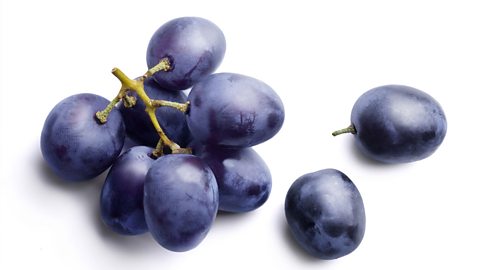
Image caption, Quantity
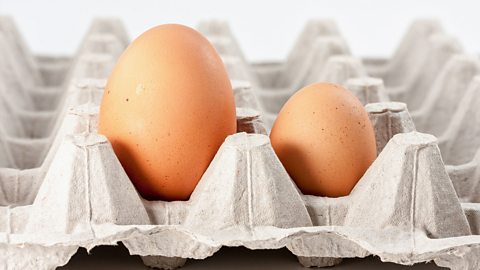
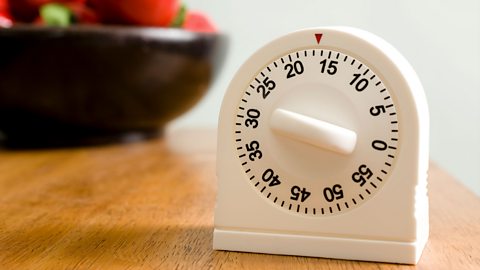
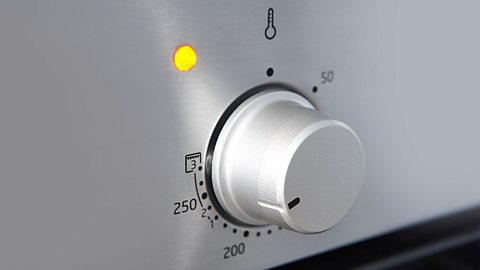
You can measure the quantity or number of ingredients. For example, nine grapes or two bananas.
1 of 6
Measuring weight
To measure the weight of ingredients when baking and cooking, we mainly use a set of scales. These will tell us how heavy the ingredients are.
There are two main types of scales:
- analogue
- digital
Analogue scales
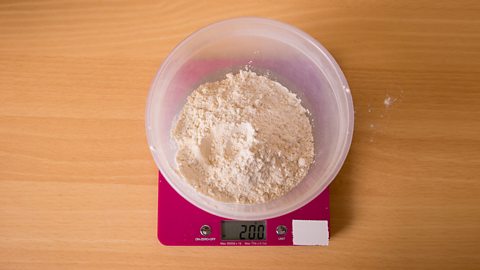
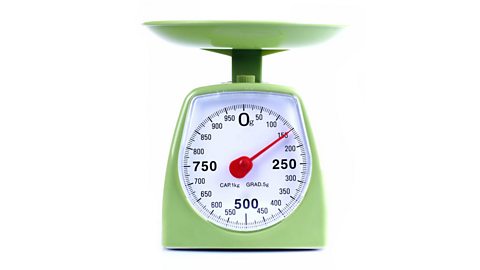
Analogue scales have a dial to show the weight of the ingredients.
The scales need to be set to zero when the basket or bowl is put on top.
They will only weigh the ingredients that are added to the basket or bowl. The hand on the dial shows how much has been added in weight.
Digital scales
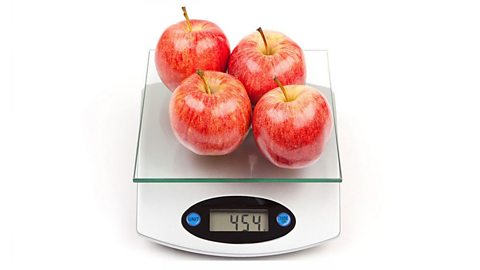
Digital scales work in the same way as analogue scales by measuring the weight added onto them.
Instead of a dial, they have a digital screen which will show the amount added in numbers. Like analogue scales, they also have to be set to zero before measuring.
Digital scales measure more accurately than analogue scales and can display the value more precisely.
Measuring volume
Volume measures the amount of space that something takes up in a container.
Measuring jugs
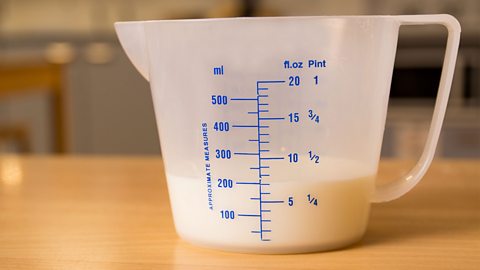
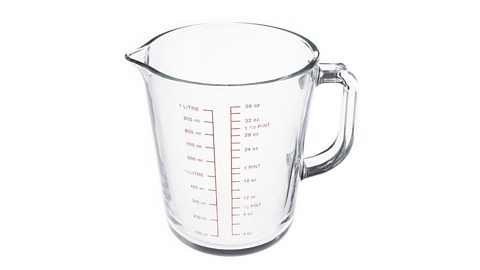
To measure larger volumes of liquid, we would mainly use a measuring jug.
To measure a liquid, you need to place the jug on a flat surface. Then, watch the scale at eye-level and fill the jug until you reach the amount you need.
The measurement scale on a jug will usually count in 50s or 100s. That means you may need to estimate when measuring an amount like 25 millilitres.
Measuring spoons
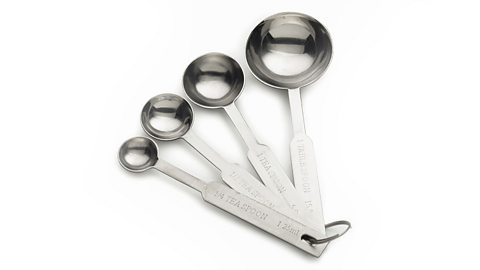
Teaspoons, tablespoons and measuring spoons can be used to measure smaller volumes.
They are used to measure both dry volumes (like a tablespoon of flour) and liquid volumes (like a teaspoon of oil).
Measuring spoons usually have a label on them to tell you how much a full spoon of ingredients contains.
Standard units of measurement
Recipes use different units of measurement to show how much of each ingredient you need to add.
Standard units of measurement are units that are normally used for measuring The mass measures how heavy something is., size and volume. They provide accurate details on how much of an ingredient needs to be used within a recipe.
Examples of standard units of measurement are:
- millilitre (ml)
- litre (l)
- gram (g)
- kilogram (kg)
- teaspoon (tsp)
- tablespoon (tbsp)
Metric and imperial measurements
Most modern recipes will be written using Metric is a system of measurement that includes units such as grams, kilograms, millilitres and litres. measurements. These include:
- grams
- kilograms
- millilitres
- litres
When researching recipes, you may find other units of measurement too. These are called Imperial is a system of measurement that includes units such as ounces, pounds, pints and gallons. measurements. Some of these include:
- ounces (oz)
- pounds (lb)
- pints (pt)
Imperial measurements were used in the UK until 1965. Some recipe writers still continued to use these measurements after that date.
Most digital scales can measure in ounces too and measuring jugs also usually have readings for pints.
Non-standard units of measurement
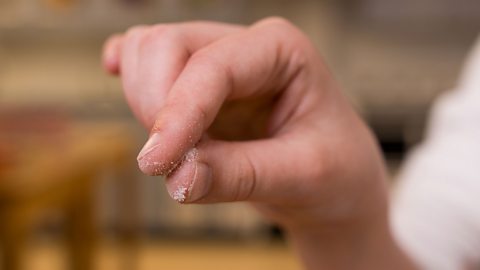
Non-standard units of measurement are used when accuracy is not important.
In baking and cooking, these are mainly used for flavourings or seasonings.
Examples of non-standard units of measurement are:
- a handful
- a pinch
- a thumb (of ginger)
- a drizzle (of oil)
- a squeeze (of lime)
Activity: Standard and non-standard measurements
Have a look at these recipes and put your measuring knowledge to the test.
Key words
| Volume | The volume measures the amount of space that something takes up in a container. |
| Mass | The mass measures how heavy something is. |
| Metric | Metric is a system of measurement that includes units such as grams, kilograms, millilitres and litres. |
| Imperial | Imperial is a system of measurement that includes units such as ounces, pounds, pints and gallons. |
Quiz: Match the measurements
Can you work out which kitchen tool you would use to measure these different ingredients?
Play BBC Bitesize educational games! game
Fun, interactive games for children aged 4-11, with maths, English, science, history and many more subjects.

More on Cooking and nutrition
Find out more by working through a topic
- count4 of 7
- count5 of 7
- count6 of 7
- count7 of 7