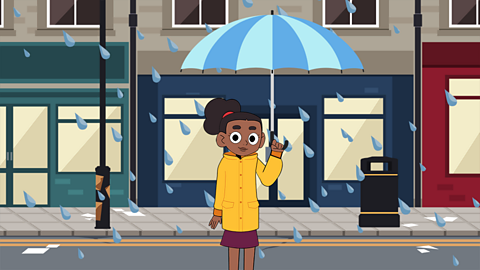
What are the states of matter?
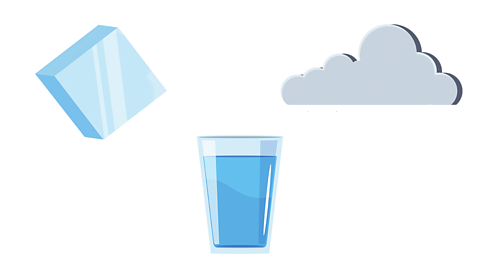
Matter is the name for anything that takes up space and that can weigh something.
Everything around us is made of matter.
There are different types of matter:
- things that are solids
- things that are liquids
- things that are gases.
We call these states of matter.
Solids, liquids and gases are all made up of particles. Particles are small parts of matter. In solids, liquids and gases, the particles are arranged differently.
Because of this, each state of matter has different properties and behaves in different ways.
Watch: What are the states of matter?
Fran: We can compare or group different materials according to whether they are solids, liquids or gases.
So let's take a look at their characteristics.
Solids, they stay in one place.
They have a definite shape and volume, meaning that they always take up the same amount of space, and they can be held.
Liquids, they can pour and flow like this.
They change shape to fit their container, but they do always take up the same amount of space.
But they are not that easy to hold.
Whereas gases are often invisible.
They have no fixed shape and spread out and move about.
You can't hold a gas but when I blow up this balloon it fills up with air, which is a mixture of gases.
Let's explore the three different states of matter using water.
Water when you can pour it, like this, it's a liquid.
When it's frozen, it turns to ice and that's a solid.
And when it's heated, it's water vapour which is a gas.
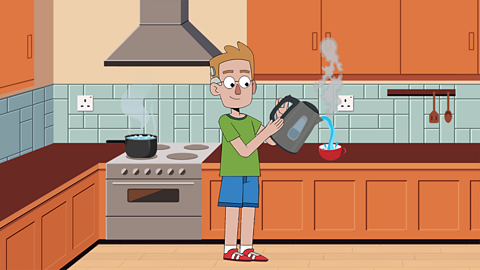
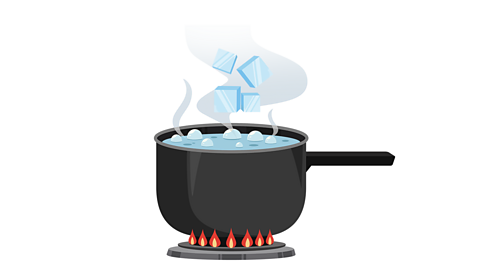
We can change the states of matter, so if I put this ice cube - a solid - into the hot pan then it turns into water, which is a liquid.
And then if you heat the water, it turns into water vapour, which is a gas.
So, let's see what my investigator is getting up to!
Child: I'm creating a mixture that doesn't follow the same rules as other liquids.
I'm adding this cornstarch to this water and I'm mixing it well so it can create a liquid.
When I press into it slowly and gently, it acts like a liquid and my finger sinks in.
But when I press it harder and quicker, it acts like a solid and I can't get my finger through.
Fran: That is so cool!
The mixture you have just made is called a non- Newtonian fluid and you're right, it has this special namebecause it doesn't follow the same rules as other liquids.
Fascinating facts
Even though we can't see them, we couldn't live without gases.
Oxygen is a gas that we breathe in.
The gas carbon dioxide is needed by plants for photosynthesis.
Water is the only common substance we have that can be a solid, liquid and a gas at normal temperatures.
Glass is made from heating up solid sand particles, in a furnace, to over 1000c to turn it into a liquid. This liquid is then shaped and called to make glass.
Our water cycle can change water from a gas (evaporation) to liquid (rain) and into a solid (snow).
Water expands by around 9% when it freezes. This is why pipes carrying water can burst in very cold weather.
Lava is molten or liquid rock that erupts from under the Earth in volcanoes. It can sometimes travel as fast as 30 mph on the slopes of steep mountains.
What is a solid?
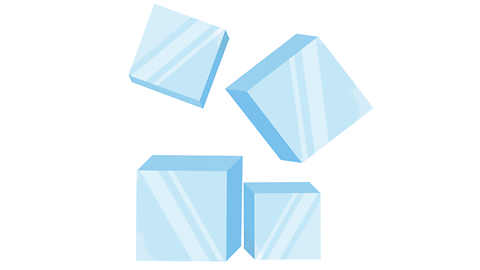
Solids are made of particles that are held close together in a tight structure by strong bonds.
Solids can be held and keep their shape.
Solids can be cut or shaped.
The space that a solid takes up doesn't change unless someone changes it, like when you squeeze a sponge or cut up a piece of paper.
Some solids can be poured a bit like a liquid (like salt, sugar and flour) but they are made up of tiny solid grains which keep their shape and volume.
Some examples of solids are wood, plastic and sand.
What is a liquid?
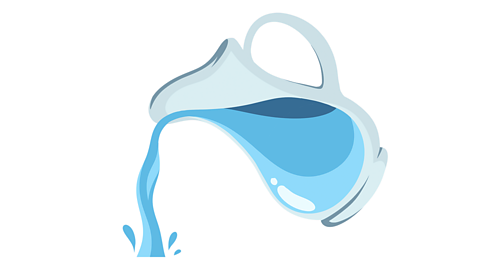
Liquids are made up of particles that aren't held together as tightly as in solids. The particles have more space between them because the bonds that hold them together aren't very strong.
Liquids can flow or be poured easily.
Liquids are not easy to hold because they run out of your hand.
When you pour liquids they may form into a pool, but not a pile like solids.
Liquids change their shape to fit the container they are in.
Even when liquids change their shape, they always take up the same amount of space (their volume stays the same).
Some examples of liquids are water, honey and milk.
What are gases?
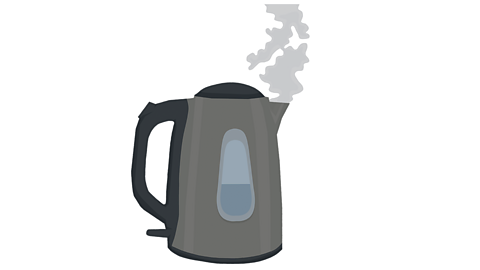
Gases have particles which can move about freely. The particles have lots of space between them because the bonds that hold them together are very weak.
Gases do not have a fixed shape.
Gases change their shape and their volume to fill any container that they are put in. If we open the container, the gas will escape into the surroundings by spreading out.
Gases can be squashed.
Gases are often invisible.
Some examples of gases are oxygen, helium and steam.
Slideshow: Changes in the states of matter
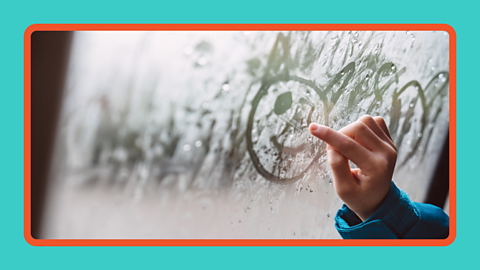
Image caption, Condensation
Water vapour (a gas) turning into liquid water is called condensation. When water vapour cools on a glass window we can see condensation forming.
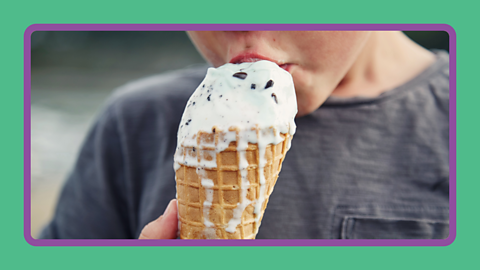
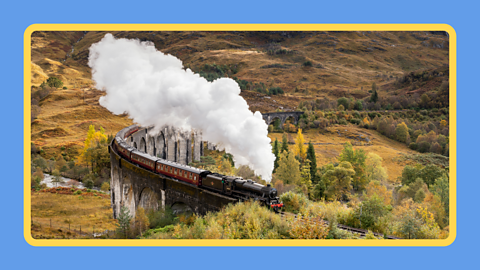
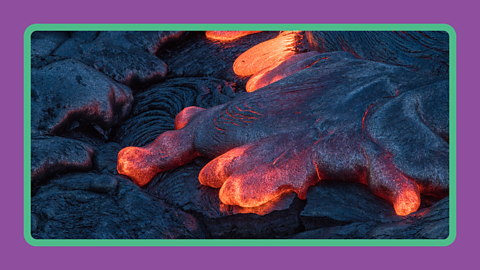
1 of 4
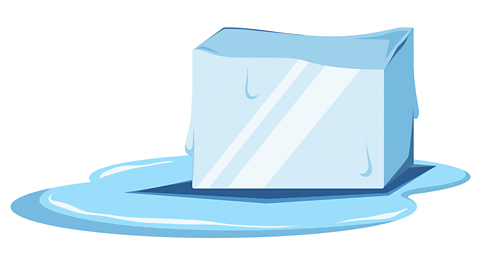
Did you know?
Some things can change state if they are heated or cooled.
Water can exist in all three states.
It is usually a liquid but if it is cooled it changes to a solid (ice) and if it is heated it changes to a gas (steam).
Important words
Bonds – A bond is something that joins or holds things together. Particles bond together to form structures.
Gases – Gases have particles that can move about, and which have lots of space between them because the bonds that hold them together are very weak.
Liquids – Liquids are made up of particles that aren't held together tightly, and which have more space between them because the bonds that hold them together aren't very strong.
Matter – Anything that can take up space and weighs something.
Particles – A particle is a tiny piece of matter, which we cannot see with our eyes.
Properties – The strengths and weaknesses of a material.
Solids – Solids are made of particles that are held close together in a tight structure by strong bonds.
Volume – The amount of space an object or material fills.
Activities
Activity 1 – Tap and find
Activity 2 – Quiz
Activity 3 – Make a lava lamp
Try making your own liquid lava lamps with this activity from the Science Museum Group
Liquid lava lamps. document
Make your own liquid lava lamp with this activity in partnership with the Science Museum Group.
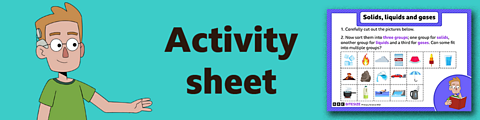
Activity 4 – Sort the states
New game! Horrible Science: Stinky Space. game
Join Pipette on her epic mission and learn some revolting facts about space along the way.
More on States of matter
Find out more by working through a topic
- count2 of 3
- count3 of 3