
Introduction
Plastic is all around us. Most of us use it every day. It’s a really useful material that has transformed all our lives, but unfortunately our used plastic is getting into the ocean. It can end up causing all sorts of problems for sea life and marine mammals. But how does our plastic waste end up littering the ocean?
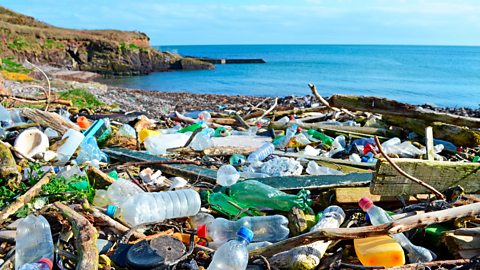
Plastic waste can last for hundreds of years. By working together and doing our bit, we all have an important role to play in reducing this plastic problem.
Did you know?
Even if you live hundreds of miles away from the sea, the plastic you use can still make its way into the ocean. As much as 80% of the plastic in our seas comes from land sources. What does this mean? The plastic is not necessarily thrown directly into the sea, but it still ends up there.
How does this happen?
Rubbish bins
Plastic rubbish is really light and it can be blown off landfill sites or rubbish bins, it then enters drains and rivers and makes its way to the ocean.
Littering
Plastic litter dropped on the street doesn’t stay there. Rain and wind can carry plastic waste into streams and rivers or into the drains – from there it travels to the ocean.
Flushing the toilet
Some plastic products, like cotton buds, are often flushed down the toilet and find their way to the sea. However, these products don’t break down in water and should not be flushed down the toilet.
Washing machines
Even washing our clothes can release tiny Microscopic pieces of plastic that are used to make synthetic fabrics like polyester. of plastic from fabrics that can easily be washed down the drain to the sea.
Properties of plastic
How would you describe a plastic food wrapper?
It’s strong, durable, lightweight and waterproof. That’s exactly why it’s the perfect material for protecting our food. But, those properties are also what makes it an issue for the environment.
Plastic is designed to last a really long time. It is not Items that can be broken down, usually by bacteria, fungi or microbes. They are reabsorbed into the surrounding environment. Items like food and plants are biodegradable.. That means it can’t decompose or rot away.
Impact
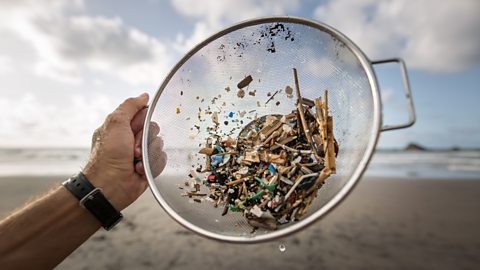
Once the plastic makes its way to the sea it decomposes really slowly. The process can take more than 400 years. The plastic breaks down into tiny particles that can be incredibly damaging to all sorts of sea life. These tiny particles are called Tiny pieces of plastic that are less than 5 millimetres in width. They are a major cause of ocean pollution.. They can be so small that you often need a microscope to see them.
Video: A paddleboarder cleans up small beaches in Anglesey
Paddleboarder Sian Sykes shows how we can reduce the impact of plastics on our oceans.
We all know that plastics are bad for the environment, but do you know how much plastic ends up in the ocean? More plastic is discarded into the sea than any other type of litter. By 2050 scientists predict that all the plastics in the ocean will weigh more than all the fish in the sea combined.
When plastics get into the sea, they can be a massive threat to marine life and even human health. Sian Sykes is a professional stand-up paddleboarder from Anglesey. She is on a mission to try and get rid of plastics that are only used once. We call these single-use plastics.
"We're so fortunate to have such a beautiful coastline. But we're taking advantage of it. We're polluting it. We're not being kind to it. When I see plastic bottles floating on the ocean, it just breaks my heart that it's us humans having an impact on this beautiful, beautiful environment."
To spread awareness about plastic pollution, Sian went on a record-breaking journey around the whole of Wales on her paddleboard. She travelled 1,000 kilometres over 60 days. Imagine running the length of 9,500 football pitches, but on a paddleboard.
Today, Sian’s using her paddleboard to get to small beaches near her home in Anglesey, where she can clean up plastics both large and small.
"The general public think plastics is litter that somebody's just dropped in the street. But it's a lot more than that. When the plastics end up in the ocean, they're breaking down into lots of microplastics. And that's getting into our food chain."
When plastics get into the ocean, they take around 500 years to break down. Often, plastics break down into tiny pieces called microplastics. Some of these are as small as the tip of a pencil… while for others you’d need a microscope to see them.
It’s estimated that there are 51 trillion pieces of microplastics floating around in our oceans. That’s nearly 200 times more than the number of stars in the Milky Way galaxy.
The problem is that fish and sea birds mistake these microplastics for food and harmful chemicals from the plastics build up inside their bodies. Then, when we come along and eat the fish, all the harmful chemicals build up inside us, which can cause illnesses.
Thanks to Sian’s hard work, Anglesey is the first place to be awarded for its efforts in lowering single-use plastics, which proves that we can all make a difference, every one of us.
And we need to act now because in some parts of the world, ocean currents bring all this plastic together to create giant patches of plastic – like an enormous rubbish bin. The biggest of all these giant rubbish patches is in the Pacific Ocean and is called the Great Pacific Garbage Patch. It’s so large that you could fit Wales inside it more than 70 times.
So now, more than ever, we need to stop plastics getting into our oceans. We can all help by making sure that no litter is left on any beach or ever dropped into the sea. You don’t need a paddleboard to do it: set yourself the challenge. Next time you’re at the beach, count how many pieces of litter you pick up. And, remember, don’t forget the little pieces.
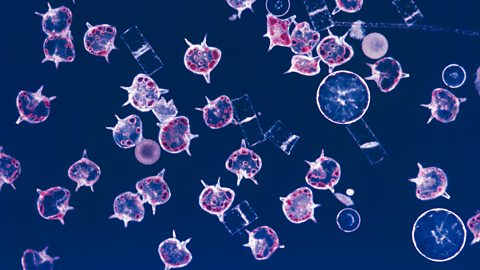
How does plastic enter the food chain?
The plankton digests the microplastic, fish eat the plankton and we eat the fish.
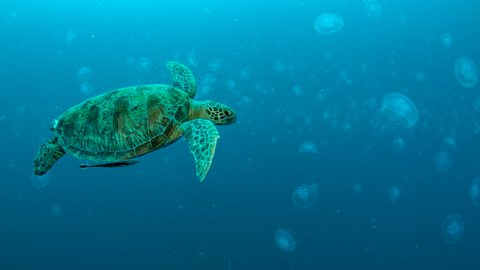
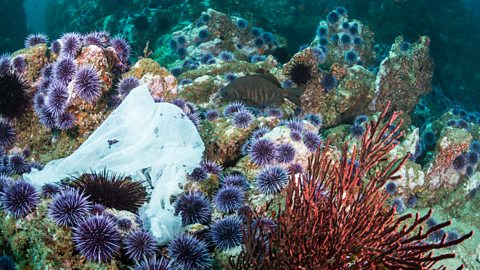
How does plastic in the ocean impact wildlife?
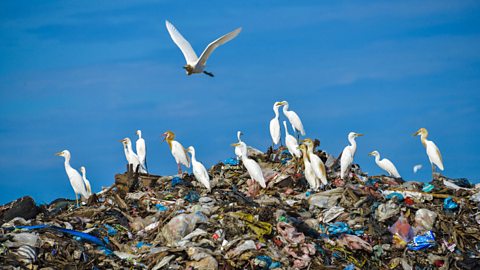
Image caption, Birds eat plastic and are often found with their tummies full of it.
1 of 4
Top tips
Bring your own bags to the shop
In Wales people now pay for every plastic carrier bag. This has resulted in an 80% reduction of the number of plastic carrier bags used.
Cut down on single-use plastics
In March 2020 the Welsh Government announced that they would move to ban single-use, hard to recycle and commonly littered plastics.
How can I help?
- Spread the word - drains lead to the ocean.
- Always put your litter in a bin and recycle.
- Lots of children are campaigning in their schools and communities, and some are even painting the drains.
Big changes start with small steps. What will you do to start cutting the plastic in your life?
Quiz: What happens when plastics get into the ocean?

Where next?
Can lobster fishing be sustainable?
How has fishing changed in Wales and how does this affect the food chain?
How can we clean up ocean plastics?
Tonnes of plastic waste is discarded into the oceans each year. What can we do to tackle this problem?
KS2 Sustainability
A collection of lessons for pupils aged 7 to 11
More on Waste and pollution
Find out more by working through a topic
- count2 of 2
