What are the key learning points about the motor effect?
A current-carrying conductor (e.g. a wire) in a A region around a magnet or around a wire carrying a current, where a magnetic force is experienced. will experience a force.
The force is If the angle between two lines is a right angle, the lines are said to be perpendicular. to the direction of both the current and the magnetic field.
Fleming’s Left Hand Rule can be used to determine the direction of the force, current or magnetic field.
This force forms the basis of the electric motor.
What is the motor effect?
The motor effect turns electrical energy into The energy an object possesses by being in motion., so electricity can be used to create movement.
The motor effect is due to a A push or a pull. The unit of force is the newton (N). on a current carrying conductor (i.e. a wire) when it is in a A region around a magnet or around a wire carrying a current, where a magnetic force is experienced..
A current carrying conductor creates its own magnetic field around the conductor.
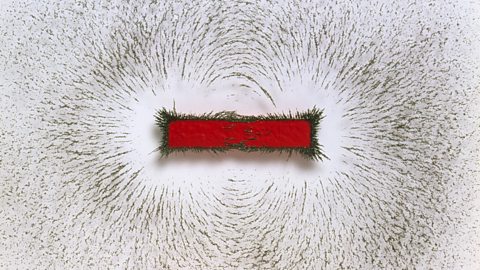
A magnet also has a magnetic field around it.
If these two magnetic fields interact then they will push or pull on each other.
The result is that the current carrying conductor is forced to move.
When a current carrying conductor is placed within a magnetic field (i.e. between the poles of a magnet) it will experience a force.
It is possible to determine the direction of this force using Fleming’s left hand rule.
Key points
A wire carrying a current creates a magnetic field.
This can interact with another magnetic field, causing a force that pushes the wire at right angles.
This is called the motor effect.
The size of the force is increased if:
The current in the wire increases.
The strength of the magnetic field increases.
The length of wire inside the magnetic field is increased
The force is always greatest when the direction of the current is 90° to the direction of the magnetic field.
The direction of the force is always at 90° (or perpendicular) to both the direction of the current and the direction of the magnetic field.
There is no motor effect force if the current and magnetic field are parallel to each other.
What is Fleming’s left hand rule?
The direction of a motor effect force can be found using Fleming’s left hand rule.
Hold your thumb, forefinger and second finger at right angles to each other:
The forefinger is pointed in the direction of the magnetic field lines - from north to south.
The second finger is pointed in the direction the current flows.
The thumb shows the direction of the force on the conductor carrying the current.
Note: it is important to point the second finger in the direction of conventional current flow, i.e. from positive to negative.
In which direction will this wire feel a force?
With forefinger (magnetic field) pointing from N to S (i.e. left to right), and second finger (current) pointing down, your left thumb (force) will point towards you.
This is the direction in which the force acts.
How do electric motors work?
Electric motors are found in many household devices e.g. tumble dryers, washing machines, vacuum cleaners, electric knives, food mixers, hair dryers and electric toothbrushes.
A coil of wire carrying a current in a A region around a magnet or around a wire carrying a current, where a magnetic force is experienced. experiences a force that tends to make it rotate.
This effect can be utilised in an electric motor.
The diagram shows a simple motor using Direct current is the movement of charge through a conductor in one direction only. (DC).
The rectangular loop of wire lies between the Either of the two points of a magnet to and from which the lines of magnetic force are directed. of a magnet.
The current flows in opposite directions along the two sides of the loop.
Using Fleming’s left-hand rule on this diagram shows that the right hand side of the loop is pushed up and the left hand side is pushed down.
This causes a turning effect on the loop.
If the number of loops is increased to form a coil, the turning effect is greatly increased.
This is the principle involved in electric motors.
Starting from the position shown in the diagram of the dc motor:
Current in the left-hand side of the coil causes a downward force, and current in the right-hand side of the coil causes an upward force.
The coil rotates anticlockwise because the forces are in opposite directions.
Each side of the coil is now near the opposite magnetic pole.
The direction of rotation of the coil can be reversed by:
Reversing the direction of the current, or
reversing the direction of the magnetic field (changing over the north and south poles).
The speed of rotation of the coil can be increased by:
Increasing the size of the current.
Using a stronger magnet.
Increasing the number of turns of wire in the coil.
Reducing A force that opposes or prevents movement. When work is done against friction, kinetic energy is converted into heat energy. between the coil and the axel it rotates on.
Worked example
Question
A wire carrying a current at right angles to a magnetic field experiences a force. List 3 ways of increasing the size of the force.
An electric current flows in a loop of wire in the direction shown in the diagram below. The loop is between the poles of a magnet.
Complete the table below to show which sections of the loop experience a force.
| Section of the loop | Force acting? Yes or No | Direction | Reason |
|---|---|---|---|
| AB | Yes | Down | Fleming’s left hand rule |
| BC | text for cell | ||
| CD |
What electrical device is based on this arrangement of coil and magnet?
What would happen if the north and south poles were reversed?
Answer
Three ways of increasing the size of the force are:
Increasing the size of the current.
Using a stronger magnet.
Increasing the length of wire inside the magnetic field.
Completed table:
| Section of the loop | Force acting? Yes or No | Direction | Reason |
|---|---|---|---|
| AB | Yes | Down | Fleming’s left hand rule. |
| BC | No | The current BC is parallel to the direction of the magnetic field and so experiences no force. | |
| CD | Yes | Up | Using Fleming’s left hand rule the direction of the force is vertically upwards (and opposite to the direction of the force on side AB). |
An electric motor.
The coil would rotate in the opposite direction but at the same speed.
How much do you know about the motor effect?
More on Unit 2: Magnetism and electromagnetism
Find out more by working through a topic
- count3 of 4
- count4 of 4
- count1 of 4