What is estimation?
Making a sensible guess or a rough calculation is known as estimation.
An estimate is not an exact calculation.
You can use estimation when you do not need to know an exact number or you can use it to quickly spot mistakes in calculations.
To learn how to estimate you need rounding skills.
Activity: How to use estimation
Complete this interactive activity to understand how to use estimation. Then put your knowledge to the test.
Rounding when estimating
Depending on how large the number is, or how near your estimation needs to be, you can round to 10, 100 or 1,000
Look at the calculation:
2,547 + 4,294
Let's use rounding to estimate the answer.
First, let's try rounding each number to the nearest 10.
The number 2,547 rounded to the nearest 10 is 2,550.
The number 4,294 rounded to the nearest 10 is 4,290.
2,550 + 4,290 = 6,840
Now let's try rounding to the nearest 100.
The number 2,547 rounded to the nearest 100 is 2,500.
The number 4,294 rounded to the nearest 100 is 4,300.
2,500 + 4,300 = 6,800
Finally, let's try rounding to the nearest 1,000.
The number 2,547 rounded to the nearest 1,000 is 3,000.
The number 4,294 rounded to the nearest 1,000 is 4,000.
3,000 + 4,000 = 7,000
But, which estimation was the closest?
The answer to the calculation is:
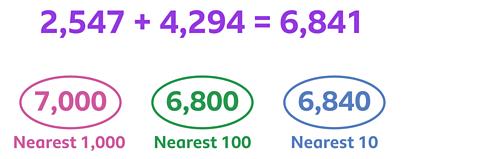
Rounding to the nearest 10 is the closest, but rounding to the nearest 100 was also close to the correct calculation.
Rounding to the nearest 1,000 is the quickest, but it's not as close to the correct calculation.
You can choose whether to round to the nearest 10, 100 or 1,000 depending on how accurate you need to be.
Example 1
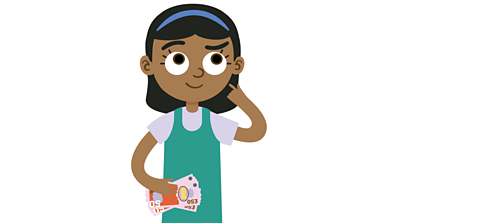
Omi has saved £329.
Estimate to the nearest 100 how much Omi would have if she saved another £189.
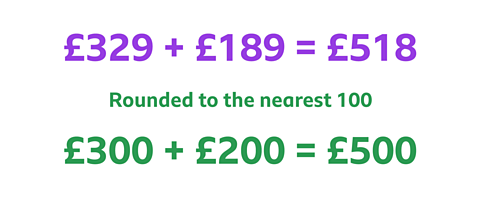
✓ The estimated answer is £500.
£329 estimated to the nearest 100 is £300.
£189 estimated to the nearest 100 is £200.
£300 + £200 = £500
Example 2
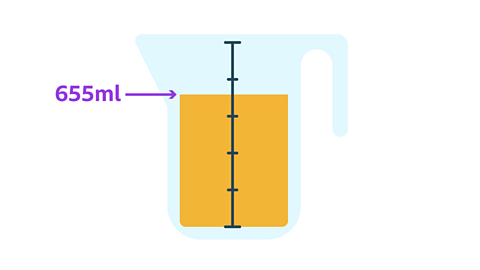
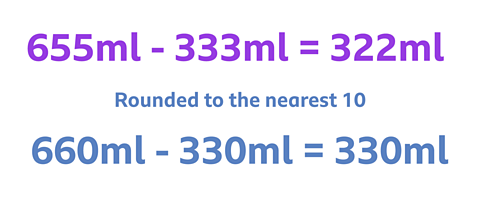
This jug contains 655ml of juice.
Estimate to the nearest 10 how much juice would be left if Lucas drank 333ml.
✓ The estimated answer is 330ml.
655ml rounded to the nearest 10 is 660ml.
333ml rounded to the nearest 10 is 330ml.
660ml - 330ml = 330ml
Example 3
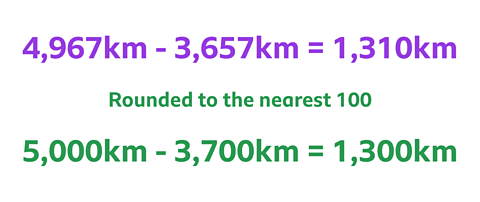
An astronaut is traveling through space on a journey that is 4,967km long, and they have already traveled 3,657km.
Estimate to the nearest 100 how much further they need to go to reach their space station.
✓ The estimated answer is 1,300km.
4,967km rounded to the nearest 100 is 5,000km.
3,657km rounded to the nearest 100 is 3,700km.
5,000 km - 3,700km = 1,300km
Play our fun maths game Guardians: Defenders of Mathematica. game
Use your times tables and more maths skills to defeat monsters and reclaim the Kingdom of Mathematica

More on Processes in mathematics
Find out more by working through a topic
- count19 of 33
- count20 of 33

- count21 of 33
- count22 of 33

