What is a prime number?
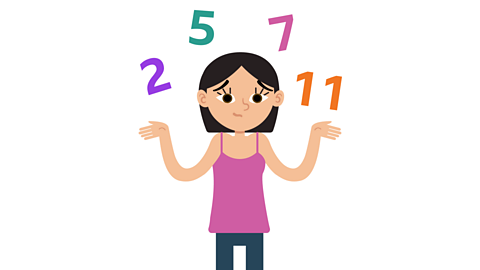
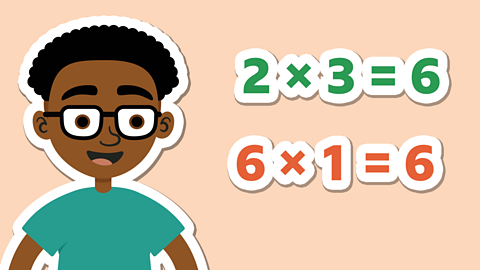
A prime number is a whole number, greater than 1, that only has two factors.
A factor is a number that divides another number evenly, with no remainder or decimal.
The factors of a prime number are the number itself and 1.
19 is a prime number. It can only be divided by 1 and 19 without any remainders. The only factors of 19 are 1 and 19.
A number that has more than two factors is called a composite number.
The number 1 is not a prime number as it only has one factor.
Activity: What is a prime number?
Complete this interactive activity to find out about prime numbers. Then put your knowledge to the test.
Prime numbers under 20
Prime numbers are numbers that have only two factors: 1 and themselves.
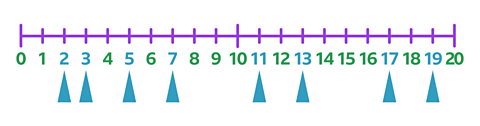
Here are all the prime numbers up to 19:
2, 3, 5, 7, 11, 13, 17, 19
Remember, 2 is the only even prime number, and 1 is not a prime number.
Working out if a number is a prime number
Ask these questions to work out if a number is prime:
1. Is it greater than 1?
If the answer is 'yes'. Then it could be a prime number.
2. Is it a whole number?
If the answer is 'yes'. It still could be a prime number.
3. Is it an odd number?
If the answer is 'yes'. It still might be a prime number. However, remember the number 2 is the only even prime number.
4. Is it a multiple of 5 or 10?
If the answer is 'no'. It could be a prime number.
5. Does it have any factors other than 1 or itself?
Use your multiplication facts and division skills to find out.
If the answer to this question is 'no', then it is a prime number!.
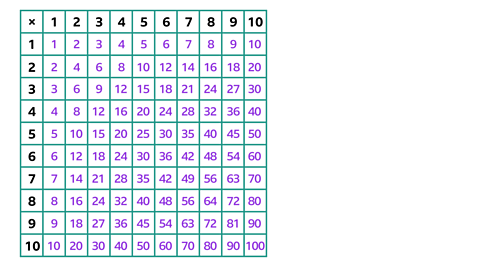
You can use a multiplication grid to help you.
Example 1

Which number in the following list is a prime number?
98, 57, 41
How do you know that the other two numbers are not prime?
✓41 is the prime number.
It is not even and doesn't end in 0 or 5. It isn't divisble by any other number.
So, it only has two factors: 1 and 41.
98 is a composite number.
You can work this out because 98 is even, so it can be divided by 2.
98 = 2 × 49
This means 98 has more than two factors, so it's not prime.
57 is a composite number.
57 is not even and doesn't end in 0 or 5.
However, 57 can be partitioned into 30 and 27 and both of those numbers are multiples of 3. So, 57 must also be a multiple of 3.
This means 57 has more than two factors, so it's not prime.
Example 2
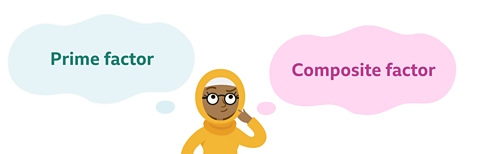
What is a prime factor?
What is a composite factor?
✓ A prime factor is a factor which is also a prime number. Composite factors are factors which are not prime numbers.
Don't forget, 1 is not a prime number.
Any factors which themselves have more than two factors are composite factors.
Example 3
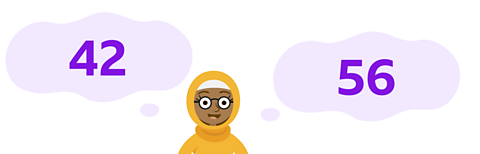
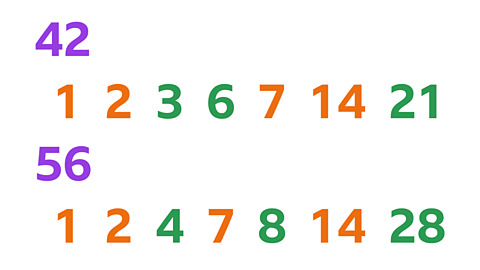
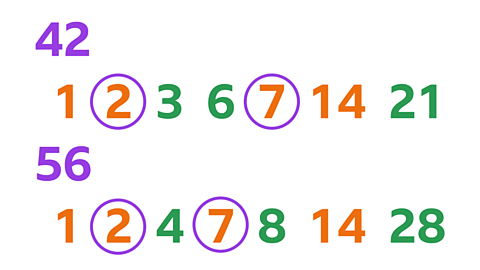
What are the common prime factors of 42 and 56?
✓ 2 and 7 are the common prime factors.
To find this out follow these steps:
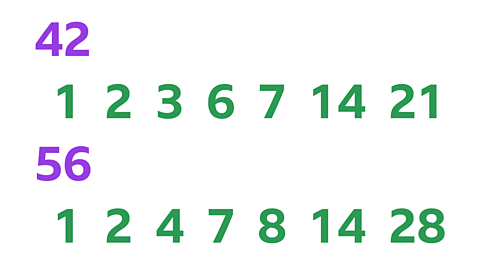
Image caption, First, find all the factors for 42 and 56.
1 of 3
Primary maths teaching resources
Visit BBC Bitesize for Teachers to see videos, activities and more resources to use in maths classes for KS1 and KS2.

More on Factors, multiples and primes
Find out more by working through a topic
- count1 of 3
- count2 of 3