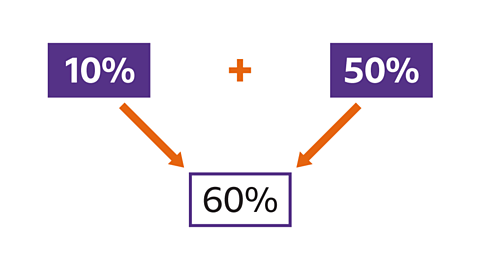
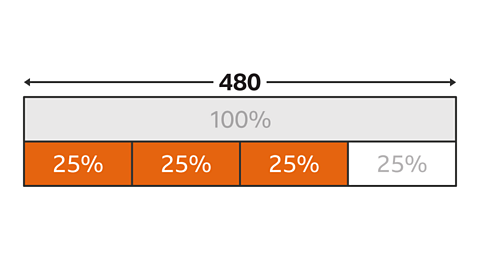
Key points
The process of working backwards to find the original amount before the percentage change. involves working backwards through a calculation to find the original amount (before a The percentage by which a value has been increased or decreased.).
Understanding The number by which another is multiplied. For example, in the calculation 80 x 1∙2, the multiplier is 1∙2 for increasing and decreasing by a percentage and being able to convert between decimals and percentages are important skills when calculating the original amounts.
Using 1% to find the original amount before percentage change
To find the original value of an amount before the percentage increase/decrease:
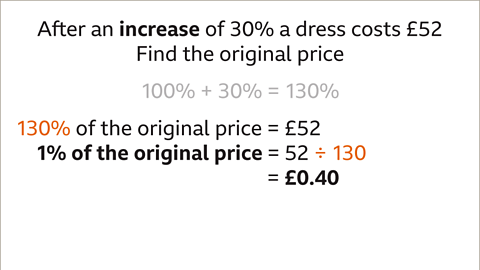
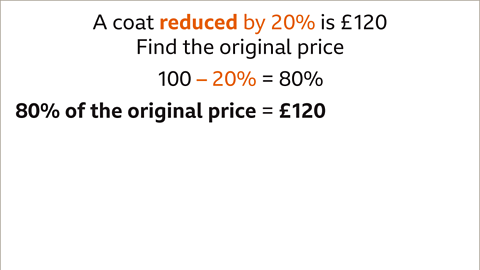
Write the amount as a percentage of the original value.
Find 1% of the original value.
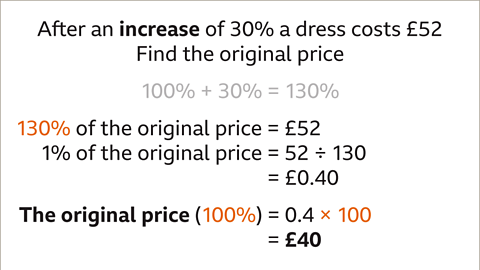
The original value is 100%, so multiply by 100 to give the original value.
Examples
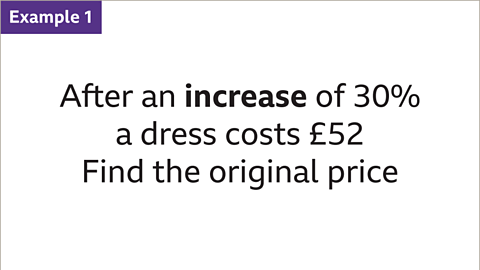
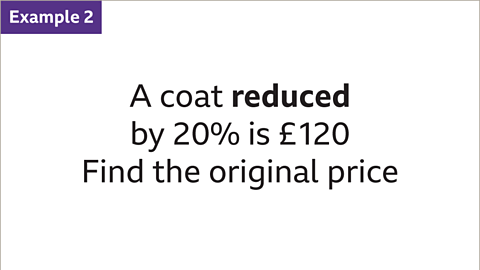
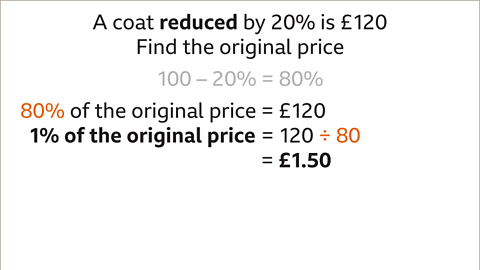
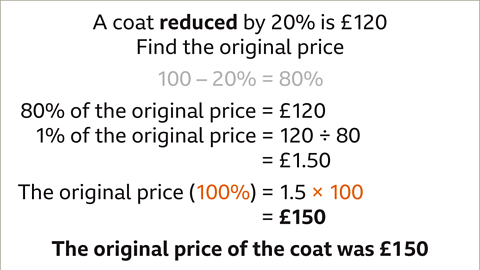
Image caption, A price is increased by 30% to give £52. Find the original price.
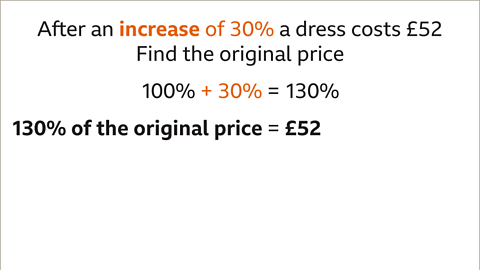
1 of 8
Question
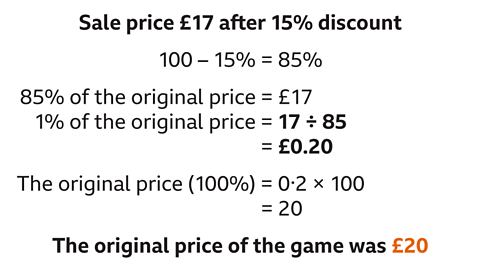
A game is reduced by 15% in a sale. The sale price is £17. What was the original price?
Work out what percentage is represented by the £17 by subtracting 15% from 100%. This is 85%. 85% of the original price is £17.
Find the value of 1% of the original price by dividing by 85. 17 ÷ 85 = 0∙2. 1% of the original price is £0∙20
Work out the original price (100%) by multiplying 1% (0∙2) by 100. 0∙2 × 100 = 20
The original price is £20
Using a multiplier to find the original amount
To find the original amount of an amount before the percentage increase/decrease:
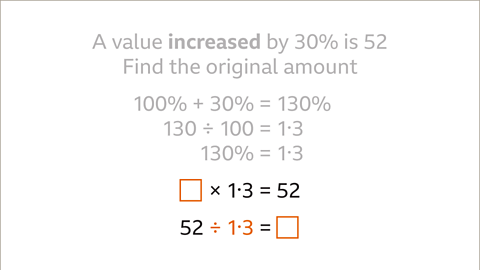
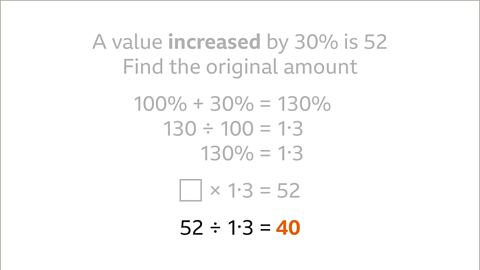
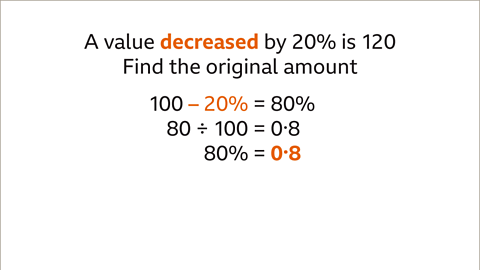
Find the The number by which another is multiplied. For example, in the calculation 80 x 1∙2, the multiplier is 1∙2 for the The percentage by which a value has been increased or decreased..
Divide the amount by the multiplier.
Examples
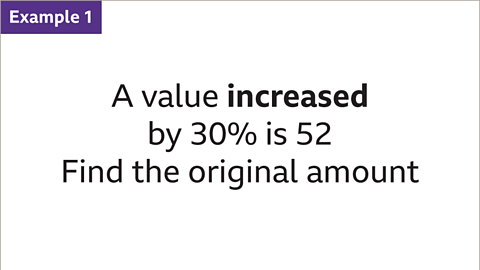
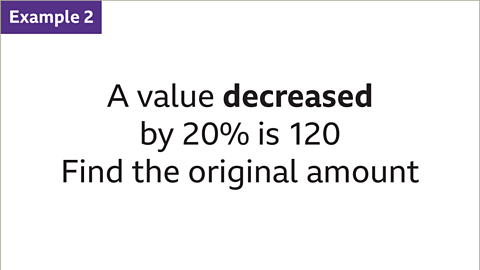
Image caption, A value is increased by 30% to give 52. Find the original amount.

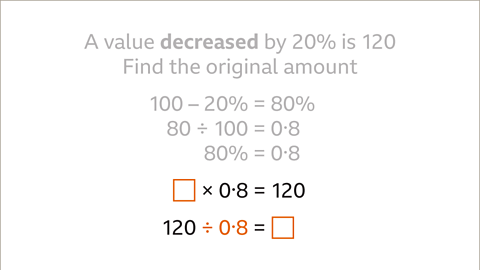
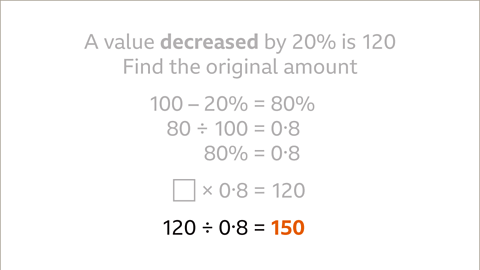
1 of 8
Practise how to find the original value before percentage off
Practise finding the original value before percentage off with this quiz.
Quiz
Real-world maths

VAT is a tax on what you spend. It is a percentage of the cost of an item or service. Some businesses can reclaim the VAT they pay on certain items. To do this, they have to reverse the percentage increase to calculate what they are owed. The rate of VAT in the UK is currently 20%.
When shopping for clothes or shoes in a sale, the price tag might show the cost after a percentage reduction. For example, the sale price of trainers is £46 following a discount of 20%. Working out the original price will show you exactly how much you are saving in the sale.
Play Sudoku with BBC Bitesize!
Every weekday we release brand new easy, medium and hard Sudoku puzzles. Perfect for testing your skill with numbers and logic.

More on Percentages
Find out more by working through a topic
- count7 of 7
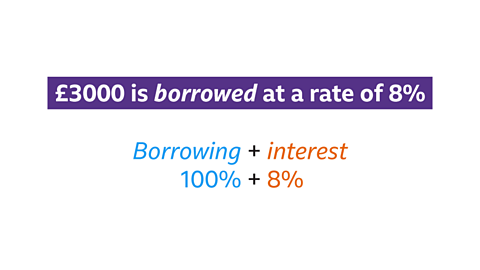
- count1 of 7
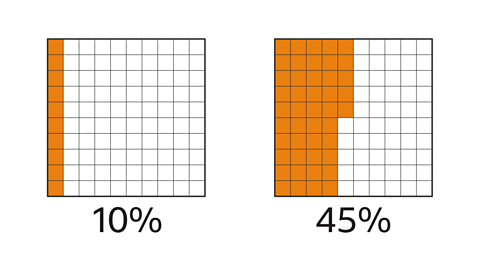
- count2 of 7