When the founding fathers of the USA began writing the basic laws about how the country will be governed, known as the Constitution, they had a number of different considerations to weigh up.
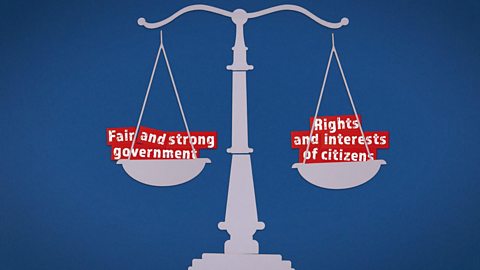
They wanted to create a fair and strong national government that could also protect the rights and interests of the citizens.
They decided to separate government into state government, local government and federal government.
State and local government is responsible for things like police departments, fire departments and schools.
Each state has its own written constitution, and all state governments are modelled after the federal government.
Federal government looks after things like immigration, foreign affairs and minting money. Some powers, such as taxation, law making and law enforcement are shared between state and federal governments.
This division of power is called federalism.
Federal government is divided so that no one part of government holds too much control.
This is known as the separation of powers.
The Constitution separates the power of government into three distinct branches.
The legislative branch makes the laws.
It is run by US Congress and it’s made up of the Senate and the House of Representatives.
The Executive Branch is responsible for enforcing the laws that Congress passes.
It is the government led by the President who is supported by the Vice President and Cabinet and the Judicial Branch enforces and interprets the law and is made up of the Supreme Court, the highest court in the country, and all federal courts that deal with national rather than state laws.
Each branch of government holds a lot of power, but it’s important that no one branch becomes too powerful.
The separation of powers was the founding fathers system of checks and balances, a way for each branch to limit or check the other’s power.
The executive branch has the power to block legislation passed by Congress, which is called a veto, and the judicial branch can also check the legislative branch by declaring laws not in line with the Constitution, or unconstitutional.
The legislative branch can check the executive branch by overriding the presidential veto.
It can also formally charge the president of a serious offence whilst in office. This is known as impeachment.
And the judicial branch can also check the executive branch by declaring presidential actions unconstitutional.
The executive branch can check the judicial branch by nominating judges, but the legislative branch needs to approve the nominated judges and can also check the judicial branch by impeaching judges.
The point here is that each of the branches has the power to limit or check the other two, creating a balance between the three separate powers.
Description
An explanation of the US Constitution
Now playing video 1 of 8