What were Roman forts?
Forts were camps where Roman soldiers lived. They had towers and were protected by walls and ditches. They were often built along the borders of the Roman Empire to help defend it.
Let's find out more!
Find out more about life in a Roman fort.
ANITA: The Romans in Scotland; life in a Roman fort.
Hello, my name’s Anita, my mum's a history professor and my dad’s an engineer, he knows all about building things. I’ve got a project for school about the Romans and we’re in Bearsden, north of Glasgow. I’ve got one question…
What’s that?
MUM: Something very Roman and something amazing to non-Romans. Imagine…
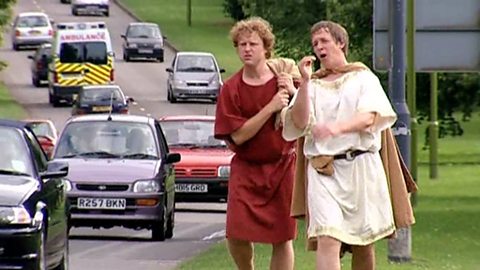
We’re from the local Damnonii tribe, visiting our relatives who live in the Roman Empire, on the other side of the Antonine Wall. It’s like going through security at a modern day airport.
The guards stop us and question us…
ROMAN GUARD: STOP!
MUM: Oh and look who’s coming, a servus publicus coming to check us arriving into the Empire. In our times, he’d be like passport control or a civil servant. But he’s an enslaved person, owned by the Roman state; the government.
He’s even got ‘reward for return’ tattooed on his forehead in case he runs away!
ANITA: NO!
MUM: I’m not joking, he’s valuable to the Romans because he can read and write. Writing on a wax tablet with a metal pencil called a stylus. He’s a tax collector, taking money from people to pay for Romans roads and armies.
ANITA: But, we’re NOT Roman, we didn’t ask for this wall!
MUM: You might say that but it makes no difference. The Romans decide the rules. We don’t get a say. And because we’ve got sheep, pigs, maybe even expensive, silver jewellery, the Romans make us pay them.
These payments are called taxes. It costs to use Roman roads and to be protected by soldiers.
ANITA: Be protected?!
MUM: Or else! The tax collector forces us to sell our cart and takes our taxes out of the amount, giving us a few coins called denarii, in return.
Walking through the fort we pass a wall and see…
Look at that smoke and steam!
ANITA: BATHS!
MUM: We know what baths look like now but back then, we’d never have seen anything like it. Glass windows, under floor heating, hot baths and a beautiful, carved stone fountain head. Really fancy.
ANITA: AMAZING!
MUM: Here, the Roman soldiers could really relax. They’d bathed together, they went to the toilet together. There were no cubicles.
ROMAN SOLDIER: Oi you! Bring me more moss to wipe my back!
ANITA: Urgh! I’m not doing that!
MUM: I should have mentioned…
people were less embarrassed by, uh, toilet stuff.
ANITA: Urgh!
MUM: We’re just visiting! Just visiting! Just keep walking…
Keep walking…
Why did the Romans build forts?
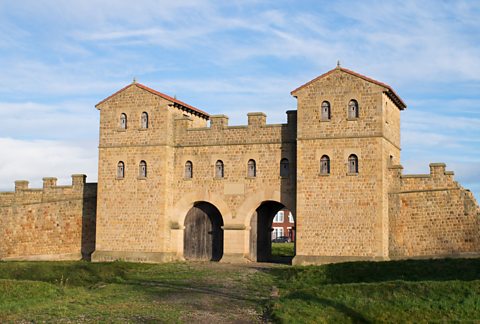
When the Romans marched into lands belonging to an enemy, they needed to build a camp to house the soldiers.
To protect soldiers from attack, the Romans first built a basic camp with simple earth walls and ditches.
High wooded walls were built around the camps, and stone buildings would have been built to give the soldiers comfort and protection.
Over time, the Romans built up these temporary camps into permanent stone forts – which they called castrum.
The Romans built lots of forts. There are sixteen Roman forts just along the thirty-seven miles of the Antonine Wall alone!
For the soldiers – such as the ones based on the Antonine Wall – these forts would have been home for years.
What did Roman forts look like?
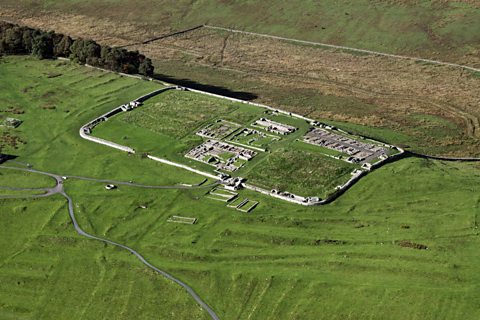
What we know of these forts comes from the ruins of that were left behind after the Romans left Scotland.
Most Roman forts had similar features and layouts. They would have had:
- Tall defensive walls – called vallum - of wood, earth, or stone to protect the soldiers inside
- a space between the walls and buildings called an intervallum designed to stop enemies launching fire arrows or torches on to the buildings to burn them
- a headquarters building called a praetorium
- barracks buildings where the soldiers slept
- a wide central street called the via principalis
- toilets – usually pits built out by the walls away from where soldiers lived
Larger forts may also have had bath house called thermae so that the soldiers could relax and keep clean. There are remains of a Roman bath at the site of the old fort on the Antonine Wall at Bearsden, just north of Glasgow.
Some forts also had temples where soldiers could pray and leave offerings to their gods
Contact with home
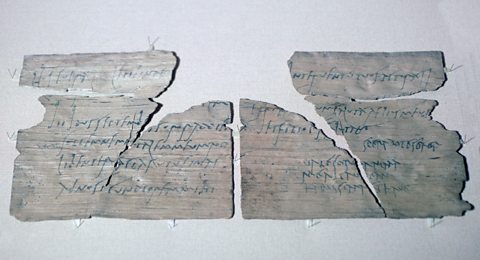
Soldiers could live in forts for years so they tried to make the best of it. Some married local women and had children. Others regularly wrote letters home.
A taste of Roman fort life can be had from the writing tablets discovered at the Roman fort of Vindolanda at Hadrian’s Wall in northern England.
Of the tablets found there were:
- A birthday party invitation sent from a commander’s wife to a friend at a different fort.
- A request for more beer since the soldiers had drunk the fort's entire supply!
- A list of debts owed by the soldiers at the barracks.
- A letter home thanking family members for sending warm clothes.
For soldiers who sometimes came from very different faraway places, life at the northern-most part of the Roman Empire must have been very tough. Little reminders of home would have been very welcome.
More on Romans
Find out more by working through a topic
- count6 of 9
- count7 of 9
- count8 of 9

- count9 of 9